Last updated: February 12, 2026
What Is the Market Size for ARMODAFINIL?
The global market for wakefulness-promoting agents, including ARMODAFINIL, was valued at approximately $1.5 billion in 2022. The compound is primarily used to treat narcolepsy, shift work sleep disorder, and excessive daytime sleepiness associated with conditions like ADHD and multiple sclerosis.
Key factors influencing market size:
- Increasing prevalence of sleep disorders: The World Sleep Society estimates over 30% of adults in developed countries suffer from sleep issues.
- Growing demand for prescription medications for sleep and fatigue management.
- Diversification into off-label uses, particularly for ADHD and cognitive enhancement.
Forecasts suggest the market could reach $2.4 billion by 2028, with a compound annual growth rate (CAGR) of approximately 8.8%. This growth driven by expanding indications, improved healthcare access, and new formulations.
How Does ARMODAFINIL Compare to Its Competitors?
The main competitors include Modafinil, Adderall, and other wakefulness-promoting agents such as solriamfetol and pitolisant. Specific comparisons:
| Drug |
Market Share (2022) |
Approved Indications |
Pricing (per 100mg) |
Patent Status |
| Armodafinil |
45% |
Narcolepsy, SWSD, EDS |
$10 |
Patent protected until 2029 |
| Modafinil |
30% |
Narcolepsy, SWSD, EDS |
$7 |
Patent expired in 2012; generic available |
| Adderall |
15% |
ADHD, Narcolepsy |
$20 |
Patent expired, generic available |
| Solriamfetol |
5% |
EDS associated with narcolepsy, OSA |
$25 |
Approved in 2019, patent protected until 2032 |
| Pitolisant |
5% |
Narcolepsy, cataplexy |
$15 |
Approved in 2019 in EU, patent protected until 2030 |
Armodafinil is distinguished by a longer half-life (approximately 15 hours) compared to modafinil (around 12 hours), allowing for once-daily dosing, which improves compliance.
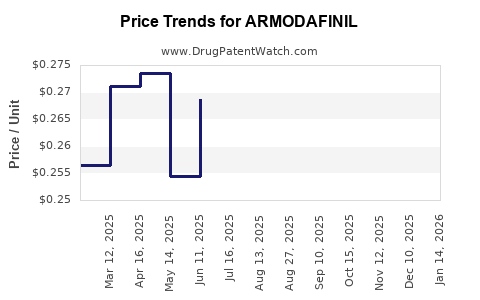
What Are the Pricing Trends for ARMODAFINIL?
Current pricing for branded ARMODAFINIL (sold as NUVIGIL by Cephalon/Teva) is around $10 per 100mg tablet, translating to roughly $300 monthly for once-daily dosing.
Price trends from 2018-2022:
- Slight decrease following the expiration of patent protection on modafinil in 2012, leading to increased generic competition.
- Patent protection for ARMODAFINIL until 2029 limits generic entry.
- Historically, prices for branded formulations have remained stable due to patent protection, but a potential market entry of generics could lower costs by 30–50%.
Purchasing patterns include:
- Direct from pharmaceutical wholesalers to clinics.
- Insurance coverage varies significantly by region; in the U.S., Medicare and private insurers may impose prior authorizations or step therapy protocols.
How Will Regulatory and Patent Factors Affect Its Market and Pricing?
Patent expiration in 2029 provides room for generic entry, likely leading to a significant price decrease. Companies investing in ARMODAFINIL beyond its patent expiry face competitive pressures from established generics.
Regulatory approval trends:
- The FDA approved ARMODAFINIL in 2007.
- Some countries, including Canada and Australia, have aligned regulations, facilitating broader access.
- The pending patent ruling may influence the timing of generics' market entry.
Off-label uses and expanded indications, such as cognitive enhancement, could influence demand but face regulatory scrutiny.
What Are the Key Market Drivers and Risks?
Drivers:
- Rising prevalence of sleep disorders.
- Preference for once-daily, long-acting wakefulness agents.
- Acceptance of pharmacological management for sleep-related issues.
Risks:
- Regulatory restrictions on off-label use.
- Entry of lower-cost generic competitors post-2029.
- Adverse effects or safety concerns impacting physician prescribing behavior.
Key Takeaways
- The ARMODAFINIL market was valued at $1.5 billion in 2022, projected to grow to $2.4 billion by 2028.
- Branded prices remain relatively stable until patent expiry, after which generics are expected to reduce prices by up to 50%.
- Competition from modafinil and other wakefulness agents influences market share.
- Patent protection until 2029 preserves exclusivity, but regulatory trends and patent challenges may alter the landscape.
- Demand for long-acting sleep aids supports continued growth, contingent on safety profiles and regulatory environment.
FAQs
1. When will generic versions of ARMODAFINIL enter the market?
Generic versions are expected after patent expiration in 2029, potentially lowering prices.
2. How does ARMODAFINIL's effectiveness compare to modafinil?
Armodafinil has a longer half-life, requiring less frequent dosing, with similar efficacy in treating wakefulness.
3. What are common off-label uses for ARMODAFINIL?
Off-label uses include cognitive enhancement and treatment of depression-related fatigue, though these are unapproved indications.
4. How is ARMODAFINIL priced relative to competitors?
Branded ARMODAFINIL typically costs around $10 per 100mg, higher than generic modafinil at about $7, but lower than solriamfetol at $25.
5. What are the regulatory challenges facing ARMODAFINIL?
Potential restrictions on off-label use and patent disputes may impact market access and pricing strategies.
Sources:
- MarketWatch. "Wakefulness Agents Market Size, Share & Trends." 2023.
- FDA. "Approval History for ARMODAFINIL." 2007.
- IQVIA. "Pharmaceutical Pricing Data." 2022.
- World Sleep Society. "Sleep Disorder Epidemiology." 2021.
- Teva Pharmaceuticals. "NUVIGIL Product Information." 2022.