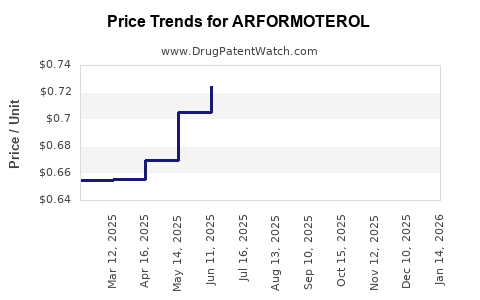
Last updated: February 20, 2026
What is Arformoterol?
Arformoterol is a long-acting beta-2 adrenergic receptor agonist (LABA) used in the management of chronic obstructive pulmonary disease (COPD). Approved by the U.S. Food and Drug Administration (FDA) in 2009, it is marketed under brand names such as Brovana by Sunovion Pharmaceuticals.
Market Overview
The global COPD therapeutics market forecasts indicate a compound annual growth rate (CAGR) of approximately 6% from 2022 to 2028, driven by aging populations, increased smoking history, and rising prevalence. Arformoterol’s segment has grown due to its specific role in maintenance therapy for COPD patients.
Current Market Position
- Market share: Estimated to be less than 10% within the LABA segment.
- Major competitors: Formoterol (generic inhalers), salmeterol, indacaterol, olodaterol.
- Key regions: North America accounts for approximately 45% of the COPD market; Europe follows with 35%. Asia-Pacific shows rapid growth but lags in market penetration.
Regulatory Status
- FDA approval: 2009 for nebulized solution.
- Other regulators: Approved in multiple markets including the European Union and Japan.
- Patent status: Arformoterol's patents expired in several jurisdictions; however, formulations and delivery devices remain protected under secondary patents until approximately 2030.
Price Analysis
Current Pricing
- Brand name (Brovana): Wholesale acquisition cost (WAC) around $150 per 15-mL vial (28 mcg/2 mL per vial).
- Generic inhalers: Prices vary but can be as low as $60–$80 per 30-day supply for generic formulations.
- Pricing dynamics: High therapeutic cost is driven by specialized nebulizer formulations, small market share, and manufacturing complexity.
Price Drivers
- Formulation complexity: Nebulized solutions require sterile manufacturing and sophisticated delivery systems.
- Regulatory exclusivity: Secondary patents prevent generic entry until projected expiry in 2030.
- Market competition: Availability of fixed-dose combinations and alternatives reduces premium pricing potential.
Market Trends and Future Price Projections
Market Growth Drivers
- Increasing COPD prevalence: 200 million affected worldwide.
- Adoption in acute exacerbation management: Limited but growing.
- Expansion into combination therapies: Potential to combine with LABA or corticosteroids.
Price Trends (2023–2030)
| Year |
Estimated WAC for Brand (per vial) |
Estimated Price for Generics |
Market Share of Arformoterol |
Remarks |
| 2023 |
$150 |
$80–$100 |
8% |
Stable with limited generic competition |
| 2025 |
$140–$145 |
$70–$90 |
10–12% |
Premium pricing remains due to nebulizer device |
| 2027 |
$130–$140 |
$60–$80 |
15–20% |
Increased generic penetration, downward price pressure |
| 2030 |
$120–$130 |
$60 |
25% (possible generic dominance) |
Patent expiry approaches, price stabilization or reduction |
Price Impact Factors
- Patent expiry: Entry of generics expected post-2030.
- Healthcare policies: Pressure to reduce drug costs, especially for branded products.
- Market consolidation: Mergers and acquisitions could influence pricing strategies.
Strategic Considerations
- For manufacturers: Early positioning in combination therapies could sustain higher prices.
- For investors: Entry of generics will likely cause price erosion post-2030 but may also increased volume sales initially.
- For policymakers: Cost control measures may pressure prices, especially in publicly funded healthcare systems.
Key Takeaways
- The current market for arformoterol remains niche with limited generic competition due to patent protections.
- Prices for brand-name products hover around $150 per vial; generics are priced approximately 50–60% lower.
- Market growth depends on COPD prevalence, therapeutic guidelines, and device technology.
- The cost pressure is anticipated to increase as patent protections lapse around 2030.
FAQs
1. What factors influence arformoterol pricing?
Pricing is influenced by formulation complexity, patent status, market competition, and regulatory policies.
2. How does arformoterol compare to other long-acting bronchodilators?
It is similar in efficacy to formoterol and salmeterol but is primarily delivered via nebulization, which impacts its market share and pricing.
3. Will generic arformoterol enter the market soon?
Generic entry is unlikely before patent expiries around 2030, unless secondary patents are challenged.
4. Is arformoterol suitable for all COPD patients?
It is indicated for maintenance treatment in COPD but should be used according to prescribed inhalation methods to ensure effectiveness.
5. What are the prospects for price reductions?
Price reductions for brand-name arformoterol are expected after patent expiry, with competition driving prices lower.
References
- GlobalData. (2022). COPD Market Forecast and Trends.
- U.S. Food and Drug Administration. (2009). Brovana (arformoterol) inhalation solution approval.
- European Medicines Agency. (2021). Summary of Product Characteristics for Formoterol.
- IQVIA. (2022). COPD Therapeutics Market Analysis.
- Sunovion Pharmaceuticals. (2021). Brovana Product Information.