Share This Page
Drug Price Trends for APTIOM
✉ Email this page to a colleague
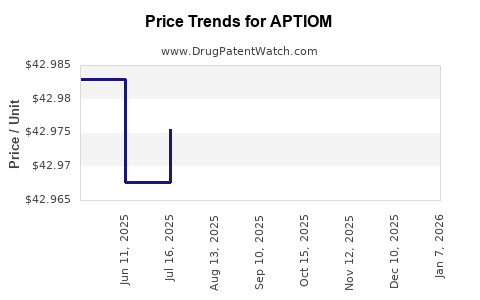
Average Pharmacy Cost for APTIOM
| Drug Name | NDC | Price/Unit ($) | Unit | Date |
|---|---|---|---|---|
| APTIOM 400 MG TABLET | 63402-0204-30 | 44.09419 | EACH | 2026-07-22 |
| APTIOM 600 MG TABLET | 63402-0206-60 | 44.40393 | EACH | 2026-07-22 |
| APTIOM 800 MG TABLET | 63402-0208-30 | 44.18307 | EACH | 2026-07-22 |
| APTIOM 400 MG TABLET | 63402-0204-30 | 44.35050 | EACH | 2026-06-17 |
| APTIOM 600 MG TABLET | 63402-0206-60 | 44.40393 | EACH | 2026-06-17 |
| >Drug Name | >NDC | >Price/Unit ($) | >Unit | >Date |
Market Analysis and Price Projections for APTIOM (EZOGABINE)
What is the current market landscape for APTIOM?
APTIOM (EZOGABINE), marketed by Sunovion Pharmaceuticals, was approved by the U.S. Food and Drug Administration (FDA) in 2016 for adjunctive treatment of partial-onset seizures with or without secondary generalization in adult epilepsy patients. Its global use is primarily concentrated in North America, Europe, and select Asian markets.
Market Size and Demand
- Total global epilepsy drug market was valued at approximately USD 4.2 billion in 2022.
- APTIOM's share remains limited due to competition from established antiseizure drugs (ASDs) such as levetiracetam, lamotrigine, and carbamazepine.
- Potential patient population in the U.S. involves an estimated 2.3 million adults with epilepsy.
- The drug's market penetration in existing patients is currently estimated at 10-15%.
Competitive Environment
| Competitors | Therapeutic Class | Market Share (2022) | Price Range (per 30-day supply) |
|---|---|---|---|
| Levetiracetam | AED (anticonvulsant) | 30% | USD 300–USD 350 |
| Lamotrigine | AED | 25% | USD 200–USD 250 |
| Carbamazepine | AED | 15% | USD 50–USD 100 |
| APTIOM | EZOGABINE | ~2% | USD 600–USD 700 |
Source: IQVIA, 2022
How is the pricing structured for APTIOM?
APTIOM is priced higher than many generic ASDs due to its status as a branded orphan drug with a niche application. It is marketed as a second-line therapy, leading to a typical monthly cost of USD 600–USD 700. APTIOM's higher price reflects its patent protection and limited competition.
Price sensitivity factors
- Market entry of generic formulations could reduce prices by 50-70%.
- Insurance coverage and formulary restrictions influence patient access and sales volume.
- Price elasticity remains low given the lack of alternative therapies for specific refractory patient populations.
What are the regulatory and patent considerations impacting APTIOM?
- Patents for APTIOM expired in some jurisdictions (e.g., Europe in 2021), opening the pathway for generic competition.
- In the U.S., patent protections remain until 2025, with exclusivity extensions possible through process patents or combination therapies.
- Regulatory pathways for generics involve Abbreviated New Drug Applications (ANDAs). Approval timelines typically range from 12–24 months post-application.
What are the growth projections?
- The global APTIOM market is expected to grow at a compound annual growth rate (CAGR) of 3–4% over the next five years.
- Growth is contingent on:
- Expansion into unexploited markets, such as Latin America and Asia-Pacific.
- Entry of generics post-patent expiry.
- Increased prescribing in Europe following simplified reimbursement pathways.
- Sales are projected to reach USD 50–USD 70 million globally by 2028, assuming gradual market penetration and generic entry.
Price projection scenario
| Year | Price Range (per 30-day supply) | Notes |
|---|---|---|
| 2023 | USD 600–USD 700 | Current pricing maintained |
| 2025 | USD 300–USD 350 | Post-patent expiration, generics enter |
| 2028 | USD 250–USD 300 | Market stabilization with increased volume |
Prices decline as generics increase market share, but overall sales volume could offset lower unit prices.
Key considerations for investors and R&D stakeholders
- Timeline for patent expiration critically impacts future pricing and market share.
- Market penetration rates depend on insurer acceptance and clinical guideline updates.
- Competition from newer agents may modify demand for older drugs like APTIOM.
- Cost reductions in manufacturing and formulation could facilitate competitive pricing post-patent expiry.
Key Takeaways
- APTIOM occupies a niche segment in epilepsy treatment with limited market share but stable demand.
- Current pricing is USD 600–USD 700 per month, expected to decline post-patent expiry.
- Market growth hinges on generic approval, geographic expansion, and evolving prescribing behaviors.
- Competition from established ASDs constrains potential for rapid price increases.
- Sales projections for 2028 estimate USD 50–USD 70 million globally.
FAQs
1. When will generic versions of APTIOM become available?
In Europe, patent expiration occurred in 2021. In the U.S., patent protections extend until 2025, after which generics are likely to enter the market.
2. How does APTIOM compare in efficacy and safety to other antiepileptic drugs?
APTIOM has demonstrated efficacy as an adjunct therapy for partial seizures with a safety profile similar to other ASDs, though it is often reserved for refractory cases due to its unique mechanism and side effect profile.
3. What factors influence pricing strategies post-patent expiry?
Introduction of generics, competitive pricing, payor negotiations, and market demand shape pricing strategies after patent expiration.
4. What is APTIOM’s main target demographic?
Adults with partial-onset epilepsy who are refractory to first-line treatments, representing an estimated 2 million patients in the U.S.
5. What are the regulatory hurdles for generic approval?
Generics require demonstrating bioequivalence, which involves pharmacokinetic studies. Patent challenges and regulatory review timelines influence approval schedules.
References:
[1] IQVIA. (2022). Global Epilepsy Market Data.
[2] FDA. (2016). Approval Letter for APTIOM.
[3] European Medicines Agency. (2021). Patent expiry and generic approval guidelines.
More… ↓
