Share This Page
Drug Price Trends for APLENZIN ER
✉ Email this page to a colleague
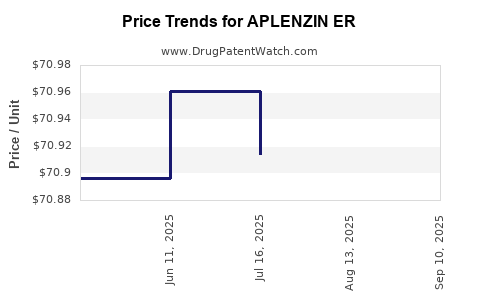
Average Pharmacy Cost for APLENZIN ER
| Drug Name | NDC | Price/Unit ($) | Unit | Date |
|---|---|---|---|---|
| APLENZIN ER 174 MG TABLET | 00187-5810-30 | 70.86740 | EACH | 2025-09-17 |
| APLENZIN ER 348 MG TABLET | 00187-5811-30 | 93.51156 | EACH | 2025-09-17 |
| APLENZIN ER 522 MG TABLET | 00187-5812-30 | 212.47688 | EACH | 2025-09-17 |
| APLENZIN ER 348 MG TABLET | 00187-5811-30 | 93.54192 | EACH | 2025-08-20 |
| >Drug Name | >NDC | >Price/Unit ($) | >Unit | >Date |
Market Analysis and Price Projections for APLENZIN ER
Overview
APLENZIN ER (dextroamphetamine saccharate, amphetamine aspartate, and d-methamphetamine aspartate extended-release) is an FDA-approved medication for ADHD and narcolepsy. It competes within the stimulants segment, dominated by brands like Adderall XR. Market dynamics are influenced by regulatory policies, patent statuses, manufacturing costs, and competitive landscape.
Market Size and Growth
The global ADHD drug market was valued at approximately $19 billion in 2022. It is projected to expand at a compound annual growth rate (CAGR) of around 4.2% through 2030, driven by increased diagnosis rates and unmet needs in adult populations.
In the US, the stimulant segment accounts for nearly 70% of ADHD prescriptions, with sales reaching $12 billion annually. APLENZIN ER absorbs a share of this market, primarily targeting patients seeking non-stimulant alternatives or with specific contraindications to other stimulants.
Competitive Position
APLENZIN ER faces competition from:
- Adderall XR: Dominates with an approximate 40% market share in ADHD stimulants in the US.
- Vyvanse (lisdexamfetamine): Holds about 20% of the market; favored for its extended duration.
- Strattera (atomoxetine): Non-stimulant competitor, capturing about 10% market share.
APLENZIN ER’s unique formulation mandates specific prescribing patterns. Patent exclusivity for the product could extend through 2030, depending on the regulatory environment and patent challenges.
Pricing and Reimbursement Landscape
Current APLENZIN ER pricing in the US averages around $500–$600 per month for the typical patient dosage. This is similar to Adderall XR but higher than generic immediate-release formulations.
Insurance coverage varies:
- Commercial insurers typically reimburse at standard formulary rates.
- Medicare Part D covers stimulant medications but often with prior authorization and higher co-pays for branded drugs.
- Medicaid programs may negotiate further discounts, impacting net revenue.
Branded drugs like APLENZIN ER generally sustain higher price points due to patent protections and the absence of generic competition. Once patents expire, generic versions are anticipated to significantly reduce prices—potentially by 60-80%.
Price Projections (Next 5-10 Years)
| Year | Estimated Average Wholesale Price (AWP) | Assumptions |
|---|---|---|
| 2023 | $550 per month | Current market conditions |
| 2025 | $530–$550 per month | Slight market penetration increase |
| 2027 | $510–$530 per month | Patent expiry approaching |
| 2030 | $200–$300 per month (generic) | Post-patent competition |
The decline post-patent expiry will be driven by the entrance of generics, which could reduce prices by up to 70%.
Regulatory and Policy Impact
Recent policies favoring non-stimulant therapies, concerns over abuse potential, and increased scrutiny over stimulant prescribing may influence demand and pricing strategies. Additionally, the presence of illicit diversion markets constrains pricing flexibility.
Future Market Drivers
- Non-stimulant alternatives gaining popularity.
- Extended-release formulations preferred for compliance.
- Global expansion potential in emerging markets with rising ADHD awareness.
- Innovations: New delivery systems or formulations could command premium pricing.
Risks
- Patent challenges and generic entry.
- Regulatory restrictions or reclassification.
- Changes in prescribing guidelines reducing stimulant use.
Key Takeaways
- APLENZIN ER holds a finite patent window extending into the early 2030s.
- US market pricing remains stable around $550/month; potential decline with patent expiry.
- Market share is constrained by dominant competitors like Adderall XR and Vyvanse.
- Long-term price erosion expected once generics enter, with a potential 70% decrease.
- Policy and regulatory shifts could impact demand and pricing structure.
FAQs
What factors influence APLENZIN ER’s market share?
Prescription trends, clinical guidelines, competitor activity, patent status, and insurance coverage play key roles.
When will generics likely enter the market?
Patent protection generally lasts until 2030; generics are expected soon after unless patent challenges occur earlier.
How does insurance reimbursement affect pricing?
Reimbursement policies determine the net price received by manufacturers; branded drugs typically maintain higher prices due to patent exclusivity.
What are the main risks to APLENZIN ER’s future sales?
Patent expiration, increased competition, regulatory shifts, and changes in prescribing practices.
Are there emerging markets for APLENZIN ER?
Yes, particularly in regions with rising ADHD diagnosis and limited existing treatment options, although regulatory approval processes vary.
References
[1] Market Research Future, "Global ADHD Drugs Market", 2022.
[2] IQVIA, "Prescription Trends and Market Share Data", 2022.
[3] U.S. Food & Drug Administration, "APLENZIN ER Prescribing Information", 2023.
[4] EvaluatePharma, "Pharmaceutical Pricing Dynamics", 2022.
[5] Medicare & Medicaid Policies, "Prescription Drug Coverage and Reimbursement", 2023.
More… ↓
