You're using a free limited version of DrugPatentWatch: Upgrade for Complete Access

Last Updated: December 15, 2025

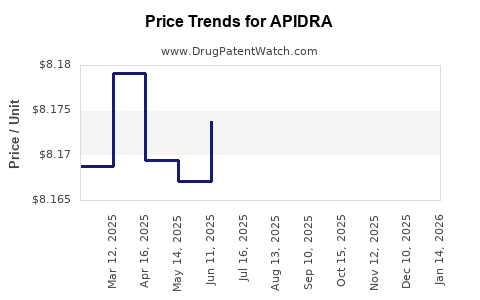
Drug Price Trends for APIDRA


✉ Email this page to a colleague

« Back to Dashboard


Drug Price Trends for APIDRA

Average Pharmacy Cost for APIDRA

These are average pharmacy acquisition costs (net of discounts) from a US national survey
Drug Name NDC Price/Unit ($) Unit Date
APIDRA 100 UNIT/ML VIAL 00088-2500-33 8.16312 ML 2025-11-19
APIDRA SOLOSTAR 100 UNIT/ML 00088-2502-05 10.52014 ML 2025-11-19
APIDRA 100 UNIT/ML VIAL 00088-2500-33 8.17150 ML 2025-10-22
APIDRA SOLOSTAR 100 UNIT/ML 00088-2502-05 10.51756 ML 2025-10-22
APIDRA 100 UNIT/ML VIAL 00088-2500-33 8.17337 ML 2025-09-17
APIDRA SOLOSTAR 100 UNIT/ML 00088-2502-05 10.51203 ML 2025-09-17
APIDRA 100 UNIT/ML VIAL 00088-2500-33 8.16932 ML 2025-08-20
>Drug Name >NDC >Price/Unit ($) >Unit >Date

Best Wholesale Price for APIDRA

These are wholesale prices available to the US Federal Government which, by law, must be the best prices available to any customer under comparable terms and conditions
Drug Name Vendor NDC Count Price ($) Price/Unit ($) Unit Dates Price Type
APIDRA 100UNT/ML INJ Sanofi Aventis U.S. LLC 00088-2500-33 10ML 84.76 8.47600 ML 2024-01-23 - 2028-05-31 FSS
APIDRA 100UNT/ML INJ 3ML PRE-FILLED SYRINGE Sanofi Aventis U.S. LLC 00088-2502-05 5X3ML 220.51 2023-06-01 - 2028-05-31 Big4
APIDRA 100UNT/ML INJ Sanofi Aventis U.S. LLC 00088-2500-33 10ML 114.15 11.41500 ML 2023-06-01 - 2028-05-31 Big4
APIDRA 100UNT/ML INJ 3ML PRE-FILLED SYRINGE Sanofi Aventis U.S. LLC 00088-2502-05 5X3ML 220.51 2023-06-01 - 2028-05-31 FSS
APIDRA 100UNT/ML INJ Sanofi Aventis U.S. LLC 00088-2500-33 10ML 114.15 11.41500 ML 2023-06-01 - 2028-05-31 FSS
APIDRA 100UNT/ML INJ 3ML PRE-FILLED SYRINGE Sanofi Aventis U.S. LLC 00088-2502-05 5X3ML 220.51 2024-01-01 - 2028-05-31 Big4
APIDRA 100UNT/ML INJ Sanofi Aventis U.S. LLC 00088-2500-33 10ML 114.15 11.41500 ML 2024-01-01 - 2028-05-31 Big4
>Drug Name >Vendor >NDC >Count >Price ($) >Price/Unit ($) >Unit >Dates >Price Type
Price type key: Federal Supply Schedule (FSS): generally available to all Federal Govt agencies / 'BIG4' prices: VA, DoD, Public Health & Coast Guard only / National Contracts (NC): Available to specific agencies

Market Analysis and Price Projections for APIDRA

Last updated: August 4, 2025

Introduction

APIDRA (insulin glulisine) is a rapid-acting insulin analog developed by Sanofi, widely prescribed for managing blood glucose levels in individuals with type 1 and type 2 diabetes. As the global diabetes epidemic accelerates, the pharmaceutical landscape surrounding insulin therapies is evolving rapidly. This report offers a comprehensive market analysis and price projection outlook for APIDRA, emphasizing key factors influencing demand, competitive dynamics, regulatory considerations, and pricing strategies.

Market Overview

Global Diabetes Therapeutics Market Context

The global diabetes care market is projected to reach approximately $110 billion by 2025, with insulin products dominating the segment due to their essential role in blood glucose management [1]. The increasing prevalence of diabetes—estimated at over 537 million people worldwide in 2021—fuels sustained demand for insulin therapies, especially in emerging markets. The insulin market is increasingly competitive owing to biosimilar entries and alternative rapid-acting insulin options.

APIDRA’s Market Position and Therapeutic Niches

APIDRA distinguishes itself as a rapid-acting insulin with an onset of action within 15 minutes, a peak at about one hour, and a duration of 2-4 hours. Its comparable efficacy and rapid activity profile position it as a preferred choice for mealtime glucose management, especially among patients seeking flexibility or minimized post-meal glucose excursions.

Historically, APIDRA's market share has been challenged by newer formulations like Lilly’s Lyumjev (insulin lispro-aabc) and biosimilars of Humalog and Novo Nordisk’s NovoRapid (insulin lispro and aspart, respectively). Nevertheless, APIDRA remains a significant player in the insulin landscape, particularly in regions where formulary preferences or clinician familiarity favor its use.

Market Dynamics and Competitive Landscape

Key Market Drivers

  • Rising Global Diabetes Prevalence: The expanding prevalence across Asia-Pacific, Africa, and Latin America significantly boosts the base for insulin therapies.
  • Patient Preference for Rapid-Acting Insulins: As treatment paradigms shift towards intensification and flexible regimens, demand for rapid-acting insulins like APIDRA remains high.
  • Advances in Delivery Devices: Pre-filled insulin pens and continuous subcutaneous insulin infusion (CSII) systems enhance the convenience of using APIDRA, boosting utilization.
  • Government Initiatives and Healthcare Funding: Increasing healthcare investments in diabetes management, especially in emerging economies, support insulin market growth.

Competitive Challenges

  • Biosimilar Competition: The entry of biosimilar insulin glulisine could pressure pricing and market share [2].
  • Emerging Long-Acting and Ultra-Long-Acting Insulins: Novel basal insulins are reducing the relative reliance on rapid-acting insulins, impacting overall growth.
  • Pricing Pressure and Reimbursement Policies: Payers in developed markets are demanding price reductions, influencing the profit margins for branded insulins like APIDRA.

Regulatory and Patent Landscape

Sanofi’s patent exclusivity on APIDRA has historically protected its market share; however, patent expirations and regulatory approvals in various jurisdictions are paving the way for biosimilar competition. Regulatory pathways for biosimilars in the U.S. and Europe are increasingly streamlined, facilitating market entry for competitors [3].

Price Projections Analysis

Historical Pricing Trends

In established markets such as the United States and Europe, the list prices for insulin analogs like APIDRA have historically been high—e.g., approximately $250-$300 per 10 mL vial (roughly $25-$30 per pen). Over the past decade, there has been a gradual downward pressure driven by biosimilar development, payer negotiations, and policy interventions.

Current Pricing Landscape

Sanofi’s APIDRA remains a premium-priced insulin, aligning with branded biosimilars. Price reductions of approximately 15-25% have been observed in response to payer pushback and biosimilar launches, but list prices generally maintain a premium compared to older human insulins.

Projected Price Trends (2023–2030)

  • Short-term (2023–2025):
    • Expect marginal price reductions (10-15%) driven by biosimilar entry and increased market competition.
    • Sanofi might pursue volume-based strategies, such as bundling and value-based agreements, to mitigate revenue erosion.
  • Medium to Long-term (2026–2030):
    • Biosimilar uptake is projected to rise, potentially reducing APIDRA’s average selling price (ASP) by 25-40% in mature markets.
    • Market consolidation and volume growth, especially in emerging markets, may offset unit price declines.
    • Overall, the price for APIDRA is likely to stabilize at approximately $10–$15 per pen in high-income countries and lower in emerging markets.

Factors Influencing Price Trajectory

  • Biosimilar Market Penetration: Greater biosimilar availability will exert downward pressure.
  • Regulatory Approvals: Accelerated approvals and interchangeability could accelerate price declines.
  • Healthcare Policy Changes: Moves towards insulin price caps, especially in the U.S. and Europe, will influence pricing.
  • Innovation and New Formulations: Development of ultra-rapid or combination insulins could alter demand dynamics, affecting pricing strategies.

Implications for Stakeholders

  • Pharmaceutical Companies: Strategic focus on biosimilar development and differentiation through delivery devices can mitigate price erosion.
  • Healthcare Providers and Payers: Negotiating volume discounts and promoting cost-effective therapies will become critical.
  • Patients: Enlarged access due to affordability initiatives, especially in emerging markets, but potential variability in drug availability.

Conclusion

The market for APIDRA is poised for moderate decline in unit prices over the next decade, driven predominantly by biosimilar competition, healthcare policy reforms, and evolving treatment standards. Despite these pressures, APIDRA's clinical profile sustains its demand in specific patient populations worldwide. Companies leveraging cost efficiencies, innovative delivery options, and strategic collaborations will be better positioned to sustain profitability.


Key Takeaways

  • Growth Drivers: Increasing global diabetes prevalence and a preference for rapid-acting insulin contribute to sustained demand.
  • Competitive Pressures: Biosimilar entries, technological innovations, and policy reforms are likely to depress prices by 25-40% over the next seven years.
  • Pricing Strategies: Sanofi and competitors will focus on volume, device integration, and value-based contracting to maintain market share.
  • Regional Variations: Emerging markets will see lower prices due to affordability initiatives; advanced markets will focus on reimbursement negotiations.
  • Innovation Impact: New formulations and delivery innovations present both opportunities for differentiation and threats to existing products.

FAQs

  1. What factors are most influential in determining APIDRA’s future pricing?
    Patent expirations, biosimilar market entry, regulatory approvals, and healthcare reforms significantly influence its pricing trajectory.

  2. How does biosimilar competition affect APIDRA’s market share?
    Biosimilars typically lead to price reductions and increased market share competition, especially in regions with supportive regulatory pathways.

  3. Are emerging markets likely to see lower prices for APIDRA?
    Yes. Due to affordability policies and a focus on access, prices in emerging markets are expected to be substantially lower than in developed countries.

  4. What role do technological advancements play in APIDRA’s market outlook?
    Innovations such as smart insulin delivery devices and ultra-rapid formulations may shift demand toward alternative products, possibly impacting APIDRA’s market share and pricing.

  5. Will APIDRA remain a viable option amid competition?
    Yes, particularly if Sanofi capitalizes on its established clinical profile, develops strategic partnerships, and adopts flexible pricing models to sustain demand.


Sources
[1] Grand View Research. (2022). Diabetes Care Market Size, Share & Trends Analysis.
[2] U.S. FDA. (2022). Biosimilar Approval Pathways and Market Dynamics.
[3] European Medicines Agency. (2022). Biosimilar Regulations and Market Entry Strategies.

More… ↓

⤷  Get Started Free

Make Better Decisions: Try a trial or see plans & pricing

Drugs may be covered by multiple patents or regulatory protections. All trademarks and applicant names are the property of their respective owners or licensors. Although great care is taken in the proper and correct provision of this service, thinkBiotech LLC does not accept any responsibility for possible consequences of errors or omissions in the provided data. The data presented herein is for information purposes only. There is no warranty that the data contained herein is error free. We do not provide individual investment advice. This service is not registered with any financial regulatory agency. The information we publish is educational only and based on our opinions plus our models. By using DrugPatentWatch you acknowledge that we do not provide personalized recommendations or advice. thinkBiotech performs no independent verification of facts as provided by public sources nor are attempts made to provide legal or investing advice. Any reliance on data provided herein is done solely at the discretion of the user. Users of this service are advised to seek professional advice and independent confirmation before considering acting on any of the provided information. thinkBiotech LLC reserves the right to amend, extend or withdraw any part or all of the offered service without notice.