You're using a free limited version of DrugPatentWatch: Upgrade for Complete Access

Last Updated: December 10, 2025

Drug Price Trends for ANTI-NAUSEA LIQUID


✉ Email this page to a colleague

« Back to Dashboard


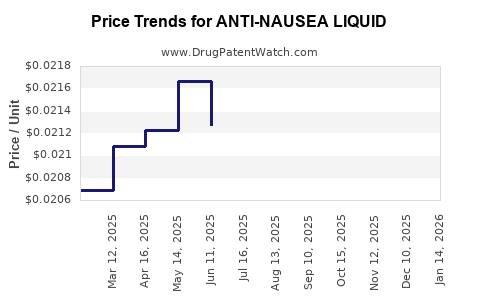
Drug Price Trends for ANTI-NAUSEA LIQUID

Average Pharmacy Cost for ANTI-NAUSEA LIQUID

These are average pharmacy acquisition costs (net of discounts) from a US national survey
Drug Name NDC Price/Unit ($) Unit Date
ANTI-NAUSEA LIQUID 00536-1302-97 0.02230 ML 2025-11-19
ANTI-NAUSEA LIQUID 00536-1302-97 0.02245 ML 2025-10-22
ANTI-NAUSEA LIQUID 00536-1302-97 0.02177 ML 2025-09-17
ANTI-NAUSEA LIQUID 00536-1302-97 0.02135 ML 2025-08-20
ANTI-NAUSEA LIQUID 00536-1302-97 0.02138 ML 2025-07-23
>Drug Name >NDC >Price/Unit ($) >Unit >Date

Market Analysis and Price Projections for the Drug: Anti-Nausea Liquid

Last updated: August 11, 2025

Introduction

The pharmaceutical landscape for anti-nausea medications is increasingly dynamic, driven by expanding indications, evolving patent landscapes, and rising global demand for effective symptomatic relief. Among these, anti-nausea liquids occupy a niche focused on rapid absorption, ease of administration, and targeted treatment for diverse patient populations, including pediatric, geriatric, and oncology sectors. This analysis evaluates the current market environment and projects future price trends for anti-nausea liquids, emphasizing key factors influencing supply, demand, and pricing strategies.

Market Overview

Global Market Size and Growth Trajectory

The anti-nausea drug segment, valued at approximately USD 2.5 billion in 2022, is projected to reach USD 4.1 billion by 2030, growing at a compound annual growth rate (CAGR) of around 6.2%. This growth is predominantly attributed to the increasing prevalence of gastrointestinal disorders, rising cancer incidence, and the expanding elderly population requiring symptom management.

Anti-nausea liquids specifically address the demand for rapid alleviation of nausea, particularly in hospitalized patients, postoperative care, chemotherapy regimens, and pediatric use cases. The liquid formulation's advantage over tablets or capsules—such as expedited absorption and operational ease—boosts its market adoption.

Key Market Drivers

  • Rising Prevalence of Nausea-Related Conditions: Conditions like chemotherapy-induced nausea, motion sickness, and gastrointestinal disorders are increasingly common globally, especially in aging populations.

  • Advancements in Formulation Technologies: Innovations in liquid drug formulations improve bioavailability, shelf stability, and patient compliance, fostering market growth.

  • Regulatory Approvals and Reimbursement Policies: Streamlined regulatory pathways and better insurance coverage enhance market access and adoption.

  • Growing Pediatric and Geriatric Population: Liquid formulations are particularly suited for children and elderly, expanding target demographics.

Major Market Players and Product Landscape

Leading pharmaceutical companies dominating this segment include:

  • Pfizer (e.g., Ondansetron Oral Solution)
  • GlaxoSmithKline (GSK) (e.g., Granisetron liquids)
  • Teva Pharmaceuticals
  • Mylan/Nuvox

Innovations include transdermal patches and novel delivery systems, but liquids retain a significant share owing to their versatility.

Regulatory and Patent Landscape

Patent expirations around key anti-nausea liquids have opened commercial opportunities for generic manufacturers, accentuating price competition. However, proprietary formulations with enhanced bioavailability or improved safety profiles command premium pricing. Regulatory agencies, such as the FDA and EMA, focus on confirming safety, efficacy, and quality, influencing product availability and market penetration.

Competitive Pricing Dynamics

Pricing for anti-nausea liquids varies based on formulation complexity, brand reputation, and regulatory status. Innovations and patents support higher margins initially, but generic entries tend to significantly lower prices post-patent expiry [1].

Current Pricing Benchmark

  • Brand-name products: Ranging from USD 15 to USD 30 per 100 mL bottle.
  • Generic products: Ranging from USD 8 to USD 15 per 100 mL bottle.

Price elasticity in different regions, reimbursement policies, and distribution channels further influence consumer pricing.

Future Price Projections

Factors Influencing Price Trends

  • Patent and Exclusivity Periods: Newly approved liquids with unique delivery mechanisms or formulations are expected to maintain premium pricing for the first 3-5 years.

  • Market Penetration of Generics: As patents expire, generic competition typically halves prices within 2-3 years, stabilizing market prices for mature products.

  • Regulatory Approvals for Biosimilars and New Formulations: These could further intensify competition, exerting downward pressure on prices.

  • Regional Market Variability: Emerging markets like India, Brazil, and Southeast Asia will see lower prices driven by lower healthcare spending, whereas developed markets like North America and Europe will sustain higher price points owing to higher per capita healthcare expenditure.

Projected Price Trends (2023-2030)

Year Expected Price Range (USD per 100 mL) Notes
2023 12 – 30 Market stabilization post-patent expiry for key brands
2025 10 – 22 Increased generic competition reduces premiums
2027 8 – 18 Dominance of generics; price stabilization
2030 8 – 15 Mature generic market; steady or slight decline

Implication of Price Trends

The initial premium for patented formulations may decline sharply as generics flood the market, but niche formulations with superior efficacy or safety profiles can retain higher prices. Notably, innovative delivery systems or combination therapies may sustain premium pricing longer-term.

Market Opportunities and Challenges

Opportunities

  • Emerging Markets: Growing healthcare infrastructure and increasing disease burden create new demand pools, potentially offering higher profit margins.

  • Personalized Medicine: Tailoring formulations, such as pediatric-friendly liquids or slow-release systems, can command premium pricing.

  • Product Differentiation: Developing liquids with improved bioavailability, reduced side effects, or combination pills targeting multiple symptoms enhances competitive positioning.

Challenges

  • Price Competition: Entry of low-cost generics can compress profit margins.

  • Regulatory Hurdles: Stringent approval processes can delay market entry or increase R&D costs.

  • Market Saturation: Mature markets face limited growth and aggressive price erosion.

Strategic Recommendations

  • Focus on Innovation: Investing in novel delivery mechanisms or combination formulations can protect premium pricing for longer periods.

  • Regional Diversification: Cultivating presence in emerging markets can offset declines in mature markets.

  • Cost Optimization: Streamlining manufacturing and supply chain efficiencies to maintain profitability amidst competitive pricing.

  • Partnerships and Licensing: Collaborating with biotech firms can facilitate access to cutting-edge formulations and accelerate market entry.

Key Takeaways

  • The anti-nausea liquid market is poised for steady growth driven by demographic shifts, clinical needs, and technological advances.

  • Price trends indicate a decline post-patent expiry, with initial premiums sustained by innovations and exclusivity.

  • Competition is intensifying, particularly from generics, exerting downward pressure on prices.

  • Regional disparities necessitate tailored market strategies, with emerging markets presenting significant growth opportunities.

  • Continuous innovation and strategic partnerships are vital to maintaining market share and profitability.


FAQs

1. How does patent expiration affect the pricing of anti-nausea liquids?
Patent expiration typically leads to the entry of generic competitors, significantly reducing prices—often by 50% or more within a few years—shifting the market toward more affordable options.

2. Are liquid formulations of anti-nausea drugs more cost-effective than tablets or injections?
While liquids offer rapid absorption and convenience, their manufacturing costs may be higher than tablets. However, their clinical benefits, especially in pediatric or difficult patients, can justify their premium price.

3. Which regions are expected to see the highest growth in anti-nausea liquid demand?
Emerging markets such as India, China, and Brazil are anticipated to experience notable growth due to expanding healthcare infrastructure and rising disease prevalence.

4. What technological advancements could impact future pricing?
Innovations like sustained-release liquids, nanoformulations, and combination drugs could justify higher prices through improved efficacy and dosing convenience.

5. How can pharmaceutical companies sustain profitability amid downward price pressure?
Focusing on innovation, expanding into underserved markets, developing differentiated products, and optimizing manufacturing costs are essential strategies.


Sources:
[1] MarketResearch.com, "Global Anti-Nausea Market Report," 2022.

More… ↓

⤷  Get Started Free

Make Better Decisions: Try a trial or see plans & pricing

Drugs may be covered by multiple patents or regulatory protections. All trademarks and applicant names are the property of their respective owners or licensors. Although great care is taken in the proper and correct provision of this service, thinkBiotech LLC does not accept any responsibility for possible consequences of errors or omissions in the provided data. The data presented herein is for information purposes only. There is no warranty that the data contained herein is error free. We do not provide individual investment advice. This service is not registered with any financial regulatory agency. The information we publish is educational only and based on our opinions plus our models. By using DrugPatentWatch you acknowledge that we do not provide personalized recommendations or advice. thinkBiotech performs no independent verification of facts as provided by public sources nor are attempts made to provide legal or investing advice. Any reliance on data provided herein is done solely at the discretion of the user. Users of this service are advised to seek professional advice and independent confirmation before considering acting on any of the provided information. thinkBiotech LLC reserves the right to amend, extend or withdraw any part or all of the offered service without notice.