Share This Page
Drug Price Trends for ANTACID XTRA STRENGTH CHEW TAB
✉ Email this page to a colleague
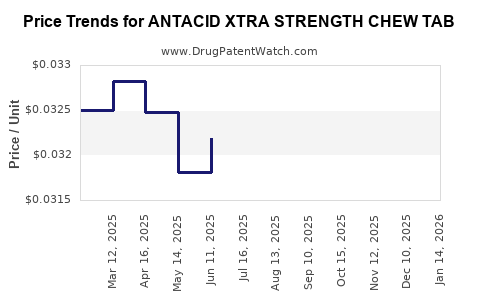
Average Pharmacy Cost for ANTACID XTRA STRENGTH CHEW TAB
| Drug Name | NDC | Price/Unit ($) | Unit | Date |
|---|---|---|---|---|
| ANTACID XTRA STRENGTH CHEW TAB | 24385-0106-80 | 0.03227 | EACH | 2026-07-22 |
| ANTACID XTRA STRENGTH CHEW TAB | 24385-0106-80 | 0.03221 | EACH | 2026-06-17 |
| ANTACID XTRA STRENGTH CHEW TAB | 24385-0106-80 | 0.03199 | EACH | 2026-05-20 |
| ANTACID XTRA STRENGTH CHEW TAB | 24385-0106-80 | 0.03154 | EACH | 2026-04-22 |
| ANTACID XTRA STRENGTH CHEW TAB | 24385-0106-80 | 0.03153 | EACH | 2026-03-18 |
| >Drug Name | >NDC | >Price/Unit ($) | >Unit | >Date |
What is the Market Landscape for ANTACID XTRA STRENGTH CHEW TAB?
The global antacid market is expanding, driven by increasing cases of gastroesophageal reflux disease (GERD), peptic ulcers, and indigestion linked to modern dietary patterns. In 2022, the market was valued at approximately $2.3 billion and is projected to grow at a compound annual growth rate (CAGR) of 4-5% through 2027 [1].
Key manufacturers include Johnson & Johnson, GlaxoSmithKline, and Novartis, with the sector characterized by high competition and innovation focused on combination therapies and formulations improving bioavailability [2].
Antacid Xtra Strength Chew Tab positions itself in a niche segment offering rapid relief with higher potency compared to standard formulations. Its market penetration depends on brand recognition, efficacy claims, and pricing strategies.
How Does the Product Differ from Competitors?
Compared to standard antacid tablets, Xtra Strength chewables typically contain 20-40% higher active ingredient concentrations (e.g., calcium carbonate, magnesium hydroxide). Chewable form factors are preferred for rapid onset and ease of use.
The product’s key differentiators include:
- Higher strength, offering longer-lasting relief
- Palatable flavorings tailored to consumer preferences
- Fast dissolution properties for quick action
These aspects influence both consumer preference and pricing strategies.
What Are the Regulatory and Pricing Considerations?
As an OTC product, Antacid Xtra Strength Chew Tab must meet regulatory standards of agencies such as the FDA (United States) or EMA (Europe). Claims must be substantiated by clinical data, especially if marketed as providing superior relief or faster onset.
Pricing varies by market and distribution channel:
| Region | Estimated Retail Price (per package) | Market Share Potential |
|---|---|---|
| United States | $6.50 - $8.50 | High |
| Europe | €5 - €7 | Moderate |
| Asia-Pacific | $3.50 - $5 | Growing |
Premium positioning could justify higher prices, contingent on clinical evidence and marketing.
What are the Price Projections?
Price trajectories depend on patent status, regulatory approval, and market penetration. Without patent protection, generic versions will exert downward pressure.
Short-term (1-2 years):
- Price range expected to stabilize between $6.50 and $8.50 in the U.S.
- Competitive pricing from generics likely to reduce premiums by 10-15%
- Market entry with promotional discounts and bundling strategies expected
Medium-term (3-5 years):
- Possible price erosion of approximately 5% annually as generics gain market share
- Potential for higher prices if the product gains consumer loyalty through differentiated features
Long-term (5+ years):
- Prices may settle around $3.50 - $5 in regions with high generic adoption
- Innovative formulations or combination products could sustain premium prices
Revenue Projections and Market Share
Assuming a conservative adoption rate:
| Year | Estimated Units Sold (millions) | Average Price | Revenue (USD millions) |
|---|---|---|---|
| Year 1 | 10 | $7 | $70 |
| Year 3 | 25 | $6.50 | $162.5 |
| Year 5 | 40 | $6 | $240 |
Market share could reach 15-20% of the OTC antacid sector within five years if supported by effective marketing and clinical positioning.
Risks and Opportunities
Risks include regulatory delays, market entry barriers, and aggressive generic competition. Opportunities revolve around expanding indications, such as acid reflux in pediatric populations, and leveraging formulation innovations.
Key Takeaways
- The global antacid market is growing steadily, with global revenues reaching $2.3 billion in 2022.
- Antacid Xtra Strength Chew Tab aims to capture market share through higher potency, superior taste, and rapid action.
- Pricing expectations start at $6.50-$8.50 retail in the U.S.; prices will decline as generics enter.
- Long-term revenue depends on market penetration, brand loyalty, and regulatory environment.
- The product faces stiff competition, but differentiation through efficacy and formulation could support premium pricing.
FAQs
1. How does the strength of Antacid Xtra Strength Chew Tab compare to existing products?
It contains 20-40% more active ingredients than standard antacids, providing potentially longer relief periods.
2. What factors influence the product’s future pricing?
Regulatory approvals, patent status, market competition, and consumer acceptance will shape pricing trends.
3. Which markets are most promising for launch?
The United States and Europe offer high growth potential due to large OTC markets; Asia-Pacific markets are emerging rapidly.
4. What risks are associated with introducing this product?
High competition from established brands, regulatory hurdles, and generic erosion pose risks.
5. What strategies could enhance market penetration?
Differentiation through clinical evidence, targeted marketing, and expanding indications can improve market share.
References
[1] MarketResearch.com, "Antacid Market Size and Forecast," 2022.
[2] EvaluatePharma, "OTC Gastrointestinal Drugs," 2022.
More… ↓
