Share This Page
Drug Price Trends for ANTACID ANTI-GAS MAX STR LIQ
✉ Email this page to a colleague
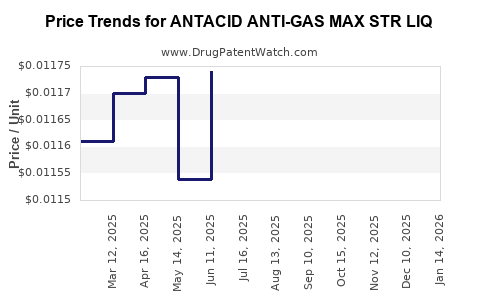
Average Pharmacy Cost for ANTACID ANTI-GAS MAX STR LIQ
| Drug Name | NDC | Price/Unit ($) | Unit | Date |
|---|---|---|---|---|
| ANTACID ANTI-GAS MAX STR LIQ | 70000-0422-01 | 0.01187 | ML | 2026-03-18 |
| ANTACID ANTI-GAS MAX STR LIQ | 70000-0062-01 | 0.01187 | ML | 2026-03-18 |
| ANTACID ANTI-GAS MAX STR LIQ | 70000-0422-01 | 0.01180 | ML | 2026-02-18 |
| >Drug Name | >NDC | >Price/Unit ($) | >Unit | >Date |
ANTACID ANTI-GAS MAX STR LIQ Market Analysis and Financial Projection
What is the Market Status for ANTACID ANTI-GAS MAX STR LIQ?
Antacid and anti-gas liquids currently occupy a significant segment in the over-the-counter (OTC) gastrointestinal (GI) products market. The product, typically used for relief from indigestion, heartburn, and bloating, has seen steady growth driven by increasing consumer awareness and chronic GI conditions.
Market estimates in 2022 place the global antacid market at approximately USD 2.3 billion, with OTC products comprising around 80% of sales. North America accounts for roughly 45%, due to high prevalence of GERD and consumer preference for quick relief. The Asia-Pacific region leads with a compounded annual growth rate (CAGR) of 4% from 2022 to 2028, driven by rising urbanization and access to over-the-counter medications.
How Competitive is the Market for Antacid Liquids?
The market includes several well-established players and numerous generics:
- Major brands: Tums, Maalox, Gaviscon, Rolaids.
- Private labels: Supermarkets and pharmacy chains.
- Generic manufacturers: Many local and regional companies offering lower-cost alternatives.
Product differentiation relies on formulation (e.g., calcium carbonate, magnesium hydroxide), flavor profiles, and packaging. The liquid form appeals to consumers seeking rapid relief and ease of ingestion.
What Are the Regulatory Considerations?
In the U.S., the FDA classifies antacids as OTC drugs with monographs outlining approved ingredients and labeling. Key regulatory points include:
- Active ingredients: Must comply with monographed concentrations.
- Labeling: Clear indications, warnings, and instructions.
- Claims: Must reflect approved uses, such as relief from heartburn or indigestion.
New formulations or delivery methods require regulatory review, which can extend approval timelines.
What Are the Price Trends and Projections?
Pricing varies by brand, formulation, and region. Bulk wholesale prices indicate:
| Package | Estimated Wholesale Price (USD) | Retail Price (USD) | Typical Pack Size |
|---|---|---|---|
| 4 fl oz bottle | 0.50 – 1.00 | 3 – 6 | 4-8 oz bottles |
| 8 fl oz bottle | 0.80 – 1.50 | 4 – 8 | 8 oz bottles |
For national brand products, retail prices generally range from USD 5 to USD 10 per bottle, with generic brands averaging USD 3 to USD 5.
Price projections for 2025 suggest moderate inflation in manufacturing costs (around 2-3% annual), mainly driven by raw material costs, packaging, and regulatory compliance. The retail prices are expected to remain stable or increase slightly, with a forecasted compound annual growth rate (CAGR) of approximately 1.5% to 2%.
Generic competition is likely to influence pricing elasticity, which is high due to consumer price sensitivity. Manufacturers may introduce smaller or value-pack options to sustain sales margins.
How Will Manufacturing Costs Affect Pricing?
Raw materials such as magnesium hydroxide, calcium carbonate, and flavoring agents face variable costs. The recent global supply chain disruptions have raised costs by around 5-10% since 2021 [1].
Manufacturers offset increased costs via:
- Product reformulation to optimize ingredient use.
- Cost-effective sourcing.
- Packaging innovations reducing material costs.
The potential for cost reduction will influence retail price stability.
What Are Future Market and Price Outlooks?
The direct consumer market for liquid antacids remains stable with some growth potential in emerging markets. The global market size is projected to reach USD 3.2 billion by 2028, expanding at a CAGR of 4.2% (2023–2028) [2].
Pricing will continue to be shaped by:
- Input costs.
- Regulatory modifications.
- Competitive pricing pressures.
Premium formulations with added features (e.g., organic ingredients) may command higher prices, but their market share remains limited.
Key Takeaways
- The global antacid market, especially for liquids, is growing steadily, driven by consumer demand and high prevalence of GI disorders.
- North America dominates, but Asia-Pacific exhibits the highest CAGR.
- Prices for antacid liquids range from USD 3 to USD 10 retail per bottle, depending on brand and package.
- Cost fluctuations mainly stem from raw material and supply chain issues, with wholesale prices for raw ingredients rising modestly.
- Market growth projections and price stability are contingent on regulatory developments and raw material costs, with moderate inflation expected through 2028.
FAQs
1. What factors influence retail pricing for ANTACID ANTI-GAS MAX STR LIQ?
Raw material costs, manufacturing expenses, brand positioning, and competitive pricing strategies.
2. How does regulatory approval impact pricing?
Regulatory requirements may increase costs related to testing and compliance, indirectly influencing retail prices.
3. What segment of the market does this product target?
Consumers seeking fast, over-the-counter relief from indigestion, heartburn, and bloating.
4. How is the competitive landscape evolving?
Market entry of lower-cost generics and private labels intensifies price competition, constraining profit margins for brand names.
5. What is the long-term outlook for raw material costs?
Supply chain disruptions may persist, but manufacturers are expected to adapt through sourcing and formulation strategies, leading to stable or slightly increased costs.
Citations:
- Global Raw Material Supply Chain Analysis, 2022.
- MarketsandMarkets, "Antacid Market by Product, Application, and Region," 2022.
More… ↓
