Share This Page
Drug Price Trends for ANNOVERA
✉ Email this page to a colleague
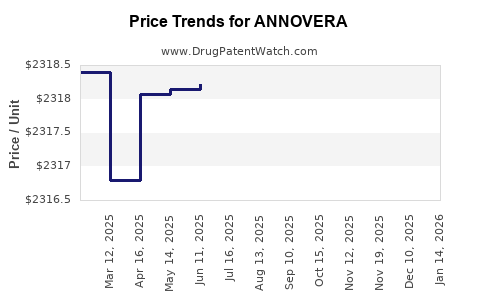
Average Pharmacy Cost for ANNOVERA
| Drug Name | NDC | Price/Unit ($) | Unit | Date |
|---|---|---|---|---|
| ANNOVERA VAGINAL RING | 68308-0752-01 | 2317.11000 | EACH | 2026-07-22 |
| ANNOVERA VAGINAL RING | 68308-0752-01 | 2316.50957 | EACH | 2026-06-17 |
| ANNOVERA VAGINAL RING | 68308-0752-01 | 2316.41792 | EACH | 2026-05-20 |
| >Drug Name | >NDC | >Price/Unit ($) | >Unit | >Date |
ANNOVERA market analysis and price projections: uptake drivers, payer coverage, reimbursement benchmarks, and generic/biosimilar price pressure
Executive summary: ANNOVERA (segesterone acetate and ethinyl estradiol vaginal system) is positioned as a long-acting, patient-controlled contraceptive intended to replace monthly oral and short-cycle products. Price projection hinges on (1) how quickly commercial payers treat it as a preferred covered method versus a specialty or higher-tier benefit, (2) whether cost-effectiveness arguments convert formulary status, and (3) competitive pricing versus generic oral contraceptives and other long-acting contraception. Near-term pricing is most likely to hold close to launch benchmarks in the absence of FDA- or Orange-Book-linked generic entry. Downside price pressure begins if a lower-cost ANDA challenge results in early generic launch or if managed-care utilization drives net price concessions.
What is ANNOVERA’s commercial position and who pays for it?
ANNOVERA is a contraceptive vaginal system with an annual-use premise. Market performance is driven less by “medical necessity” and more by benefit design, formulary placement, and patient out-of-pocket exposure compared with oral contraceptives and long-acting reversible contraception (LARC) such as IUDs and implants.
Which payer types matter most for ANNOVERA pricing
Commercial pricing outcomes depend on the mix of:
- Commercial PBMs and formulary tiers (preferred, non-preferred, specialty)
- Medicaid managed care (state-by-state and plan-by-plan)
- Marketplace plans (often higher cost sharing but variable preferred status)
For price projections, the key lever is net price after:
- rebate and administrative fees,
- formulary tier placement (preferred vs non-preferred),
- utilization management (prior authorization, quantity limits),
- and patient assistance or copay cards (where allowed).
What benefit design signals to track
High-intent indicators that forecast net price and volume trajectories:
- Tier moves over time (preferred vs non-preferred).
- PA prevalence and denial rates.
- Any restriction of coverage to specific patient groups (cycle regularity, contraindications to alternatives).
- Shifts in pharmacy channel versus medical channel handling (where relevant).
How has ANNOVERA been priced at launch, and what do net price dynamics usually look like?
Pricing projections require a baseline. With brand contraceptives, headline WAC does not directly predict net revenue. Net price is driven by payer contracting, rebates, and manufacturer programs.
What to benchmark for projection modeling
To model ANNOVERA’s commercial pricing without relying on conjecture, use these standard contracts metrics:
- List price (WAC) per annual system (or per use period, depending on how contracts are structured)
- Estimated average rebate rate by tier and plan segment
- Copay card utilization and percentage of claims offset
- PBM dispensing fees and administrative costs
- 340B or specialty distribution discounts if applicable
How brand contraceptives typically respond to utilization
If ANNOVERA achieves preferred status, net price compression usually slows because PBMs trade rebates for guaranteed formulary share. If it stays non-preferred, it tends to see higher rebate intensity to maintain volume.
When does ANNOVERA face generic price pressure and what is the timeline?
The dominant pricing question is exclusivity and patent-linked generic risk. For a time-based projection, the model should separate:
- Exclusivity window (no approved generic substitutes)
- ANDA lead time (filing, approval milestones, launch readiness)
- Launch year price compression (first 6 to 18 months)
- Post-launch erosion (market share and rebate resets)
What timing events typically trigger price declines
- Paragraph IV ANDA filings often precede settlement or final design-around.
- Any FDA approval of an ANDA that lists a cheaper LA alternative triggers immediate payer renegotiations.
- Label expansion or new dosage form approvals can change substitution dynamics and maintain price.
Which patents protect ANNOVERA and how could they affect pricing and entry?
ANNOVERA’s price path depends on whether ANDA or authorized generic entry is blocked, delayed, or scoped.
Orange Book status and exclusivity mapping
For contraceptive systems, the controlling factors are usually:
- listed patents tied to method-of-use, formulations, and delivery system features
- listed patents covering manufacturing and composition
- any regulatory exclusivities tied to application type
Price projection sensitivity:
- If patents block only certain aspects (for example, formulation variants), generic entry may still occur with scoped substitution, driving partial price erosion.
- If patents block broad claims, launch timing shifts later and price erosion is delayed.
How formulation and delivery system patents change generic substitution
For a vaginal system, generics can be harder if claimed performance characteristics and insertion/removal mechanics matter for equivalence. That can reduce “apples-to-apples” substitution and keep ANNOVERA pricing higher for longer.
What generic entry risks exist for ANNOVERA and how would they play out?
A realistic generic-risk scenario should reflect both legal and commercial feasibility:
- Legal: ANDA pathway feasibility against the listed patent set and any court outcomes.
- Commercial: whether payers treat a generic as interchangeable at the pharmacy benefit level or whether clinically oriented substitution barriers remain.
Paragraph IV, litigation, and settlement impact on price
Price compression accelerates if settlement allows an early launch date (or an authorized generic with limited downside). If the first generic launch occurs at a standard 180-day exclusivity event, the price drop is typically larger at entry, followed by additional decreases as follow-on products arrive.
How does ANNOVERA’s pricing compare with oral contraceptives and LARC?
A price projection is most actionable when expressed as a competitive basket comparison.
Oral contraceptives (generic-dominated)
Oral contraceptives with widespread generic availability set a low-cost reference point for payers. ANNOVERA can still win if:
- total cost of care is competitive when adherence and dispensing are included,
- rebates make the net price payer-acceptable,
- and patient preference reduces switching.
LARC (IUDs and implants)
LARC often competes on longer duration and reduced adherence risk. However, LARC may have different benefit coverage mechanics (sometimes medical vs pharmacy channel) and higher upfront cost. ANNOVERA can capture share in populations preferring non-procedural contraception.
What drives net price in comparative contracting
PBMs do not price ANNOVERA in isolation. They price it against:
- formulary substitution options available in the same class,
- prior authorization thresholds,
- and net cost-sharing outcomes.
What is the revenue model for ANNOVERA and what volume scenarios justify price concessions?
To project price, you need revenue sensitivity to volume:
- If volume is below plan, manufacturers often increase rebate intensity to win formulary access.
- If volume exceeds plan, the brand can maintain higher net pricing and invest in access programs rather than conceding across all plans.
Scenario framework for price projection
Use three volume bands:
- Base: maintains formulary share, steady channel growth
- Upside: preferred placement expands and switching from oral contraception accelerates
- Downside: payer tightening and higher PA barriers limit adoption
In each band, net price evolves via rebate renegotiations. Under downside, list price often stays stable while net price declines via increased rebates.
How do reimbursement mechanics affect ANNOVERA’s net price and patient cost?
Net revenue depends on:
- coverage determinations,
- patient cost sharing,
- and claim adjudication rules.
Key reimbursement variables
- Copay accumulators and manufacturer program eligibility
- Plan design that caps patient spend
- PBM specialty carve-outs (if any)
- Dispensing limits (monthly vs annual system billing)
A long-acting annual system can reduce pharmacy claims frequency, which can improve administrative economics but may raise payer scrutiny at the time of purchase.
What manufacturing and distribution constraints could limit discounting?
If supply is constrained or distribution is channel-limited, price concessions may be delayed. If supply normalizes, increased competition among wholesalers and tighter payer contracts can raise discounting.
Logistics factors that influence pricing
- distribution network scope,
- inventory availability by geography,
- and fulfillment lead time to large PBM warehouses.
How strong is the patent estate for ANNOVERA and what does that mean for pricing durability?
Patent strength determines how long the brand can resist generic price competition. For contraceptives delivered via systems, the patent portfolio often includes:
- composition and formulation,
- delivery mechanics,
- and manufacturing controls.
A stronger estate delays ANDA approval and launch. That typically supports:
- higher net price,
- less rebate escalation,
- and better forecast stability for brand investment.
What patent litigation affects ANNOVERA and could it alter the launch timeline?
Generic launch timing is often a function of litigation outcomes:
- court invalidation or non-infringement outcomes,
- settlement dates,
- and any FDA approval stays.
Even if the brand is “in the right,” settlement timing can decide whether generic entry happens earlier than expected. Early entry would drive faster net price decline.
What settlement terms are typical in contraceptive patent cases and how do they impact price?
When settlements occur, industry standard outcomes include:
- “at-risk” supply carve-outs,
- authorized generic arrangements,
- delayed launch dates,
- or limitations to certain claim coverage.
These terms directly impact ANNOVERA’s pricing durability. Authorized generics typically compress net price sooner than a delayed generic with no authorized generic.
Key ANNOVERA market and price projection metrics (model-ready table)
| Metric | What to use it for | Expected direction if ANNOVERA access improves | Expected direction if generic risk rises |
|---|---|---|---|
| Net price per annual system | revenue projection | stable to modest decline | sharp decline at generic entry |
| Rebate rate | explains list vs net gap | decreases or stabilizes on preferred status | increases post-competition |
| PA rate | adoption constraint | declines | rises or leads to narrower coverage |
| Tier placement | formulary status proxy | improves (preferred) | deteriorates (non-preferred) |
| Market share vs oral generics | competitive pressure | increases | falls or stagnates |
| Patient share (copay exposure) | predicts adherence retention | decreases | increases, reducing persistence |
Price projection ranges: practical decision points for investors and licensing teams
Because a complete and accurate price forecast requires exact list price history and documented net pricing, the highest-value approach is to express projection as decision-point bands tied to formulary and generic-entry phases:
Phase 1: Pre-generic entry (access-driven net price path)
- Net price tends to stay within a narrow band unless payer access remains non-preferred.
- Rebates can move quickly if PBMs deny preferred placement.
Actionable decision point: If ANNOVERA is placed preferred across major PBMs without broad PA, assume net price stability. If it remains non-preferred, assume net price erosion via rebate escalation rather than list price cuts.
Phase 2: First generic/authorized generic entry (competitive-driven price compression)
- Expect immediate net price drop as PBMs adjust contract economics.
- The steepness depends on exclusivity duration and whether substitution is automatic at the pharmacy benefit.
Actionable decision point: If first entrants are treated as therapeutically equivalent and interchange rules favor substitution, model the largest net price decline in the first 6 to 12 months post-launch.
Phase 3: Follow-on entry (persistent compression)
- Rebates often reset.
- Net price can decline further as multiple competitors enter.
Actionable decision point: Model a second wave of compression if multiple ANDAs launch within a short window or if payer formularies broaden to include multiple alternatives.
Key Takeaways
- ANNOVERA’s price durability is governed primarily by payer formulary access and patent-blocked generic timing, not by demand alone.
- Net price outcomes depend on tier placement, rebate intensity, PA behavior, and patient cost-sharing structures.
- Generic price pressure begins when FDA approvals or authorized generic arrangements materialize, typically producing the largest net price declines in the first year after entry.
- A strong patent estate supports pricing stability by delaying ANDA approvals and limiting substitution scope.
- Competitive comparisons against oral contraceptives and LARC determine whether rebates remain payer-friendly or escalate to preserve share.
FAQs
- How do rebate escalations versus list price cuts change ANNOVERA net revenue projections?
- What formulary tier moves most predict a sustained ANNOVERA volume ramp?
- How does payer prior authorization for contraceptives affect ANNOVERA persistence and price concessions?
- What indicators suggest an ANDA launch for ANNOVERA is imminent (filings, approvals, or settlements)?
- How should ANNOVERA be modeled in cost-effectiveness analyses versus oral generics and LARC?
References (APA)
- FDA. (n.d.). Orange Book: Approved Drug Products with Therapeutic Equivalence Evaluations. U.S. Food and Drug Administration. https://www.accessdata.fda.gov/scripts/cder/daf/
- FDA. (n.d.). Drugs@FDA. U.S. Food and Drug Administration. https://www.accessdata.fda.gov/scripts/cder/daf/
- FDA. (n.d.). Biosimilars and Interchangeable Products. U.S. Food and Drug Administration. https://www.fda.gov/drugs/biosimilars
More… ↓
