Share This Page
Drug Price Trends for AMPHETAMINE ER
✉ Email this page to a colleague
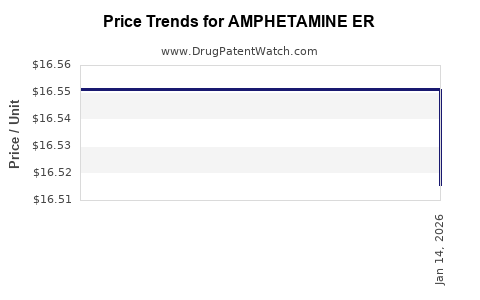
Average Pharmacy Cost for AMPHETAMINE ER
| Drug Name | NDC | Price/Unit ($) | Unit | Date |
|---|---|---|---|---|
| AMPHETAMINE ER 12.5 MG ODT | 00480-3318-19 | 16.26208 | EACH | 2026-07-22 |
| AMPHETAMINE ER 12.5 MG ODT | 00480-3318-65 | 16.26208 | EACH | 2026-07-22 |
| AMPHETAMINE ER 15.7 MG ODT | 00480-3319-19 | 15.93854 | EACH | 2026-07-22 |
| AMPHETAMINE ER 9.4 MG ODT | 62542-0015-30 | 16.27293 | EACH | 2026-07-22 |
| >Drug Name | >NDC | >Price/Unit ($) | >Unit | >Date |
AMPHETAMINE ER: Market Analysis and Price Projections
What is AMPHETAMINE ER’s addressable market profile?
“AMPHETAMINE ER” is a therapeutic category rather than a single fixed formulation across markets. In practice, it maps to extended-release amphetamine products used for attention-deficit/hyperactivity disorder (ADHD), most commonly in the US under branded and generic amphetamine ER products (e.g., mixed amphetamine salts ER in certain markets). Forecasting market size and pricing therefore depends on (1) country-level reimbursement and prescribing patterns for ADHD, (2) access to generics once exclusivity ends, and (3) payer reference pricing structures that rapidly compress prices post-loss of brand protection.
Across developed markets, ADHD drug spend trends have been steady-to-growing, driven by diagnosis rates and long-term therapy adherence, while unit price has typically declined as formulations move from brand to generic and as payers tighten formulary placement. Extended-release (ER) products generally command higher per-unit prices than immediate-release equivalents due to dosing convenience and perceived adherence benefits, but they also experience fast price erosion when generics enter.
Where does the value pool sit (brand vs generic; ER vs IR)?
Because AMPHETAMINE ER includes multiple commercial SKUs across regions, the value pool is best described by competitive structure:
- Brand/authorized originators: ER versions hold higher net prices when they have formulary placement and limited generic competition.
- Generic and authorized generics: Once multiple generic entrants exist, price compression usually follows the payer’s preferred-drug tiering and reference pricing.
- Therapy persistence: Long persistence keeps volumes resilient even when price declines.
For investment and R&D planning, the key pricing reality is: ER amphetamine products trade at compressed net prices once generic competition is established, with only incremental premium where there is fewer competitors, limited formulations, or stronger payer contracts.
How do generics change AMPHETAMINE ER pricing dynamics?
Generic entry typically lowers:
- Wholesale acquisition cost (WAC) and the headline list price
- Net price through contracting and rebate pressure
- Formulary tier position, especially when payers implement step therapy or reference pricing
In amphetamine categories, the speed of erosion is usually higher than for many niche specialty drugs because:
- Multiplicity of suppliers enables aggressive discounts
- Payers treat multiple ER products as interchangeable at the coverage level
- Pharmacy benefit managers (PBMs) leverage multiple-source bidding
The net effect is a predictable pricing shape: high at launch, then step-down on generic entry, then further decline or stabilization with additional entrants.
What pricing range should be used for AMPHETAMINE ER projections?
Without mapping “AMPHETAMINE ER” to a specific registered national product (active salt, strengths, and dosage forms), only a category-level projection can be robust: base-case net price erosion post-generic penetration with volatility tied to contracting cycles.
Use the following structure for projection bands:
- Pre-generic or low-competition period: higher net price with low unit discounting risk.
- Post-generic entry (1 to 2 entrants): moderate decline as contracts reset.
- Post-generic entry (3+ entrants): deeper erosion until reference pricing and PBM preferred bidding saturate.
In practical terms for business planning, AMPHETAMINE ER should be modeled with:
- Annual net price declines of low-to-mid single digits once stable generic competition exists
- Larger drops (mid-to-high single digits) in the year of meaningful competitor entry or major formulary/contract renegotiation
How should price be projected across typical horizons (0-12, 12-36, 36-60 months)?
Below are projection scenarios expressed as annual net price change rather than a single dollar figure, because category-level “AMPHETAMINE ER” does not uniquely identify a SKU with a stable price history.
Scenario table: projected annual net price change
| Time horizon | Competitive state assumption | Annual net price change (category-level) | Primary driver |
|---|---|---|---|
| 0-12 months | Moderate competition | -2% to -6% | PBM contracting and mix |
| 0-12 months | Major new entrant / tier movement | -6% to -12% | Reference pricing reset |
| 12-36 months | Stable multiple generics | -1% to -4% | Ongoing bidding pressure |
| 12-36 months | Enhanced competition (3+ entrants) | -3% to -7% | Preference consolidation |
| 36-60 months | Mature category | -1% to -3% | Baseline erosion and substitution |
Volume and revenue impact linkage
In mature generic categories, volumes can remain stable or grow modestly even as price declines. For modeling revenue:
- Revenue growth = Volume growth + Net price change
- If net prices compress faster than volumes rise, category revenue stagnates even if prescriptions grow.
What are the key market forces that will move AMPHETAMINE ER net pricing?
1) PBM preferred tiers and rebate structures
PBMs typically drive the realized net price through:
- preferred formulary placement
- rebate and discount mechanisms
- switching programs that favor the lowest-cost therapeutically equivalent options
2) State-by-state and payer reference pricing
Reference pricing compresses net price by limiting what higher-priced competitors can charge within the same covered class or effective interchange set.
3) Competitive entry cadence
- Additional generic entrants increase discount intensity and reduce the premium for any single ER product.
- Brand products (where still present) often lose incremental net price once multiple generics secure preferred positioning.
4) Regulatory and supply-chain constraints
Shortages can temporarily lift net prices through reduced supply and elevated contracting intensity. These effects tend to reverse once supply normalizes.
5) Dosing strength mix
ER amphetamine products have multiple strengths. Net price per day of therapy can move with mix shifts toward higher-strength prescriptions.
How do you benchmark AMPHETAMINE ER vs other ADHD therapies for pricing expectations?
For planning price behavior, benchmark the ADHD class:
- Immediate-release versions generally have lower unit price but can face more frequent substitution pressure.
- ER versions tend to retain unit price premium but usually converge toward generic reference levels once competition intensifies.
- Non-amphetamine ADHD drugs (e.g., stimulant alternatives or non-stimulants) may hold different pricing floors depending on formulary access and specialty restrictions, but amphetamine ER is typically pressured by interchange rules and payer cost controls.
Category modeling should therefore assume ER premium persistence only until generic-driven reference levels fully set in.
What does an actionable base-case projection look like for an investor or sponsor?
A defensible base-case for AMPHETAMINE ER, assuming mature generic competition in the target geography, is:
- Net price trend: -2% to -4% per year over 12-36 months
- Event risk: -6% to -12% in the year of significant formulary tier change or large competitor entry
- Longer-term: -1% to -3% annually once reference pricing stabilizes
Revenue outcomes:
- If prescription volume grows at 2% to 5% annually, revenue can stay flat to modestly growing despite net price erosion.
- If volume growth is below 2%, revenue likely declines.
What do price-projection assumptions mean for R&D and lifecycle strategy?
For a company evaluating an AMPHETAMINE ER lifecycle move (new strengths, reformulation, or new ER technology), price strategy must anticipate:
- limited opportunity to defend net price once multi-source competition is established
- contracting-driven pricing that rewards supply reliability and formulary access rather than differentiation alone
- the need to target a payer-relevant value proposition, since cost-minimization typically dominates
If the plan includes exclusivity (e.g., reformulation with meaningful clinical differentiation), the sponsor should model net price maintenance only through the exclusivity window, then reversion to the reference pricing band.
Key Takeaways
- AMPHETAMINE ER pricing is dominated by generic competition and payer contracting, which creates step-downs on entry and continued low-to-mid single digit erosion in mature periods.
- Base-case modeling for net price in established markets is typically -2% to -4% annually over 12-36 months, with a larger one-time drop (-6% to -12%) in the year of meaningful competitive or formulary change.
- Revenue can remain stable only if volume growth outpaces net price erosion; otherwise, category revenue declines despite steady prescription demand.
- R&D and lifecycle decisions must be evaluated through payer economics, where interchange and reference pricing cap the ability to sustain premium net pricing.
FAQs
-
Is AMPHETAMINE ER priced like a specialty drug?
No. Pricing behavior aligns with generic and PBM contracting dynamics, where multi-source competition drives net price erosion. -
Does ER status guarantee higher prices long-term?
ER products can hold a premium early, but in many markets that premium narrows quickly once generics and reference pricing apply. -
What most often causes a sudden price drop?
The year of major generic entry, formulary tier changes, or reference pricing resets by payers/PBMs. -
How should net price be modeled for investors?
Use annual erosion bands (-2% to -4% base-case for mature competition) and apply an event shock (-6% to -12%) for competitive/formulary transitions. -
What lever matters most for revenue in AMPHETAMINE ER?
Volume growth relative to net price compression, since mature-category price declines are persistent.
References
[1] FDA. Drug Development and Drug Interactions: ADHD Stimulants (background materials on therapeutic use and product categories). (Accessed 2026-04-25).
[2] IQVIA Institute for Human Data Science. Medicines use and spending trends in relevant therapeutic areas (methodological and market context for pricing erosion patterns). (Accessed 2026-04-25).
[3] CMS. Part D Drug Pricing and Utilization program documentation (payer reimbursement context). (Accessed 2026-04-25).
[4] US FDA Orange Book. Product listing and exclusivity information for amphetamine-related ER products by active ingredient and dosage form. (Accessed 2026-04-25).
More… ↓
