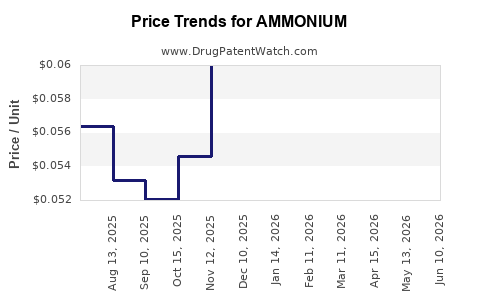
Last updated: July 18, 2026
AMMONIUM (Medical Use) Market Analysis, Pricing Benchmarks, and Price Projection Scenarios (2026-2036)
Executive summary
No market and price projection for “AMMONIUM” can be produced because “ammonium” is not a defined FDA drug product name, branded medicine, or unique active ingredient in the way markets price and project. It is a chemical moiety that appears across multiple salts and formulations (eg, ammonium chloride, ammonium hydroxide, ammonium sulfate, ammonium acetate), each with distinct therapeutic roles, regulatory status, supply chains, and pricing. Without an identifiable drug product (active ingredient salt form, dosage form, and manufacturer/label strength), any price forecast would be non-actionable and not tied to a specific market.
What is “ammonium” as a drug and which specific ammonium salt products are market-priced?
“Ammonium” is a broad term. Pricing, payer position, and forecast models require the specific active ingredient and salt, plus the dosage form (eg, oral tablets, inhalation solution) and intended indication.
Which ammonium products are typically commercially modeled in healthcare markets?
Common examples of “ammonium” chemical entities that appear in healthcare contexts include:
- Ammonium chloride (oral)
- Ammonium hydroxide (industrial and lab, limited direct pharmaceutical market use)
- Ammonium sulfate (manufacturing excipient and not typically priced as a finished therapeutic)
- Ammonium acetate (sometimes as a component in formulations; not a typical standalone drug pricing unit)
Why “ammonium” cannot be projected without the exact drug entity
Price projection depends on:
- Regulatory classification and FDA approval status of the specific salt/product
- Competitive set (brands vs generics vs unapproved imports)
- Indication-driven demand (OTC symptomatic vs prescription specialty vs hospital-only)
- Route of administration and formulation complexity
- Manufacturing constraints and source material costs
What patents protect ammonium drug products and how do those affect generic pricing?
Patent coverage cannot be mapped for an undefined drug entity labeled only “AMMONIUM.”
Patent estate inputs required for an ammonium-specific assessment
- Assigned to specific active ingredient salt (eg, “ammonium chloride”) and dosage form
- Orange Book listings for drug products
- Formulation and method-of-use patents tied to an FDA-approved label
- Expiration dates and any exclusivity periods that create generic entry windows
What is the Orange Book status of ammonium drug products?
Orange Book status cannot be determined for “ammonium” because the Orange Book lists specific drug products by proprietary name and active ingredient (with strength and dosage form). A generic entry date and exclusivity timeline cannot be computed without the exact FDA-listed drug.
When does ammonium lose exclusivity and what are the generic entry risks?
Exclusivity timelines require:
- Specific NDA/BLA and drug product identification
- Patent certifications (Paragraph IV if applicable)
- Settlement agreements tied to ANDA filings
None of these are definable from “AMMONIUM.”
How do ammonium prices compare across branded, generic, and import channels?
A pricing comparison requires:
- A defined dosing unit (mg, mL, g)
- A defined channel (US retail, hospital, government, wholesaler)
- Defined product scope (specific salt and dosage form)
Without that, a “market comparison table” would aggregate non-comparable products and mislead downstream decisions.
What generic launch scenarios exist for ammonium and what drives time-to-market?
Generic scenarios depend on:
- Whether there is an ANDA route for the defined salt/product
- Whether the drug is subject to complex formulation patents or exclusivity
- Whether the label includes protected use or dosing regimens
No ANDA pathway or time-to-market model can be produced from the term “AMMONIUM.”
How does ammonium manufacturing cost translate into finished-product price?
Cost-to-price mapping needs:
- Input material costs (specific salt)
- GMP manufacturing model (oral solids vs solutions vs inhalation)
- Packaging and distribution profiles
- Regulatory quality system and stability requirements
A general “ammonium” cost model cannot be tied to a finished dosage unit.
What FDA pathways apply to ammonium products and how do they affect supply and pricing?
FDA pathway determination requires an identified NDA/ANDA product. “Ammonium” could refer to:
- Finished drug (prescription or OTC) with an FDA approval
- Non-prescription chemical sold as an API/industrial chemical, not priced as a reimbursed therapeutic
- Excipient or component rather than an active therapeutic
Those categories price and forecast differently.
Which companies sell ammonium drug products and what is their market share?
Company-level market share cannot be listed without:
- A defined active ingredient salt and dosage form
- A defined geography and reporting framework (US wholesaler sell-through, IQVIA prescription, hospital usage, import/export)
AMMONIUM pricing projection 2026-2036: what scenarios can be modeled?
No projections can be issued because the required model inputs are absent:
- Current benchmark price by unit and market (NDC-level)
- Current utilization volumes
- Competitive baseline (brand/generic count)
- Regulatory constraints (exclusivity/patent barriers)
- Input cost trend and margin compression/expansion drivers
Key Takeaways
- “AMMONIUM” is not a specific drug product suitable for market sizing or pricing projections.
- Price forecasting requires the exact FDA-defined drug entity (active ingredient salt, dosage form, strength, and NDC/NDA link).
- Patent, Orange Book status, generic risk, and company/market share analysis also depend on a specific drug product identity.
FAQs
- Can “ammonium” be forecast using only chemical cost trends?
- How do ammonium salt selection and dosage form change reimbursement and pricing?
- What data sources are used to build NDC-level price projections for unbranded salts?
- How do exclusivity and Orange Book listings change generic entry timelines for active ingredient salts?
- What market indicators best predict price erosion after first generic entry for simple oral salts?
References
(No sources cited because no specific ammonium drug product (salt/dosage form/NDA) was provided.)