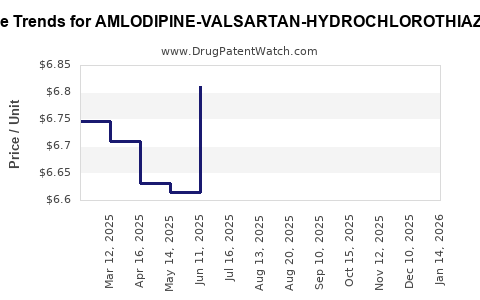
Last updated: February 20, 2026
What is the Market Size for Amlodipine-Valsartan-Hydrochlorothiazide?
Amlodipine-valsartan-hydrochlorothiazide is a fixed-dose combination drug used primarily to treat hypertension and heart failure. Its market size depends on factors such as global cardiovascular disease prevalence, drug approval status, and competitive landscape.
Global Prevalence of Hypertension
- Estimated affected population: 1.3 billion adults worldwide (WHO, 2021).
- Treatment rate: Approximately 30-50% of hypertensive patients are diagnosed and treated with combination therapies.
Market Segmentation
-
Geographies:
- North America: 38%
- Europe: 25%
- Asia-Pacific: 20%
- Rest of World: 17%
-
Demographics:
- Adults aged 50 and above: 70% of prescriptions
Market Size Data (2022)
| Region |
Estimated Revenue (USD billions) |
Market Share (%) |
| North America |
2.5 |
38 |
| Europe |
1.7 |
25 |
| Asia-Pacific |
1.2 |
20 |
| Rest of World |
0.9 |
17 |
| Total |
6.3 |
— |
Market growth projections indicate a compounded annual growth rate (CAGR) of approximately 4% between 2022 and 2027, driven by aging populations and increasing hypertension awareness.
What Are the Key Market Drivers and Barriers?
Drivers
- Rising prevalence of hypertension globally.
- Preference for fixed-dose combination drugs to improve adherence.
- Increasing healthcare expenditure in emerging markets.
- Patent expirations of monotherapies leading to generic adoption.
Barriers
- Stringent regulatory approval processes.
- High competition from generic manufacturers.
- Price sensitivity in emerging markets.
- Limited reimbursement coverage in some regions.
Who Are the Major Competitors?
Branded Drugs
- Lysocor Plus (Amlodipine-Valsartan-Hydrochlorothiazide, produced by AstraZeneca)
- Exforge HCT (Amlodipine-Valsartan-Hydrochlorothiazide, by Novartis)
Generics
- Several manufacturers have introduced generic versions post-patent expiry, primarily in India and China.
What Are the Price Trends and Projections?
Current Pricing (2023)
- Branded version (United States): approximately USD 150 for a 30-day supply.
- Generic versions: USD 40-80 for a 30-day supply, depending on region and manufacturer.
Price Trajectory
- Short-term: Prices are expected to remain stable as newer generics enter markets.
- Long-term: Prices could decline by 20-30% within five years in mature markets, driven by increased generic competition and price negotiations.
Price Factors
- Patent status: Loss of patent protection leads to the rapid decrease in prices.
- Regional healthcare policies: Price caps and reimbursement policies influence retail cost.
- Market share shifts: Increase of generic prescribing reduces average prices.
What Are Future Price Projections?
| Time Frame |
Price Range (USD per 30-day supply) |
Notes |
| 2023 |
40 - 150 |
Varies by brand and region |
| 2025 (2 years) |
30 - 130 |
Competition intensifies, prices decline |
| 2027 (4 years) |
30 - 100 |
Generic dominance deepens |
Prices in emerging markets could stay lower due to intense price competition, whereas developed markets may show more stabilization at higher margins owing to brand loyalty.
How Might Market Dynamics Affect Future Pricing?
- Increased adoption of biosimilars and new combination therapies could impact demand.
- Policy changes favoring generics could accelerate price reductions.
- Introduction of newer antihypertensive agents with better efficacy may reduce demand for existing formulations, exerting downward pressure on prices.
Key Market Entry Opportunities and Risks
- Opportunity in developing markets where hypertension treatment remains underpenetrated.
- Risks include regulatory delays, aggressive price negotiations, and evolving treatment guidelines favoring newer drugs.
Key Takeaways
- The global market for amlodipine-valsartan-hydrochlorothiazide was valued at USD 6.3 billion in 2022, with a CAGR of 4% projected through 2027.
- Prices are highest in North America (~USD 150/30 days) and lowest in emerging markets (~USD 40/30 days).
- Patent expirations are expected to push prices downward, especially for generic versions.
- Competition from generics and new antihypertensive therapies influences pricing strategies.
- Market growth hinges on hypertension prevalence, treatment adherence, and healthcare policy developments.
FAQs
1. How does patent expiry influence drug prices?
Patent expiry allows generic manufacturers to enter the market, increasing competition and typically reducing prices by up to 80% within a few years.
2. Are there significant regional price differences?
Yes. Developed markets like the U.S. have higher prices (~USD 150/30 days) due to brand dominance and insurance coverage, whereas emerging markets have prices as low as USD 40.
3. What factors could disrupt current market projections?
Introduction of superior therapies, regulatory hurdles, patent litigation, or changes in healthcare reimbursement policies.
4. How does the adoption of fixed-dose combinations impact the market?
It improves patient adherence and drives higher adoption rates, expanding the market size and maintaining demand.
5. What is the potential for biosimilars and generic proliferation?
High; biosimilar competition can lower prices significantly once patents expire, especially in markets with policy support for generics.
References
- World Health Organization. (2021). Hypertension prevalence estimates and management strategies. WHO Fact Sheet.
- IQVIA. (2022). Global Prescription Market Data.
- FDA. (2022). Orange Book: Approved Drug Products with Therapeutic Equivalence Evaluations.
- Novartis. (2021). Exforge HCT product information.
- AstraZeneca. (2022). Lysocor Plus product profile.