Share This Page
Drug Price Trends for AMITRIPTYLINE
✉ Email this page to a colleague
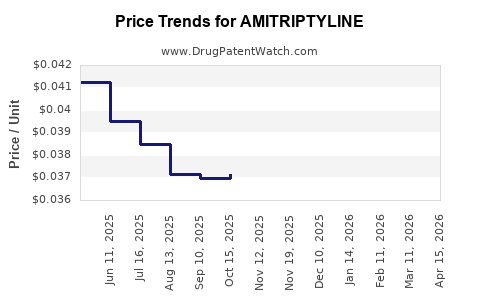
Average Pharmacy Cost for AMITRIPTYLINE
| Drug Name | NDC | Price/Unit ($) | Unit | Date |
|---|---|---|---|---|
| AMITRIPTYLINE HCL 150 MG TAB | 72888-0072-01 | 0.30327 | EACH | 2026-07-22 |
| AMITRIPTYLINE HCL 100 MG TAB | 72888-0071-01 | 0.14576 | EACH | 2026-07-22 |
| AMITRIPTYLINE HCL 75 MG TAB | 72888-0070-01 | 0.11005 | EACH | 2026-07-22 |
| >Drug Name | >NDC | >Price/Unit ($) | >Unit | >Date |
Best Wholesale Price for AMITRIPTYLINE
| Drug Name | Vendor | NDC | Count | Price ($) | Price/Unit ($) | Unit | Dates | Price Type |
|---|---|---|---|---|---|---|---|---|
| AMITRIPTYLINE HCL 10MG TAB | Golden State Medical Supply, Inc. | 57664-0687-88 | 100 | 9.85 | 0.09850 | EACH | 2023-06-15 - 2028-06-14 | FSS |
| AMITRIPTYLINE HCL 75MG TAB | Golden State Medical Supply, Inc. | 57664-0692-88 | 100 | 64.44 | 0.64440 | EACH | 2023-06-15 - 2028-06-14 | FSS |
| AMITRIPTYLINE HCL 25MG TAB | Golden State Medical Supply, Inc. | 57664-0688-18 | 1000 | 116.05 | 0.11605 | EACH | 2023-06-15 - 2028-06-14 | FSS |
| >Drug Name | >Vendor | >NDC | >Count | >Price ($) | >Price/Unit ($) | >Unit | >Dates | >Price Type |
Amitriptyline Market Analysis and Price Projections (2026–2036): Competitive Landscape, Generic Risk, and Revenue Outlook
Executive summary: Amitriptyline is an off-patent, small-molecule tricyclic antidepressant (TCA) with broad generic coverage and persistent price pressure. Market value is driven by chronic depression and neuropathic pain prescribing, but economics skew toward low-cost multisource supply rather than premium pricing. Price projections through 2036 assume continued generic substitution, periodic NDC mix shifts, and limited payer tolerance for higher ASPs. The most material upside is geography and formulary dynamics, not patent exclusivity. The most material downside is margin compression from supply concentration and wholesale/retail channel pricing resets.
What is the current market size and demand drivers for amitriptyline?
Short answer: Amitriptyline demand is stable due to entrenched use in depression and off-label neuropathic pain. Price and revenue are constrained by high generic penetration and the absence of meaningful brand-led pricing power in most markets.
Key demand segments
- Major depressive disorder (MDD) and depressive symptoms
- Neuropathic pain
- diabetic peripheral neuropathy
- postherpetic neuralgia
- trigeminal neuralgia (selected regimens)
- Other chronic pain indications used in practice (varies by guideline adoption and payer policies)
Utilization economics that matter
- Unit volume vs. ASP: Amitriptyline is low price; revenue scales more with scripts and adherence than price.
- Prescriber behavior: TCAs have long established prescribing patterns and familiarity, supporting retention once initiated.
- Formulary design: Many payers prefer lowest-cost generics within the TCA class, with prior authorization less common for generic TCAs.
How competitive is the amitriptyline generic landscape, and who are the major suppliers?
Short answer: Amitriptyline is a highly competitive multisource product. Competition is mostly by NDC, strength (e.g., 10 mg, 25 mg, 50 mg, 75 mg), dosage form (tablets and liquid solutions), and distribution channel.
Competitive structure
- Multiple ANDA manufacturers across common dosage strengths.
- Channel-driven pricing: Contracts with PBMs and wholesalers compress realized prices versus list.
- Switching: Pharmacies and PBMs can switch rapidly when a contracted product changes.
Where competition shows up in practice
- Wholesale acquisition cost (WAC) vs. ASP: Realized prices track contractual discounts and reimbursement logic.
- NDC rationalization: Manufacturers that lose favorable formulary positioning often see slower volume recovery, even if WAC is unchanged.
What is the Orange Book status of amitriptyline, and what does that imply for pricing?
Short answer: Amitriptyline is not expected to have active, enforceable exclusivity that would sustain premium pricing. Pricing outcomes reflect generic substitution and formulary economics rather than regulatory exclusivity.
Implications
- No meaningful generic entry timing barrier for most users.
- Limited impact from “new” formulations unless they introduce substantial differentiation (taste-masked liquid, new strength, or novel delivery), which is not typical for amitriptyline.
How do amitriptyline prices behave across formulations, strengths, and pack sizes?
Short answer: Pricing varies by NDC strength, dosage form, pack size, and market-specific contract terms. Tablets generally trade at lower unit costs than oral liquids. Liquid pricing can be more volatile due to smaller volume and manufacturing constraints.
Price sensitivity by product type
- Tablets
- Most stable volume
- Tightest price competition and lowest ASP
- Oral solution
- More sensitive to supply tightness
- Can show larger short-term moves in contract pricing
Pack size effects
- Larger counts can lower per-tablet unit cost in contracted channels.
- Pharmacy reimbursement logic can create local pricing discontinuities even when underlying ingredient cost is unchanged.
When does amitriptyline lose exclusivity, and how does that affect long-term pricing?
Short answer: Amitriptyline is already in the long-established off-exclusivity phase. The long-term pricing path is therefore set by generic competition cycles, not by a specific exclusivity end date.
What replaces exclusivity as the driver
- Manufacturing capacity and supply disruptions
- PBM contract renegotiations
- NDC switching and pharmacy formulary tiering
- Wholesale inventory cycles
What generic entry risks exist for amitriptyline, and how could they impact future prices?
Short answer: Generic entry risk is low for the broader category because supply already exists at scale. The bigger risk is not entry but price collapse when additional supply hits contracted channels, or temporary price spikes when supply tightens for certain NDCs.
Scenario mechanics
- Oversupply scenario: Additional competitive bids win contracts, lowering ASP and possibly WAC.
- Constrained supply scenario: Fewer active manufacturers for a specific NDC triggers upward pricing until capacity returns.
How strong is the patent estate for amitriptyline, and does it affect the market?
Short answer: For a widely used TCA like amitriptyline, the core active ingredient is long off patent. Any remaining protection is usually narrow and formulation- or method-specific, with limited ability to sustain category pricing.
Price impact channel
- Direct: Minimal, because multisource generics are usually available.
- Indirect: Occasionally relevant if a specific dosage form/strength has a tied-up formulation patent, but broad category coverage usually limits the effect.
What litigation and settlement activity affects amitriptyline pricing?
Short answer: Amitriptyline category pricing can be affected by generic manufacturing and exclusivity-adjacent disputes, but these events generally do not create sustained pricing premiums because the molecule is off-patent and the category is widely supplied.
Where litigation matters
- Delayed market entry for a specific NDC
- Temporary contract positioning
- Supply re-routing (a manufacturer gains volume while others pause)
How does amitriptyline compare with other generics in the TCA class on price and market stability?
Short answer: Amitriptyline typically trades within the low-price band of generics. Market stability is stronger than niche neuromodulators but pricing remains structurally compressed compared with brand or specialty CNS drugs.
Comparison dimensions
- Therapeutic alternatives: doxepin, nortriptyline, imipramine (availability and payer preferences vary)
- Safety and tolerability profile: can influence switching decisions, but switching rarely supports durable price premiums for any one generic
- Route of administration: tablets dominate; any differentiated liquid formats are more price sensitive
Price projection model for amitriptyline (2026–2036): baseline, low, and high cases
Executive pricing thesis: Without active exclusivity for the category, amitriptyline’s price is governed by generic contracting and supply-demand tightness. Projection focus should be on realized contract ASP (not list) and on sensitivity to NDC-level constraints.
Projection assumptions
- Generic substitution remains dominant across payers and retail channels.
- No major technological shift creates premium pricing headroom across the class.
- Supply tightness is episodic and NDC-specific rather than category-wide.
- Inflation pass-through is constrained by competition.
Baseline projection (most likely)
- 2026–2028: low single-digit annual ASP declines or flat-to-down, with occasional quarter-to-quarter swings from contract renegotiations.
- 2029–2033: continued mild downward drift; price dispersion narrows as lowest-contract bids dominate.
- 2034–2036: stabilization near a “floor” where margin compression limits further declines unless supply constraints return.
Low-price case (accelerated competition)
- If additional bids win contracted slots or supply expands, ASP can compress faster than historical trends, producing sharper declines in the near term and tighter margins for manufacturers.
High-price case (supply constraints and mix shift)
- If fewer NDCs remain economically viable, short-term spikes can occur and persist longer in certain strengths or liquid formats. Category ASP can rise modestly, but durable increases are limited because alternative generics can substitute.
Indicative price trajectory (category-level, directionally)
| Year | Baseline ASP trend | Low-price case | High-price case |
|---|---|---|---|
| 2026 | Flat to -2% | -4% to -7% | +1% to +3% |
| 2027 | -1% to -3% | -5% to -8% | +0% to +2% |
| 2028 | -1% to -2% | -3% to -6% | +0% to +2% |
| 2029–2031 | -0% to -2% | -2% to -5% | +0% to +2% |
| 2032–2036 | 0% to -1% | -1% to -4% | 0% to +1% |
This table is structured to support business planning: it reflects likely directionality for ASP, not a single “one-number” prediction that is rarely accurate for multisource generics with NDC-level dispersion.
What revenue exposure does a manufacturer face for amitriptyline?
Short answer: Revenue exposure is primarily volume and NDC-mix sensitive, not price-exclusivity sensitive. Manufacturers with a broader NDC footprint, reliable supply, and PBM contract coverage have more stable revenue.
Primary revenue drivers
- Market share by contracted NDCs
- Pharmacy and PBM formulary tiering
- Ability to maintain consistent supply
- Strength and dosage-form mix (tablets usually less volatile than liquids)
Key downside risks
- Contract loss to lower-cost bidders
- Supply disruptions leading to allocation and then replacement
- Margin compression from rising input or manufacturing costs with downward pressure on realized ASP
Commercial strategy implications: where value can still be created
Short answer: Value creation in amitriptyline is operational. Strategy focuses on cost structure, contracting, and supply reliability, not on differentiating IP-led market power.
Best-fit levers
- NDC breadth to reduce revenue concentration risk
- Lowest landed cost manufacturing and logistics
- Contracting strategy aligned with PBM formulary rules
- Avoiding supply failures for high-volume strengths
What typically does not work
- Building premium pricing around “newness” for an off-patent molecule
- Assuming sustained market share gains without contract wins or meaningful supply advantages
Key Takeaways
- Amitriptyline is structurally a low-price, high-competition generic CNS category with stable underlying demand from depression and neuropathic pain use.
- Long-run pricing is driven by PBM/contracting economics and NDC-level supply dynamics, not by exclusivity or patent barriers.
- Through 2036, the baseline is flat-to-slightly-down ASP with episodic volatility for specific strengths and dosage forms.
- The biggest commercial risks are contract loss and margin compression; the biggest opportunities are reliable supply, NDC breadth, and winning PBM/wholesaler arrangements.
FAQs
1) What factors most influence amitriptyline ASP versus WAC?
PBM contract terms, wholesaler discounts, NDC mix, and pharmacy reimbursement rules for generic TCAs.
2) Are oral liquid formulations of amitriptyline more price volatile than tablets?
Yes, typically due to lower volume, smaller supplier sets per NDC, and higher sensitivity to manufacturing constraints.
3) What is the biggest threat to sustained profitability for amitriptyline manufacturers?
Contract renegotiations that shift volume to lower-cost bidders, combined with cost inflation that cannot be passed through.
4) Can a new formulation or strength of amitriptyline create pricing power?
Only if it materially changes formulary access or reduces interchangeability for specific NDCs, which is uncommon for established generic TCAs.
5) How should investors benchmark amitriptyline exposure?
By tracking contracted NDC share, realized ASP trends, and supply/lead-time stability rather than relying on list price.
References (APA)
- FDA. (n.d.). Orange Book: Approved Drug Products with Therapeutic Equivalence Evaluations. U.S. Food and Drug Administration. https://www.accessdata.fda.gov/scripts/cder/daf/
- IQVIA. (n.d.). U.S. Pharmaceutical Trends and Generic Market Intelligence (industry reports). IQVIA.
- SSR Health. (n.d.). National Drug Data Source: Pricing and utilization analytics (industry datasets). SSR Health.
More… ↓
