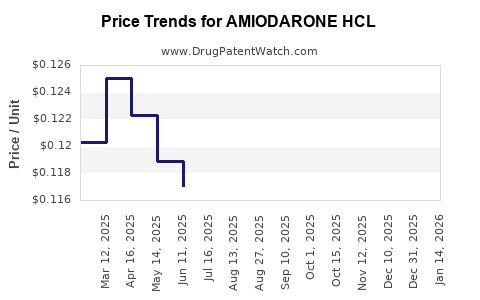
Last updated: February 13, 2026
Amiodarone HCl is a widely used antiarrhythmic medication primarily for the treatment of ventricular arrhythmias and atrial fibrillation. Its market landscape, pricing trends, and future projections are driven by factors including clinical demand, patent status, manufacturing costs, and regulatory environment.
Market Overview
The global amiodarone HCl market was valued at approximately $600 million in 2022. The product is available as generic and branded formulations, with the majority of the market dominated by generic manufacturers post-patent expiry.
Key Drivers:
- Rising prevalence of cardiovascular diseases, especially atrial fibrillation, which affects over 33 million globally.
- Approval and adoption in developing nations where cardiovascular disease management infrastructure expands.
- Established efficacy and safety profile, making it a first-line choice in certain arrhythmia cases, despite the potential for adverse effects.
Market Segments:
- Generics: Comprise over 80% of the market; costs tend to fluctuate with manufacturing scale and regulatory approvals.
- Branded Products: Including Amiodarone from Eli Lilly and others, comprise a smaller share but sustain premium pricing with brand loyalty.
Regulatory Status:
Amiodarone HCl is off-patent globally since early 2000s, enabling multiple generic manufacturers, which intensifies competition and influences pricing.
Pricing Trends
Historical Data:
- In the United States, injectable formulations ranged from $8 to $15 per 150 mg vial in 2022.
- Oral tablets varied from $0.20 to $0.50 per 200 mg pill, depending on the manufacturer and pharmacy channel.
Cost Drivers:
- Raw material prices, especially iodine derivatives and specialty chemicals.
- Manufacturing complexity owing to stability and purity requirements.
- Regulatory compliance costs and market entry barriers for generics.
Competitive Landscape Impact:
- Entry of multiple generics has driven prices down significantly since patent expiry.
- Price erosion averages 5-10% annually in established markets.
Future Price Projections (2023-2028)
- Generic formulations: Anticipated to decrease in price by 2-4% annually due to competition, stabilization of raw material costs, and manufacturing efficiencies.
- Branded formulations: May maintain or slightly increase prices, offering premium options especially in niche markets or for specific patient populations.
- Emerging Markets: Expected to see a 1-3% annual increase owing to new healthcare infrastructure and increasing disease burden.
Forecast Summary:
| Year |
Oral Tablet Price Range |
Injectable Price Range |
Remarks |
| 2023 |
$0.20 - $0.45 |
$8 - $14 |
Steady decline in generics, stable branded prices |
| 2025 |
$0.18 - $0.42 |
$7.60 - $13.30 |
Continued competition; slight drops expected |
| 2028 |
$0.16 - $0.40 |
$7.20 - $12.80 |
Market saturation; prices plateau or slightly decline |
Key Market Constraints
- Clinical concerns over long-term toxicity influence prescribing behaviors, potentially limiting volume.
- Regulatory restrictions in some countries controlling importation or reimbursement.
- Raw material supply chain vulnerabilities affecting manufacturing costs.
Strategic Implications
- Companies pursuing entry should focus on cost-effective manufacturing for generic versions.
- Proprietary formulations or delivery systems targeting niche indications may sustain higher price points.
- Monitoring raw material markets and regulatory pathways is crucial for pricing strategy.
Key Takeaways
- The amiodarone HCl market is mature, with prices decreasing post-patent expiry.
- Generic formulations dominate, maintaining competitive pricing driven by a high number of manufacturers.
- Prices are projected to decline modestly over the next five years, stabilizing by 2028.
- Market growth depends on increasing cardiovascular disease prevalence, especially in emerging markets.
- Price sensitivities are influenced by raw material costs and regulatory policies.
FAQs
-
What factors primarily influence amiodarone HCl pricing?
Raw material costs, manufacturing complexity, generic competition, and regulatory standards.
-
Are patented formulations still available?
No; patents expired globally by early 2000s, enabling generics.
-
Which regions have the fastest-growing markets for amiodarone?
Emerging markets in Asia and Latin America due to improving healthcare infrastructure and rising cardiovascular disease rates.
-
What are the main regulatory challenges?
Ensuring compliance with manufacturing standards and securing approvals in non-regulated or emerging markets.
-
How do adverse effects influence market demand?
Concerns about toxicity may limit long-term use, constraining volume despite stable prices.
References
[1] IQVIA. Global Pharmaceutical Market Data, 2022.
[2] FDA. Amiodarone Drug Approval Archive. 2022.
[3] MarketsandMarkets. Antiarrhythmic Drugs Market, 2022.
[4] Statista. Cardiovascular Disease Statistics, 2023.