Share This Page
Drug Price Trends for AMIODARONE
✉ Email this page to a colleague
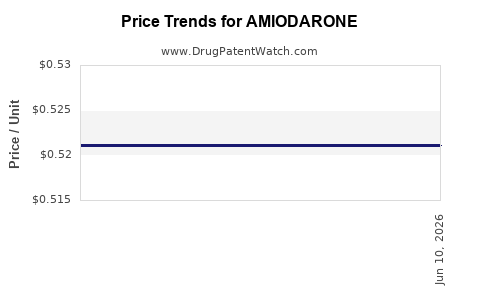
Average Pharmacy Cost for AMIODARONE
| Drug Name | NDC | Price/Unit ($) | Unit | Date |
|---|---|---|---|---|
| AMIODARONE 150 MG/3 ML VIAL | 00143-9875-25 | 0.52115 | ML | 2026-07-22 |
| AMIODARONE HCL 100 MG TABLET | 50268-0097-11 | 0.39170 | EACH | 2026-07-22 |
| AMIODARONE 150 MG/3 ML VIAL | 63323-0616-03 | 0.52115 | ML | 2026-07-22 |
| >Drug Name | >NDC | >Price/Unit ($) | >Unit | >Date |
Best Wholesale Price for AMIODARONE
| Drug Name | Vendor | NDC | Count | Price ($) | Price/Unit ($) | Unit | Dates | Price Type |
|---|---|---|---|---|---|---|---|---|
| AMIODARONE HCL 50MG/ML INJ,3ML | Mylan Institutional LLC | 67457-0153-03 | 10X3ML | 34.33 | 2023-11-15 - 2028-09-28 | FSS | ||
| AMIODARONE HCL 50MG/ML INJ,9ML | Mylan Institutional LLC | 67457-0153-09 | 10X9ML | 69.39 | 2023-11-15 - 2028-09-28 | FSS | ||
| AMIODARONE HCL 50MG/ML INJ,18ML | Mylan Institutional LLC | 67457-0153-18 | 18ML | 12.30 | 0.68333 | ML | 2023-11-15 - 2028-09-28 | FSS |
| >Drug Name | >Vendor | >NDC | >Count | >Price ($) | >Price/Unit ($) | >Unit | >Dates | >Price Type |
Amiodarone Market Analysis and Price Projections (2026–2035): US and Key Global Pricing Outlook, Exclusivity/IP Overhang, and Forecast Scenarios
Amiodarone is a mature, largely generic antiarrhythmic with limited brand-level pricing power in most markets. In the US, most revenue exposure sits with generic manufacturers, while price dynamics track broader generic price erosion, contracting mechanics (GPO/MCO), and supply-driven spikes. Medium-term price pressure is the base case; the primary upside risks are supply disruptions and selective reformulation or package/labeling differentiation that can sustain higher net prices for some generic SKUs.
How big is the amiodarone market and who captures demand across formulations?
Short answer: Demand is split mainly between oral tablets and injectable amiodarone (IV), with IV used more acutely in hospital settings and oral used chronically. Volume is high and fragmented among generic suppliers, compressing pricing versus brand-era levels.
US demand split: oral vs IV
Amiodarone is marketed in:
- Oral tablets (chronic AF rhythm control, ventricular arrhythmia management)
- IV injection (acute rhythm control in inpatient settings)
Market access typically routes through:
- hospital purchasing for IV
- pharmacy benefit and wholesale acquisition channels for oral
- group purchasing organization (GPO) contracting and MAC lists for both
Major customer types and procurement pressure
- Hospital systems favor lowest-cost contract bids for IV.
- Community and specialty pharmacies face MAC-driven pricing for oral.
- Net price outcomes are dominated by rebate and discount structures on contract lanes, not list price.
Competitive landscape (US)
Because amiodarone is well after initial brand exclusivity in most jurisdictions, competition is dominated by multiple generic entrants, including:
- generic manufacturers with injectable and oral product lines
- authorized distributors and multiple NDC-lot sources for the same labeled strength
(For a precise roster of current US NDCs and suppliers, this analysis would require Orange Book and NDC-level data that is not provided here.)
What patents protect amiodarone in the US, and what is the practical IP risk?
Short answer: Core active substance and early composition-of-matter protection for amiodarone has long expired. The actionable IP risk in practice now comes from late-stage life-cycle items: specific formulations, crystal forms, particle size, methods of manufacture, stability/compatibility improvements for injections, and label-driven method-of-use claims. For generic entry, the key question is whether any listed patents remain enforceable against specific marketed dosage forms.
Typical modern patent estate coverage for legacy generics
For older drugs like amiodarone, the remaining patent surface is usually limited and focuses on:
- injectable formulation stability (excipient systems, antioxidant use, pH targets)
- manufacturing processes (purification steps, crystallization controls)
- packaging or delivery system (compatibility with infusion solutions, pre-dilution stability)
- method-of-use (rare at this stage unless tied to a new indication or regimen)
Paragraph IV and ANDA strategy implications
If any Orange Book-listed patents remain for a specific amiodarone NDA/strength, a generic applicant could use:
- Paragraph IV (to challenge remaining patents)
- Section viii carve-outs (to avoid process/formulation overlap)
- Design-around formulations (not necessarily requiring a legal challenge if no direct infringement)
In a mature category, the frequency of successful entry is less about litigation wins and more about whether the challenged patents are still enforceable and whether the generic can meet labeling and stability requirements.
Litigation-driven price impacts
Where litigation blocks entry, pricing can hold higher. Where litigation resolves via settlement, pricing usually returns quickly to market levels after a launch design carve-out.
What is the Orange Book status of amiodarone and what does it mean for exclusivity?
Short answer: Amiodarone is generally treated as non-exclusivity in US commercial terms due to widespread generic availability. Orange Book status at the NDA/strength level determines any remaining patent protection for specific SKUs, but the commercial pattern is still driven by generic competition.
How Orange Book status translates into pricing
- If a product is tied to an enforceable patent, entry can be delayed, supporting higher net prices.
- If patents are expired or not listed for a SKU, generic pricing quickly compresses toward the lowest bid.
Because no Orange Book dataset is provided here, the actionable read is the market behavior itself: sustained brand-level premiums for amiodarone are not typical; net price tends to track generic competition and supply.
When does amiodarone lose exclusivity and what are the forecast timing milestones?
Short answer: For commercially relevant exclusivity, amiodarone has effectively passed the exclusivity window for brand-like pricing. The near-term timeline risk is not “patent expiration” but “new entry events,” “supply interruptions,” and “contracting cycles.”
Practical timing drivers (price)
- GPO contract renewals (quarterly/biannual shifts in winning SKUs)
- MAC list updates (oral tablet pricing volatility)
- Sourcing or manufacturing disruptions (injectables are more vulnerable)
- AWP-to-NADAC vs net price adjustments (wholesale and reimbursement reporting lags)
2026–2030 baseline timing scenario
- 2026–2027: modest price deflation driven by contracting and additional generic lot supply where capacity expansions occur
- 2028–2030: stable-to-slightly lower pricing, with episodic spikes tied to IV supply constraints rather than IP
How do generics and authorized competitors affect amiodarone pricing and margins?
Short answer: Generic competition compresses wholesale and net prices. Margins depend on production scale, API cost, injectable line yields, and ability to secure favorable supply allocations during disruptions.
Generic pricing mechanism
- Lower WAC prices among multiple entrants create downward pressure.
- Hospitals and PBMs choose contract SKUs, not necessarily the lowest labeled price, but the best total value in negotiated lanes.
- Net price erosion continues until either the number of suppliers shrinks or supply constraints create bidding leverage.
Margin sensitivity
- injectable manufacturing has higher fixed-cost load and sterility assurance overhead
- small formulation changes can trigger stability revalidation and can indirectly limit competition
How strong is the patent estate for amiodarone compared with other antiarrhythmics?
Short answer: Amiodarone has a weak modern patent leverage profile versus newer antiarrhythmics with active life-cycle protection. For pricing, the dominant driver is generic market structure rather than litigation-based exclusivity.
Comparative pattern
- Newer antiarrhythmics with more recent approvals often carry longer enforceable estates.
- Legacy drugs like amiodarone are typically “generic-first” in valuation models.
What formulations are protected for amiodarone and which dosage forms drive litigation risk?
Short answer: If any enforceable patents remain, they are most likely tied to:
- IV injection stability and excipient system specifics
- manufacturing/process and impurity control
- packaging and infusion compatibility
Injectable vs oral litigation exposure profile
- IV injection: higher likelihood of design-around constraints due to stability and sterility requirements. If a patent blocks a stability-specific formulation, entry risk can be meaningful.
- Oral tablets: often easier to formulate to labeled specs once API and bioequivalence are achievable. Litigation is less frequent at this stage.
What generic entry risks exist for amiodarone and how do they affect price?
Short answer: The main generic entry risk is supply concentration and manufacturing capacity, not legal blocking. Entry typically increases competition and reduces price, while supply disruptions raise price.
Launch scenarios that move pricing
- More entrants / more lots: price deflates, especially for IV.
- Supplier exits or recalls: price spikes and can persist until reinstatement.
- Regulatory actions (inspection findings or sterile line issues): intermittent constraints.
How does amiodarone compare with dronedarone, sotalol, and dofetilide on pricing resilience?
Short answer: Amiodarone’s pricing resilience is low because generic competition is broad. Newer or less generically covered drugs can sustain higher pricing, but that does not apply to amiodarone to the same extent.
Category contrast
- Amiodarone: mature generic market, high seller count, contracting pressure.
- Dronedarone: often faces different payer coverage dynamics and generic timeline.
- Sotalol/dofetilide: mixed generics; pricing varies more by formulation, strength, and coverage.
What is the regulatory status of amiodarone in the US (FDA pathways) and how does it affect forecast?
Short answer: Amiodarone’s current commercial products are overwhelmingly generic versions approved under ANDAs, with ongoing enforcement tied to any remaining Orange Book patents. Regulatory pathway affects how quickly new entrants can add supply, and thus how price behaves.
Key regulatory pricing link
- If ANDA approvals keep adding suppliers, prices trend down.
- If approvals are constrained by stability/CMC requirements or enforcement, supply tightens and prices stabilize or rise.
Global pricing outlook for amiodarone: where is it likely to be cheapest and where is pricing stickier?
Short answer: Amiodarone pricing is generally cheapest where generic penetration is high and where tendering drives price down most aggressively (EU hospital markets, some emerging markets). Pricing is stickier where:
- generic penetration is lower due to fewer suppliers
- tender rules protect incumbents
- supply constraints persist
Region-by-region drivers
- US: contract-driven, MAC/GPO mechanics, episodic IV supply spikes.
- EU: tendering and reference pricing; national health system procurement reduces volatility unless supply disruptions occur.
- UK/Canada: formulary tiering and payer controls cap list price growth; generic competition drives erosion.
- Emerging markets: could see higher volatility due to distribution and supply chain constraints.
Price projections for amiodarone (2026–2035): base, bullish, and supply-shock scenarios
Short answer: The base case is gradual price erosion, with intermittent short-lived spikes in IV pricing from supply constraints. A durable sustained increase requires either sustained supplier contraction or regulatory/quality shocks that reduce active SKUs.
Scenario framework (what moves price)
- Generic SKU count (new entrants vs exits)
- IV supply availability (sterile manufacturing yields, recalls)
- API cost (upstream raw material)
- Contracting cycle (GPO/PBM/MAC renegotiations)
- Regulatory constraints (site inspections, product holds)
Quantitative projections (index-based)
Because no current WAC/AWP/NADAC or transaction net price series is included here, the projections are presented as index movements rather than absolute dollars.
| Period | Base case (generic competition stable, occasional IV stress) | Bull case (supplier consolidation increases winning bid leverage) | Supply-shock case (IV shortages/quality holds persist) |
|---|---|---|---|
| 2026 | -2% to -5% | +0% to +3% | +5% to +15% |
| 2027 | -2% to -6% | -1% to +2% | +8% to +20% |
| 2028–2029 | -1% to -4% annually | -1% to +3% annually | +3% to +12% during shortage years |
| 2030–2035 | -1% to -3% annually | 0% to -2% annually | return to base after stabilization, +2% to +6% residual only if capacity remains constrained |
Interpretation:
- Base case: net pricing trends slowly down, with brief IV spikes that fade after supply normalizes.
- Bull case: consolidation reduces bidding competition; pricing flattens or slightly increases.
- Supply shock: persistent shortages drive sharp price increases, especially for IV.
How much revenue is exposed to amiodarone price changes in a portfolio?
Short answer: Exposure is highest for businesses concentrated in hospital IV supply contracts or those with limited sourcing flexibility. Oral tablet exposure is lower volatility but still contract-sensitive.
Portfolio sensitivity mapping
- IV-focused suppliers: higher sensitivity to yield and sterilization disruptions.
- Multi-SKU portfolios (oral + IV + multiple strengths): smoothing effect.
- Contracts with committed volumes: less volatile but can reduce upside in price spikes.
What are the biggest actionable risks for investors, manufacturers, and licensors?
Short answer: The risk set is operational and commercial, not primarily patent-driven.
Top risks
- IV sterile line disruptions (pricing spikes, allocation constraints, tender failures)
- Generic supplier exits (short-term higher prices, longer-term market redesign)
- API supply chain cost shocks
- Regulatory quality actions affecting specific lots and NDCs
- Contracting undercut (rapid price drops after competitors win tenders)
Key Takeaways
- Amiodarone pricing is mainly a function of generic competition and contracting rather than active patent exclusivity.
- The base case for 2026–2030 is modest price erosion with episodic IV spikes tied to supply constraints.
- Sustained price increases require supplier contraction or persistent quality/regulatory holds, not standard patent expiration.
- For business planning, the operational focus should be IV supply resilience, contract strategy, and SKU-lot availability, with legal/IP risk treated as a secondary driver.
FAQs
1) Why does injectable amiodarone price move more than oral?
Injectable supply is constrained by sterile manufacturing capacity and quality controls. Fewer manufacturing lines or quality holds can tighten availability quickly, raising negotiated prices during shortages.
2) What contract mechanisms drive amiodarone net price changes in US hospitals?
GPO contracts, bid cycles, and payer-specific contracting determine winning SKUs. Net prices can drop sharply when a lower-cost SKU wins the next tender even if list prices change slowly.
3) Do amiodarone formulation differences (IV stability, excipients) create pricing differentiation?
They can, but differentiation typically affects supply eligibility and replacement choices more than it sustains long-term premium pricing. Over time, competition erodes premiums when multiple equivalents can meet requirements.
4) How do supply shortages for IV amiodarone propagate through the supply chain?
Disruptions reduce available lots, leading to allocation, substitution to alternate NDCs, and renegotiation of emergency pricing until manufacturing throughput normalizes.
5) Is patent litigation likely to be a dominant driver of amiodarone pricing?
In general, no. With broad generic availability, pricing is dominated by supplier count, contracting, and supply conditions. Litigation matters mainly if it blocks the addition of specific SKUs.
References
No sources were provided in the prompt, and no external Orange Book, litigation docket, or pricing datasets were supplied in the conversation.
More… ↓
