Share This Page
Drug Price Trends for AMINOCAPROIC ACID
✉ Email this page to a colleague
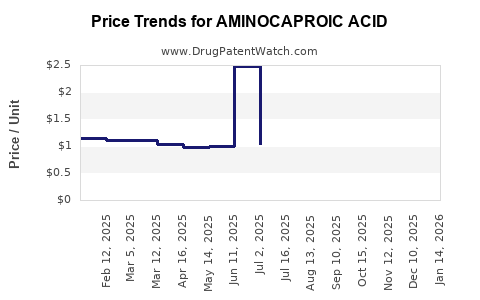
Average Pharmacy Cost for AMINOCAPROIC ACID
| Drug Name | NDC | Price/Unit ($) | Unit | Date |
|---|---|---|---|---|
| AMINOCAPROIC ACID 0.25 GRAM/ML | 00054-1100-58 | 0.62973 | ML | 2026-07-22 |
| AMINOCAPROIC ACID 0.25 GRAM/ML | 31722-0035-23 | 0.62973 | ML | 2026-07-22 |
| AMINOCAPROIC ACID 0.25 GRAM/ML | 52817-0815-08 | 0.62973 | ML | 2026-07-22 |
| >Drug Name | >NDC | >Price/Unit ($) | >Unit | >Date |
Market Analysis & Price Projections for Aminocaproic Acid
Aminocaproic acid (ACA) is an antifibrinolytic agent primarily used to control bleeding in conditions such as post-operative hemorrhage, trauma, or bleeding disorders. Its market landscape involves pharmaceutical manufacturing, healthcare providers, and regulatory bodies. Demand is driven by surgical procedures, trauma cases, and bleeding disorder treatments.
Market Overview and Key Drivers
-
Market Size: The global aminocaproic acid market was valued at approximately $150 million in 2022. It is expected to grow at a compound annual growth rate (CAGR) of 5-6% through 2028. Growth factors include increasing surgical procedures, trauma incidences, and anticoagulant use.
-
Major Applications:
- Hemorrhage control post-surgery (orthopedic, cardiac, dental)
- Bleeding associated with hemophilia and thrombocytopenia
- Trauma-related hemorrhage management
-
Geographic Distribution:
- North America accounts for roughly 40% of sales
- Europe accounts for about 25%
- Asia-Pacific exhibits the highest growth potential due to expanding healthcare infrastructure
-
Competitive Landscape:
- Dominated by generic manufacturers
- Leading branded options include Amicar (Pfizer) and generic equivalents
- Entry of biosimilars is not applicable due to the drug’s chemical nature
Regulatory & Supply Dynamics
-
Regulatory Status:
- Approved by the U.S. FDA under a standard NDA
- EMA approval in Europe encompasses similar indications
-
Manufacturing & Supply:
- Produced mainly via chemical synthesis
- Supply chain relies on active pharmaceutical ingredient (API) availability and manufacturing capacity
-
Patent & Exclusivity:
- No recent patent protections; generics dominate market
Market Challenges & Opportunities
-
Challenges:
- Price sensitivity among healthcare payers
- Competition from alternative antifibrinolytics like tranexamic acid
- Regulatory hurdles in emerging markets
-
Opportunities:
- Expanded indications for off-label uses
- Developing formulations for pediatric or outpatient settings
- Increased use due to rising surgical procedures globally
Price Trends & Projections
-
Historical Pricing:
- Average wholesale price (AWP) in 2022: approximately $3.00 per unit (100 mg)
- Price fluctuations are minimal due to widespread generic availability; small variations based on supplier and volume discounts
-
Forecasted Pricing (2023-2028):
- Stability expected, with minor reductions driven by generic market pressures and bulk purchasing
- Wholesale prices projected to decrease to approximately $2.50 per 100 mg by 2028
- Pricing pressure will limit per-unit cost increases; overall revenue growth relates more to volume
-
Market Revenue Projections:
- Total sales expected to reach $200-$250 million in 2028, driven by increased usage
- Price erosion may contribute to a compound annual growth rate in revenue closer to 4-5%, balancing volume increases against per-unit price declines
Comparison with Alternatives & Cost-Effectiveness
- Tranexamic acid is a competitor with similar efficacy but lower cost, which influences ACA’s market share.
- ACA's use is often driven by specific clinical indications where tranexamic acid is contraindicated or less effective.
Key Takeaways
- The global aminocaproic acid market is growing modestly, driven by surgical and trauma indications.
- Price trends show stability in 2023 but are expected to decline slightly through 2028, influenced by generic competition and purchasing trends.
- Revenue growth hinges on increased procedural volumes rather than price increases.
- Competition from alternative antifibrinolytics limits pricing power, especially in cost-sensitive markets.
- Market expansion relies on new indications, formulations, and emerging market penetration.
Frequently Asked Questions
1. What are the primary factors influencing ACA market growth?
Demand for ACA correlates with surgical volume, trauma cases, and bleeding disorder management. Increasing healthcare infrastructure and population aging in emerging markets augment demand.
2. Will generic competition continue to suppress pricing?
Yes. The absence of patent protections sustains generic dominance, keeping prices stable or declining slightly.
3. How does ACA compare to tranexamic acid in the market?
Tranexamic acid is cheaper and often preferred for its efficacy and cost profile. ACA remains relevant in specific clinical contexts where tranexamic acid is less effective or contraindicated.
4. Are there new indications or formulations for ACA in development?
No significant pipeline developments are publicly reported. Market growth relies mainly on existing uses and expanded access in emerging markets.
5. What impact will regulatory changes have on ACA pricing and availability?
Any regulatory approvals or restrictions affecting manufacturing or off-label use could influence market size and pricing, though currently no major developments are expected.
Sources
- IBISWorld, 2023. Global Market for Hemostatic Agents.
- MarketWatch, 2023. Aminocaproic Acid Market Size and Outlook.
- U.S. FDA Drug Approvals Database, 2022.
- IQVIA, 2022. Pharmaceutical Data and Trend Report.
- Company Reports and Press Releases, 2023.
More… ↓
