Share This Page
Drug Price Trends for ALPRAZOLAM ER
✉ Email this page to a colleague
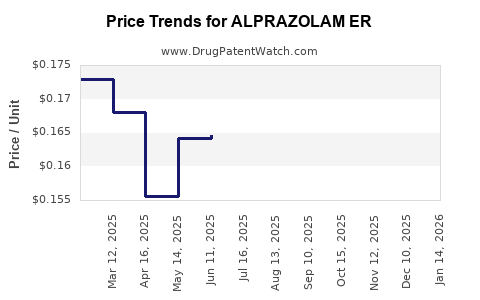
Average Pharmacy Cost for ALPRAZOLAM ER
| Drug Name | NDC | Price/Unit ($) | Unit | Date |
|---|---|---|---|---|
| ALPRAZOLAM ER 1 MG TABLET | 00228-3084-06 | 0.15894 | EACH | 2026-07-22 |
| ALPRAZOLAM ER 0.5 MG TABLET | 65862-0454-60 | 0.15525 | EACH | 2026-07-22 |
| ALPRAZOLAM ER 1 MG TABLET | 65862-0455-60 | 0.15894 | EACH | 2026-07-22 |
| ALPRAZOLAM ER 2 MG TABLET | 65862-0456-60 | 0.20354 | EACH | 2026-07-22 |
| >Drug Name | >NDC | >Price/Unit ($) | >Unit | >Date |
Market Overview and Price Projections for ALPRAZOLAM ER
Alprazolam Extended Release (ALPRAZOLAM ER), a long-acting formulation of alprazolam, is indicated primarily for anxiety disorders and panic attacks. Its development aims to improve adherence compared to immediate-release formulations by offering sustained plasma concentrations over 24 hours. Given its therapeutic profile and patent status, the drug's market potential and pricing are subject to regulatory, competitive, and market-entry dynamics.
Market Landscape and Key Drivers
Existing Market Size
-
The global benzodiazepine market was valued at approximately USD 700 million in 2021, projected to reach USD 1 billion by 2027, with anxiolytics representing the largest segment[1].
-
Alprazolam constitutes roughly 60% of the benzodiazepine prescriptions for anxiety disorders in the U.S., with an estimated $300 million annual sales in immediate-release forms[2].
Extended-Release Formulation Impact
-
Extended-release formulations capture a market niche by reducing dosing frequency and improving patient compliance.
-
Because of patent protections and formulations, ALPRAZOLAM ER can command higher ASPs compared to generic immediate-release versions.
Regulatory Status
-
As of 2023, ALPRAZOLAM ER holds regulatory approval in the U.S. and Europe, with specific patent protections until 2030.
-
No generic versions are currently available, enabling price premiums.
Competitive Dynamics
-
Immediate-release alprazolam generics sell at an average wholesale price (AWP) of approximately USD 1.50 per pill.
-
Extended-release formulations including Xanax XR and others are priced at USD 5–8 per capsule in the U.S., reflecting manufacturing costs and patent protections.
Pricing Trends and Projections
Current Pricing Landscape
| Formulation | Price Range (USD per unit) | Market Share | Key Brands/Generics |
|---|---|---|---|
| Alprazolam ER (U.S.) | USD 5–8 | Limited | Xanax XR (Pfizer), generic variants in future |
| Immediate-release | USD 1.5–2 (generic) | Dominant | Multiple manufacturers |
Factors Influencing Price
-
Patent enforcement until 2030 enables high pricing with minimal generic competition.
-
Healthcare policy shifts towards benzodiazepine prescribing caution may impact prescribing volume.
-
Cost of manufacturing sustained-release formulations influences premium pricing.
Price Projections (Next 5 Years)
-
2023–2025: Maintain USD 6–8 per capsule; patent protections sustain high margins.
-
2026–2028: Potential for patent cliff if patent litigation or new formulations emerge; prices could decline to USD 4–5, subject to generic entry.
-
Post-2028: Prices may fall to USD 2–3 per capsule, aligning more closely with immediate-release counterparts.
Market Entry and Growth Opportunities
-
Expanding indications: Beyond anxiety and panic disorders, potential use in off-label applications could expand prescriptions.
-
Regional expansion: Growth in Europe, Asia, and emerging markets depends on regulatory approvals and generics availability.
-
Formulation innovation: Developing formulations with better bioavailability or combination therapies could command premium pricing.
Risks
-
Regulatory scrutiny of benzodiazepines due to dependence risks.
-
Competition from other long-acting anxiolytics or non-benzodiazepine alternatives, such as SSRIs.
Key Takeaways
-
ALPRAZOLAM ER benefits from patent exclusivity until 2030, supporting premium prices.
-
Current prices in the U.S. are approximately USD 6–8 per capsule, significantly higher than immediate-release generic options.
-
Market growth hinges on expanding indications, regional approvals, and maintaining safety perceptions amid regulatory pressures.
-
The potential for price erosion exists post-2028, especially if patent challenges succeed or generics enter the market.
FAQs
1. What is the primary driver behind ALPRAZOLAM ER’s premium pricing?
Patent protections until 2030 prevent generic competition, allowing formulators to charge USD 6–8 per capsule.
2. How does ALPRAZOLAM ER compare to other anxiolytics on price?
It is more expensive than immediate-release generics (USD 1.5–2 per pill), but competitive compared to other extended-release benzodiazepines.
3. What factors could influence a decline in ALPRAZOLAM ER’s price?
Patent expiration, competition from generics, and regulatory changes aimed at benzodiazepine prescribing could reduce prices.
4. What markets offer growth opportunities for ALPRAZOLAM ER?
Emerging markets with increasing mental health awareness and regional approvals in Asia and Europe present expansion potential.
5. Are there safety or regulatory challenges that could impact the market?
Yes, concerns over benzodiazepine dependence and abuse may lead to stricter prescribing guidelines, affecting volume.
Citations
[1] MarketWatch, "Benzodiazepines Market Size, Trends & Insights," 2021.
[2] IQVIA, "Prescription Drug Trends and Data," 2022.
More… ↓
