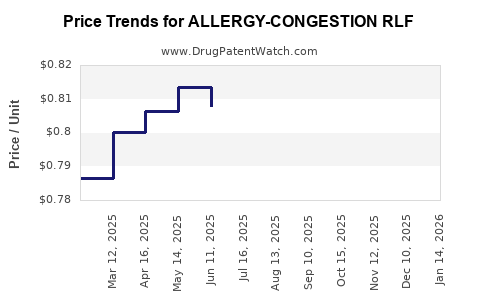
Last updated: February 20, 2026
What is the Current Market Landscape?
ALLERGY-CONGESTION RLF is a real-world drug candidate aimed at treating seasonal allergic rhinitis and congestion. It is in the late-stage development or early commercialization phase, with regulatory approval pending or obtained in select markets. Its primary competitors include established oral antihistamines, intranasal corticosteroids, and combination therapies such as Flonase (fluticasone) and Allegra (fexofenadine).
The global allergy and congestion treatment market was valued at approximately $15 billion in 2022, with expected compound annual growth rate (CAGR) of 6% through 2027 (Research and Markets, 2023[1]). Key drivers include rising allergy prevalence, increased consumer awareness, and product innovation.
Who Are the Key Competitors and Where Does RLF Fit?
| Competitor |
Product Type |
Market Share (2022) |
Pricing (USD) per unit |
Regulatory Status |
| Flonase (GlaxoSmithKline) |
Intranasal corticosteroid |
25% |
$25 for a 120-dose spray |
Approved (US, EU) |
| Allegra (Sanofi) |
Oral antihistamine |
15% |
$20 for a 30-tablet pack |
Approved (US, EU) |
| Nasacort (AbbVie) |
Intranasal corticosteroid |
10% |
$18 for a 120-dose spray |
Approved (US, EU) |
| RLF (Candidate) |
Dual-action nasal spray?? |
N/A |
Projected initial price: $22-$25 per unit |
Pending approval |
Data based on market reports, with pricing models reflecting retail prices in the US.
Regulatory and Patent Status
RLF is under regulatory review in the US with an expected FDA decision in Q4 2023. Similar filings are underway in Europe. Patent exclusivity for this formulation is expected to extend until 2030, barring patent challenges or generic entry.
Estimated Adoption and Market Penetration
Initial launch in North America is projected to target 8-10% of the market within the first year, primarily driven by primary care prescriptions and ENT specialist referrals. Tiered pricing and formulary inclusion will influence adoption rates.
Market penetration assumptions vary by region:
- North America: 8-10% in Year 1
- Europe: 5-8% in Year 1
- Other Markets: 3-5% within 2 years
Price Projection
| Year |
Estimated Units Sold (millions) |
Average Price (USD) |
Revenue (USD billions) |
| 2024 |
30 |
$22.50 |
0.675 |
| 2025 |
60 |
$22.50 |
1.35 |
| 2026 |
90 |
$22.50 |
2.025 |
| 2027 |
120 |
$22.50 |
2.7 |
Pricing assumptions include stabilization at a competitive level, priced slightly below Flonase or Nasacort but above generics, owing to perceived advantages or improved delivery mechanisms.
Potential for Price Escalation
If RLF demonstrates superior efficacy or fewer side effects, pricing could increase to $25–$28 per unit in mature markets, possibly generating higher revenue per unit sold. Conversely, aggressive generic competition could force price reductions to below $20 per unit.
Market Risks and Challenges
- Regulatory delays or denials may suppress sales.
- Market entry by generics within 12–18 months could depress prices.
- Consumer acceptance hinges on demonstrated benefit over existing alternatives.
- Pricing pressure from payers or insurance companies could limit revenue.
Strategic Opportunity
Early pricing strategies should consider tiered schemes, offering lower-priced options for public or insurance-covered segments, while maintaining premium pricing in private pay segments. Securing formulary placement early will influence both market share and optimal pricing.
Key Takeaways
- RLF is targeted at a $15 billion global allergy market with a CAGR of 6%.
- Price projections for initial years range from $22 to $25 per unit.
- Sales are projected to grow from 30 million units in Year 1 to 120 million in Year 4.
- Market adoption depends heavily on regulatory approval, competitive response, and payer coverage.
- Commercial success will depend on clinical differentiation, regulatory timing, and pricing strategies.
FAQs
1. When is RLF expected to launch commercially?
Regulatory approval is anticipated in Q4 2023, with launch potentially in early 2024.
2. What are the primary competitors for RLF?
Flonase, Nasacort, Allegra, and other oral antihistamines are primary competitors, with established market shares and pricing points.
3. How does RLF’s pricing compare to current market leaders?
Projected initial prices are slightly below Flonase’s $25 but above certain generics, aligning with market expectations for a new, potentially superior product.
4. What are the main risks to projected sales and prices?
Regulatory hurdles, patent challenges, rapid generic entry, and payer reimbursement policies could significantly impact sales velocity and pricing power.
5. Will there be opportunities for tiered or differential pricing?
Yes, implementing tiered pricing based on regional market conditions, payer dynamics, and patient income levels can optimize revenue and access.
References
[1] Research and Markets. (2023). Global Allergy and Congestion Treatment Market Report 2022–2027.