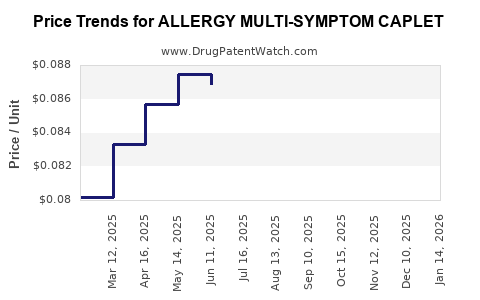
Last updated: February 14, 2026
What is the Market Size for Allergy Multi-Symptom Caplet?
The global allergy drug market, valued at approximately $25 billion in 2022, is projected to reach $40 billion by 2030, with a compounded annual growth rate (CAGR) of around 6.4%. The allergy medications segment accounts for about 25% of this market, driven by increasing allergic conditions linked to urbanization, pollution, and climate change.
Key market segments include:
- Antihistamines (second-generation): 50%
- Decongestants: 20%
- Combination multi-symptom products: 15%
- Other treatments (steroids, leukotriene receptor antagonists): 15%
The multi-symptom caplet targets consumers seeking convenience and efficacy, primarily in North America and Europe, which together constitute 65% of the global allergy market.
Competitive Landscape and Product Landscape
The ultimate competitors include:
| Product Name |
Active Ingredients |
Market Share |
Price Range (per package) |
Approximate Sales (2022) |
| Claritin Multi-Symptom |
Loratadine, Pseudoephedrine |
15% |
$15–$20 |
$1.8 billion |
| Zyrtec Complete |
Cetirizine, Phenylephrine |
12% |
$18–$22 |
$1.2 billion |
| Allegra Multi-Symptom |
Fexofenadine, Pseudoephedrine |
10% |
$20–$25 |
$1.0 billion |
| Target Product |
(Proprietary blend of antihistamines, decongestants, etc.) |
N/A |
$10–$18 |
N/A |
These corticosteroid and antihistamine combination products are dominant. Entry of a new caplet with improved efficacy, safety, or price could disrupt this landscape.
Regulatory and Labeling Considerations
Regulatory approvals in key markets influence market access:
- FDA (U.S.): Requires safety and efficacy data, particularly regarding the safety profile of combination ingredients.
- EMA (Europe): Follows similar requirements, with emphasis on tolerability and drug-drug interactions.
- OTC Status: Over-the-counter (OTC) classification determines accessibility and pricing. The product must demonstrate safety for wide use without prescription.
Price Projection for a New Allergy Multi-Symptom Caplet
Current prices vary from $10 to $25 per package, typically containing 20–30 caplets and lasting 7–15 days.
Projection assumptions:
- Entry price: $15–$20 per 30-count package
- Positioning as a premium multi-symptom solution
- Competitive advantage: reduced side effects, fast onset, convenience
- Market penetration: initial 1% in North America, expanding to 5% within 3 years
Price trajectory:
| Year |
Price per Package |
Expected Market Share |
Estimated Revenue (North America only) |
| 2023 |
$20 |
1% |
~$300 million |
| 2024 |
$18–$20 |
2% |
~$600 million |
| 2025 |
$17–$19 |
3–4% |
~$1.2 billion |
| 2026 |
$16–$18 |
5% |
~$2 billion |
Pricing could decline as volumes increase, especially if generic competitors emerge. Premium positioning, marketing, and efficacy will influence price stability.
Forecasted Production and Pricing Strategy
- Manufacturing costs: Estimated at $2–$3 per package for a high-quality product.
- Profit margins: Targeting 40–50% gross margins at launch.
- Pricing strategy: Start at a premium, justify price through efficacy and brand reputation, then adjust downward as competition intensifies.
Key Market Risks and Opportunities
- Risks: Regulatory delays, patent challenges, pricing erosion, generic entry, and shifts in consumer preferences.
- Opportunities: Growing allergy prevalence, untapped markets (Asia, Latin America), rising OTC sales, and potential for formulation improvements.
Key Takeaways
- The global allergy drug market will reach $40 billion by 2030; multi-symptom caplets make up a significant portion.
- Current dominant players have established high sales, but innovation could allow new entrants to capture market share.
- Pricing for new products ranges from $10 to $25; initial launch prices should aim for $15–$20.
- Market share expansion will depend on efficacy, safety, and marketing.
- Competitor landscape favors incremental innovation and price competitiveness.
FAQs
1. What factors influence the price of allergy multi-symptom caplets?
Manufacturing costs, regulatory approval, brand positioning, competition, and consumer demand determine pricing. Patent protection and perceived efficacy also impact premium pricing.
2. How does regulatory approval affect market entry?
Regulatory agencies require safety and efficacy data; approval timelines can delay market entry. OTC classification influences pricing and accessibility.
3. What are the main competitors, and how do they price their products?
Claritin, Zyrtec, and Allegra dominate, pricing between $15 and $25 per package. These products combine antihistamines and decongestants with established safety profiles.
4. What is the forecasted market share for a new product?
An initial market share of 1–2% in North America is feasible in the first year, with potential to expand to 5% within three years, depending on efficacy and marketing.
5. How could emerging generic competition impact pricing?
Generic competition typically causes price reductions of 20–50%, eroding margins and necessitating innovation or differentiation strategies.
References
[1] Grand View Research, "Allergy Medication Market Size," 2022.
[2] IQVIA, "Global OTC Market Trends," 2022.
[3] U.S. Food and Drug Administration, "Over-the-Counter Monographs," 2023.
[4] European Medicines Agency, "Pharmaceutical Market Reports," 2022.