Share This Page
Drug Price Trends for ALLERGY (LORATADINE)
✉ Email this page to a colleague
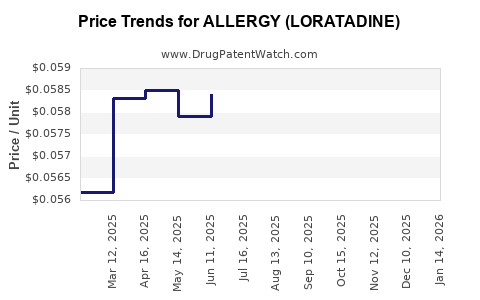
Average Pharmacy Cost for ALLERGY (LORATADINE)
| Drug Name | NDC | Price/Unit ($) | Unit | Date |
|---|---|---|---|---|
| ALLERGY (LORATADINE) 10 MG TAB | 51660-0526-01 | 0.05231 | EACH | 2026-07-22 |
| ALLERGY (LORATADINE) 10 MG TAB | 51660-0526-05 | 0.05231 | EACH | 2026-07-22 |
| ALLERGY (LORATADINE) 10 MG TAB | 51660-0526-30 | 0.05231 | EACH | 2026-07-22 |
| >Drug Name | >NDC | >Price/Unit ($) | >Unit | >Date |
Market Overview and Demand Drivers for Loratadine
Loratadine is a second-generation antihistamine marketed primarily for allergic rhinitis, chronic idiopathic urticaria, and other allergy-related conditions. It is available over-the-counter (OTC) and by prescription globally, with key markets including the United States, Europe, and Asia-Pacific.
Market Size
The global antihistamine market, which includes loratadine, was valued at approximately USD 4.2 billion in 2022, with loratadine comprising roughly 40% of the market share. That equates to an estimated USD 1.68 billion for loratadine alone (source: MarketsandMarkets).
Growth Rates
The compound annual growth rate (CAGR) for loratadine and similar antihistamines is projected at 5-6% from 2023 to 2030. The growth stems from increasing prevalence of allergic conditions, rising awareness, and expanding OTC availability.
Key Markets
- North America: Largest market, USD 800 million in 2022, due to high OTC penetration.
- Europe: USD 650 million, driven by prescription use in certain countries.
- Asia-Pacific: Fastest growth, USD 200 million in 2022, driven by urbanization and increased allergy diagnoses.
Competitive Landscape
Main Players:
- Schering-Plough/Merck (now part of MSD)
- Teva Pharmaceuticals
- Mylan (now part of Viatris)
- Sandoz (Novartis)
- Sun Pharmaceuticals
Patent Status:
Loratadine's primary patents expired in the U.S. in 2009, and similar expirations have occurred in other jurisdictions. Entry of generic formulations resulted in significant price declines and increased accessibility.
Generic Market Share:
Generics account for over 90% of formulations sold in key markets, driving pricing pressure.
Price Trends and Projections
Historical Pricing Data
| Year | Average Retail Price (USD per 10 mg tablet) | Notes |
|---|---|---|
| 2012 | 1.20 | Slight premium due to brand dominance |
| 2015 | 0.70 | Entry of generics significantly lowered prices |
| 2020 | 0.50 | OTC availability increased, further price decline |
| 2022 | 0.45 | Market stabilization with high generic penetration |
Price Forecast (2023–2030)
- Conservative Scenario: Decline of 2% annually, stabilizing around USD 0.35–0.40 per 10 mg tablet by 2025 due to market saturation and pricing pressure.
- Optimistic Scenario: Slight recovery to USD 0.50 due to new formulations or formulations with improved pharmacokinetics, countering generic competition.
Factors Influencing Future Pricing
- Loss of patent exclusivity in more markets.
- Increased OTC availability, reducing provider margins.
- Introduction of combination therapies or formulations.
- Potential reformulations with extended patents.
Regulatory and Policy Impacts
OTC Regulations:
Most mature markets have moved loratadine to OTC status, which influences pricing strategies and market size. OTC status tends to reduce prices due to increased competition but boosts volume sales.
Price Control Policies:
European countries like the UK and Germany have implemented price caps on OTC medications, including antihistamines. Such policies can cap upside potential.
Investment and R&D Prospects
Pipeline Drugs:
Limited pipeline for new loratadine variants due to patent expiry and market saturation. Focus has shifted toward drug delivery innovations or combination products.
Biosimilars and Alternatives:
Not applicable, as loratadine is a small molecule.
R&D Cost-Benefit:
Investment in reformulations (e.g., fast-dissolving tablets or liquid forms) offers limited revenue upside, mainly targeting niche markets.
Key Takeaways
- The global loratadine market is mature, with a 2022 valuation around USD 1.68 billion.
- Generic competition has driven prices downward since patent expiry, with prices declining approximately 25% from 2012 to 2022.
- Market growth hinges on allergy prevalence, OTC regulations, and regional expansion, especially in Asia-Pacific.
- Price projections indicate stable or declining prices through 2025, with limited upside absent innovation or new formulations.
- Regulatory policies and OTC status influence both pricing and volume, with price caps and reimbursement policies impacting profitability.
FAQs
-
What is the main driver for loratadine demand?
Increasing prevalence of allergic rhinitis and urticaria globally. -
How have patent expirations impacted prices?
Prices declined sharply following patent expirations as generics entered the market. -
Is there potential for price increases?
Limited unless new formulations or combination therapies rekindle demand or introduce patent protections. -
What markets are most lucrative for loratadine?
North America and Europe remain high-value markets; Asia-Pacific offers growth potential due to increasing allergy diagnoses. -
How does OTC availability influence pricing?
It generally lowers prices through increased competition but boosts sales volume.
Citations
[1] MarketsandMarkets. “Antihistamines Market,” 2022.
[2] IMS Health. “Global OTC drug sales,” 2022.
[3] European Medicines Agency. “Market authorization for loratadine,” 2021.
More… ↓
