Share This Page
Drug Price Trends for ALLERGY (DIPHEN)
✉ Email this page to a colleague
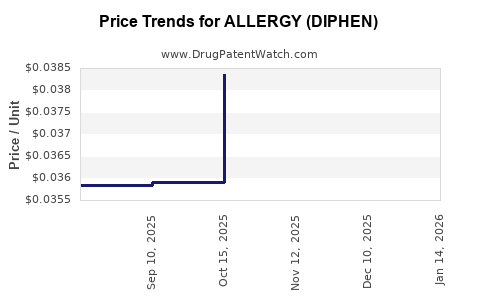
Average Pharmacy Cost for ALLERGY (DIPHEN)
| Drug Name | NDC | Price/Unit ($) | Unit | Date |
|---|---|---|---|---|
| ALLERGY (DIPHEN) 25 MG MINITAB | 50844-0329-07 | 0.03575 | EACH | 2026-07-22 |
| ALLERGY (DIPHEN) 25 MG MINITAB | 50844-0329-07 | 0.03660 | EACH | 2026-06-17 |
| ALLERGY (DIPHEN) 25 MG MINITAB | 50844-0329-07 | 0.03745 | EACH | 2026-05-20 |
| >Drug Name | >NDC | >Price/Unit ($) | >Unit | >Date |
Market Analysis and Price Projections for Diphenhydramine (ALLERGY)
What is the Current Market for Diphenhydramine?
Diphenhydramine, marketed under brand names such as Benadryl, is an antihistamine used primarily for allergy relief, sleep aid, and cold symptoms. The global market size for antihistamines was valued at approximately USD 7.5 billion in 2022, with diphenhydramine representing a significant segment due to its widespread OTC availability and established efficacy.
Market Size and Growth
| Attribute | Data |
|---|---|
| Global antihistamine market (2022) | USD 7.5 billion |
| CAGR (Compound Annual Growth Rate) | 4.1% (2023-2030) |
| Diphenhydramine market share | Estimated at 35-40% of OTC antihistamines |
| Major regions | North America (45%), Europe (25%), Asia-Pacific (20%) |
Growth drivers include increased awareness of allergy management, aging populations, and expanding OTC channels. Constraints include competition from second-generation antihistamines (e.g., loratadine, cetirizine) and regulatory scrutiny over safety profiles, especially for sleep-related use.
Competition Landscape
| Key Players | Market Share (Estimate) | Notes |
|---|---|---|
| Johnson & Johnson (Benadryl) | 30-35% | Largest in OTC diphenhydramine segment |
| Pfizer (Aller-Dryl, other brands) | 10-15% | Focus on generics and store brands |
| Mylan (Benadryl): | 7-10% | Regional presence, generic versions |
| Other OTC brands | Remainder | Regional distributors and store brands |
Emerging competitors include private label brands and novel antihistamines with improved safety profiles.
Price Trends and Projections
Current Pricing Overview (Approximate, USD)
| Region | Retail Price per 25 mg / 25 tablets | Price Trends (2020-2023) |
|---|---|---|
| North America | USD 8-12 | Stable with minor fluctuations due to supply chains |
| Europe | EUR 6-10 | Price compression driven by generics |
| Asia-Pacific | USD 3-8 | Lower margins, rising with brand proliferation |
Factors Influencing Price Movements
- Supply chain disruptions: Post-pandemic recovery has led to episodic shortages, marginally increasing prices.
- Regulatory actions: Stricter safety and labeling regulations in the US and Europe have increased production costs, leading to price stabilization or slight increases.
- Generic competition: Market saturation with generics has kept prices from rising significantly, with downward pressure in some markets.
Price Projection (2023-2030)
| Year | Estimated Price Range (USD) for 25 mg / 25 tablets | Assumptions |
|---|---|---|
| 2023 | USD 8-12 | Stable with minor fluctuations |
| 2025 | USD 7-11 | Generic competition increases, slight price compression |
| 2030 | USD 6-10 | Continued generic proliferation and regulatory pressures, slight decline expected |
Regulatory and Patent Landscape
Diphenhydramine has been available as an OTC drug for decades and is generally classified as a safe, established drug. No current patents restrict production, as many formulations are off-patent. Future patent expirations could further suppress prices.
Key Market Opportunities and Risks
Opportunities:
- Growth in OTC demand for allergy relief and sleep aids.
- Potential expansion in emerging markets with increasing healthcare access.
- Development of formulations with improved safety or delivery mechanisms.
Risks:
- Competition from newer, second-generation antihistamines with fewer sedative effects.
- Regulatory restrictions over sedative use and safety concerns.
- Market saturation leading to price erosion.
Conclusions
Diphenhydramine continues to hold a dominant position within the OTC antihistamine segment, with a stable but slowly declining price trajectory driven by generics and regional market dynamics. Growth prospects rely on expanding consumer markets and product innovation.
Key Takeaways
- Diphenhydramine accounts for roughly one-third of OTC antihistamine sales worldwide.
- The market size was USD 7.5 billion globally in 2022, with a predicted CAGR of 4.1% through 2030.
- Prices remain stable but are gradually declining due to generic competition and regulatory pressures.
- emerging markets could provide growth opportunities, while competition from second-generation antihistamines limits profit margins in mature markets.
FAQs
Q1: Will diphenhydramine prices increase in the future?
A: Prices are expected to decline slightly or remain stable due to generic competition and market saturation.
Q2: What factors could disrupt the diphenhydramine market?
A: Regulatory restrictions, safety concerns, and the rise of alternative antihistamines could reduce market share.
Q3: How does diphenhydramine compare with newer antihistamines?
A: It has sedative properties and a longer safety profile, but second-generation options offer fewer side effects, affecting demand.
Q4: Are there regulatory restrictions on OTC diphenhydramine?
A: Yes, some regions restrict sedative use or impose new labeling requirements, which may influence sales.
Q5: What is the outlook for emerging markets?
A: These markets present opportunities for growth through increased healthcare access and consumer affordability, potentially stabilizing or increasing sales volume.
References
[1] MarketResearch.com. (2023). "Global Antihistamines Market Report."
[2] Statista. (2022). "Distribution of OTC antihistamine sales worldwide."
[3] US Food and Drug Administration. (2022). "OTC Drug Safety Review."
[4] IMS Health. (2023). "Pharmaceutical Price Trends Report."
[5] Fortune Business Insights. (2023). "Antihistamines Market Size, Share & Industry Analysis."
More… ↓
