Share This Page
Drug Price Trends for ALLERGY
✉ Email this page to a colleague
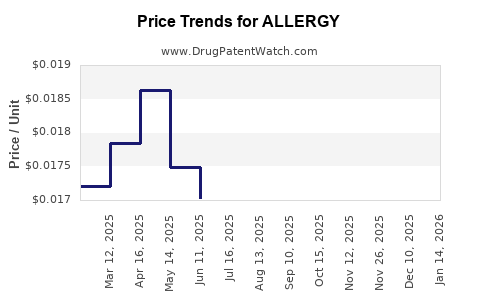
Average Pharmacy Cost for ALLERGY
| Drug Name | NDC | Price/Unit ($) | Unit | Date |
|---|---|---|---|---|
| ALLERGY (LORATADINE) 10 MG TAB | 51660-0526-01 | 0.05248 | EACH | 2026-06-17 |
| ALLERGY (LORATADINE) 10 MG TAB | 51660-0526-05 | 0.05248 | EACH | 2026-06-17 |
| ALLERGY (DIPHEN) 25 MG MINITAB | 50844-0329-07 | 0.03660 | EACH | 2026-06-17 |
| >Drug Name | >NDC | >Price/Unit ($) | >Unit | >Date |
What Is the Current Market Size for Allergy Drugs?
The global allergy therapeutics market was valued at approximately $10 billion in 2022. It is projected to grow at a compound annual growth rate (CAGR) of 7.2% from 2023 to 2030, reaching around $19 billion by 2030. The growth is driven by increasing prevalence of allergic conditions, expanded drug indications, and advancements in biological therapies.
What Are the Key Segments in the Allergy Drug Market?
The market is segmented into antihistamines, corticosteroids, leukotriene receptor antagonists, immunotherapy, and biologics.
- Antihistamines hold the largest market share, accounting for around 45%. They include first-generation drugs such as diphenhydramine and newer options like loratadine.
- Corticosteroids represent about 20%, primarily used in nasal sprays.
- Leukotriene receptor antagonists like montelukast hold roughly 10%.
- Immunotherapy (allergy shots and sublingual tablets) accounts for 15%, with notable growth due to longer-term efficacy.
- Biologics, targeting severe allergic asthma and other hypersensitivities, comprise approximately 10% but exhibit high growth potential.
Which Companies Dominate the Allergy Therapeutics Market?
Leading firms include:
- Sanofi: With blockbuster drugs such as Dupixent (dupilumab), approved for atopic dermatitis and allergic asthma.
- AstraZeneca: Known for medications like Singulair (montelukast).
- Regeneron Pharmaceuticals: Developing biologics targeting severe allergies.
- Allergan (Johnson & Johnson): Historically active in allergy immunotherapy and biologics.
- Kaléo and GlaxoSmithKline: Focused on nasal sprays and immunotherapy.
Market consolidation is ongoing, with mergers and acquisitions, such as Sanofi's acquisition of Principia Biopharma in 2022, aiming to strengthen allergy and immunology portfolios.
What Are the Price Trends for Existing Allergy Drugs?
Average retail prices vary significantly across segments:
| Segment | Average Price per Course (USD) | Market Trends |
|---|---|---|
| Antihistamines | $20 - $70 per month | Prices remain stable, with new OTC formulations reducing costs. |
| Corticosteroids (nasal) | $30 - $50 per bottle | Slight reductions due to generic availability. |
| Leukotriene antagonists | $40 - $80 per month | Stable, with generics dominating the market. |
| Immunotherapy (allergy shots) | $200 - $600 per year | Increased adoption leads to a steady demand, with some premium therapies reaching $1,000+ annually. |
| Biologics | $2,000 - $4,000 per injection | Prices trending upward, driven by manufacturing costs and innovation. |
What Are the Price Projections for New and Existing Allergy Drugs?
Forecasts indicate biologics and immunotherapies will experience continued price increases, with biologics projected to reach $5,000 per injection by 2030. Factors influencing this include R&D costs, regulatory requirements, and patent protections.
Generic drugs for antihistamines and corticosteroids are expected to maintain or slightly lower prices due to competition. The emergence of biosimilars may decrease biologic prices slightly, but premium biologics will retain a price premium.
What Are the R&D and Regulatory Trends Affecting Pricing?
Increased regulatory stringency is raising the importation and approval costs of new drugs, including allergy therapeutics. The focus on personalized medicine and biologics leads to higher R&D expenses, which companies typically pass on through higher prices.
The shift toward immunotherapy and biologics targeting severe forms of allergy suggests a premium pricing strategy, especially given the lack of equivalent generics for these products.
How Will Market Dynamics Affect Future Pricing?
The rise in prevalence of allergies in developed and developing countries will sustain volume growth. Competition will pressure prices in low-margin segments such as antihistamines, but biologics and immunotherapies will maintain high prices due to patent protections and clinical efficacy.
Introduction of biosimilars may lower biologic prices marginally but will take years due to regulatory barriers.
What Are the Key Regulatory and Policy Factors?
- Expansion of reimbursement coverage enhances drug accessibility.
- Patent expirations scheduled for the next five years include key biologics, potentially reducing prices.
- Increased focus on biosimilars in the US and Europe aims to drive competition and lower prices.
Summary
The allergy drug market is expanding both in volume and revenue. While traditional treatments like antihistamines and corticosteroids are stable in pricing due to generic competition, biologics and immunotherapies are anticipated to see significant price increases, driven by innovation and demand. Cost containment strategies are evolving with biosimilars, but high-cost biologics will continue to command premium prices.
Key Takeaways
- The global allergy therapeutics market is projected to reach $19 billion by 2030.
- Biologics account for a growing segment with prices around $2,000 - $4,000 per injection, trending upward.
- Competition from biosimilars may moderate biologic prices over time.
- R&D costs and regulatory hurdles influence drug pricing strategies.
- Market consolidation and patent expirations will shape future pricing landscapes.
FAQs
-
What factors most influence allergy drug prices? R&D investment, patent status, regulatory requirements, and competition from generics and biosimilars dominate pricing dynamics.
-
Are biosimilars expected to significantly reduce biologic drug prices? Yes, over the next 3-5 years, biosimilars could cut biologic prices by 15-30%, but high-cost biologics will retain a premium for some time.
-
Which allergy segment has the highest growth potential? Biologics targeting severe allergy and asthma have the strongest projected growth, with CAGR estimates exceeding 8%.
-
How does patent expiration impact prices? Expirations open the market to generics and biosimilars, usually resulting in price reductions of 20-40%, but high-value biologics tend to maintain higher prices longer.
-
What is the outlook for over-the-counter allergy medications? OTC antihistamines are stable, with some new formulations lowering costs; however, major price shifts are unlikely due to mature generic markets.
Sources
[1] Market Research Future, 2023. "Global Allergy Treatment Market."
[2] Grand View Research, 2023. "Allergy Therapeutics Market Size & Share."
[3] IQVIA, 2022. "Pharmaceutical Pricing and Market Trends."
[4] FDA, 2023. "Biologics Price Competition and Innovation Act."
[5] PwC, 2022. "Impact of Patent Expirations on Biologic Market."
More… ↓
