Share This Page
Drug Price Trends for ALENDRONATE
✉ Email this page to a colleague
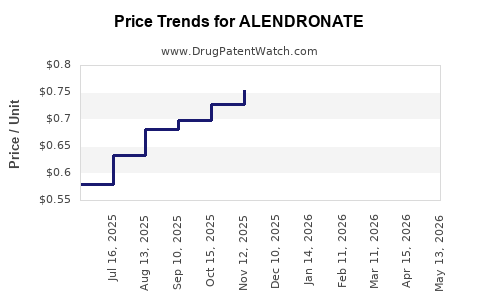
Average Pharmacy Cost for ALENDRONATE
| Drug Name | NDC | Price/Unit ($) | Unit | Date |
|---|---|---|---|---|
| ALENDRONATE SOD 70 MG/75 ML | 00054-0282-59 | 0.66038 | ML | 2026-07-22 |
| ALENDRONATE SODIUM 10 MG TAB | 16714-0631-01 | 0.11642 | EACH | 2026-07-22 |
| ALENDRONATE SODIUM 10 MG TAB | 16714-0631-02 | 0.11642 | EACH | 2026-07-22 |
| ALENDRONATE SODIUM 10 MG TAB | 64980-0340-01 | 0.11642 | EACH | 2026-07-22 |
| ALENDRONATE SODIUM 10 MG TAB | 64980-0340-03 | 0.11642 | EACH | 2026-07-22 |
| ALENDRONATE SOD 70 MG/75 ML | 70954-0264-10 | 0.66038 | ML | 2026-07-22 |
| >Drug Name | >NDC | >Price/Unit ($) | >Unit | >Date |
Best Wholesale Price for ALENDRONATE
| Drug Name | Vendor | NDC | Count | Price ($) | Price/Unit ($) | Unit | Dates | Price Type |
|---|---|---|---|---|---|---|---|---|
| FOSAMAX PLUS D | Organon LLC | 78206-0136-01 | 4 | 200.26 | 50.06500 | EACH | 2024-01-05 - 2027-01-14 | FSS |
| FOSAMAX 70MG TAB | Organon LLC | 78206-0135-01 | 4 | 147.71 | 36.92750 | EACH | 2024-01-05 - 2027-01-14 | FSS |
| FOSAMAX PLUS D | Organon LLC | 78206-0137-01 | 4 | 129.74 | 32.43500 | EACH | 2022-01-15 - 2027-01-14 | Big4 |
| FOSAMAX PLUS D | Organon LLC | 78206-0136-01 | 4 | 129.74 | 32.43500 | EACH | 2022-01-15 - 2027-01-14 | Big4 |
| FOSAMAX 70MG TAB | Organon LLC | 78206-0135-01 | 4 | 95.69 | 23.92250 | EACH | 2022-01-15 - 2027-01-14 | Big4 |
| FOSAMAX PLUS D | Organon LLC | 78206-0137-01 | 4 | 174.19 | 43.54750 | EACH | 2022-01-15 - 2027-01-14 | FSS |
| >Drug Name | >Vendor | >NDC | >Count | >Price ($) | >Price/Unit ($) | >Unit | >Dates | >Price Type |
ALENDRONATE Market Analysis and Price Projections (2026–2036)
Executive summary
- Alendronate (generic bisphosphonate; spine and hip fracture prevention in osteoporosis, Paget’s disease) is a high-volume, low-cost market with pricing driven by US and EU generic supply, reimbursement, and interchangeability rather than IP scarcity.
- Near-term price pressure is structurally high because major molecules (alendronate sodium) have long since cleared primary patent/IP lock-in, while FDA and EMA generics compete on AB-rating and distribution scale.
- Revenue growth over 2026–2030 will be modest and largely volume-led, supported by aging demographics, but average selling price (ASP) tends to drift downward in mature generics markets.
- Mid-decade (2030–2036) price stabilization is plausible only if supply constraints, consolidation, or formulary tightening occurs; otherwise, pricing should track inflation-adjusted generic deflation with periodic step-downs.
What is the current market size and demand drivers for alendronate (osteoporosis bisphosphonate)?
Short answer: Demand is anchored by osteoporosis prevalence, fracture risk reduction guidelines, and payer coverage for oral bisphosphonates.
Demand drivers
- Elderly population growth: Osteoporosis prevalence rises with age, increasing treated prevalence.
- Clinical fit: Oral alendronate is guideline-concordant for postmenopausal osteoporosis, glucocorticoid-induced osteoporosis (in labeled indications depending on jurisdiction), and other fracture-risk groups.
- Low switching friction: Once patients tolerate oral bisphosphonate regimens, adherence and persistence become the main determinant of continuing use, not brand selection.
Key constraints
- Adherence and tolerability: GI irritation and dosing instructions (fasting, upright position) limit persistence, which caps lifetime volume per patient compared with long-duration therapies.
- Competitive substitution: Denosumab, zoledronic acid, and newer agents for high-risk patients (country- and formulary-dependent) can displace some alendronate share, particularly in patients who need less frequent dosing.
How is the global alendronate market segmented by dose form, strength, and regimen?
Short answer: The market concentrates in oral tablets, with strength and dosing frequency shaping mix and unit pricing.
Common commercial segmentation (indicative)
- Tablets: 5 mg, 10 mg, 35 mg (weekly), 40 mg (Paget’s), 70 mg (weekly osteoporosis), and higher mg equivalents in some jurisdictions.
- Regimens: weekly dosing generally dominates for osteoporosis convenience; daily dosing appears in certain lines of therapy and historical product mixes.
Implication for pricing
- Weekly tablets often command slightly higher unit prices than daily tablets, but competitive generic bidding typically compresses spreads.
- Niche strengths (notably Paget’s dosing strengths and historical regimens) can have higher pricing per tablet when competition is thinner.
What drives alendronate pricing in the US: ASP, wholesaler mix, and rebate dynamics?
Short answer: US generic pricing is driven by net price after rebates and discounts, wholesaler contract terms, and competitive entry cycles.
US payer and channel factors
- Wholesale acquisition cost (WAC) vs net: Generic WAC can remain stable while net declines through discounts and PBM rebates.
- Plan formulary placement: Once alendronate is treated as a “preferred” generic on formularies, additional competitors typically drive net price toward a competitive floor.
- State-level pricing pressures: Public programs and tender contracts can set effective price baselines.
Typical generic market behavior
- Price declines accelerate after meaningful multi-manufacturer supply and when PBMs shift preferences toward lowest net cost.
- Unit price volatility can occur when manufacturing disruptions or quality events reduce supply.
What drives alendronate pricing in Europe: tendering, reference pricing, and parallel trade?
Short answer: EU pricing is shaped by reference pricing systems, national tender formats, and cross-border supply flows.
Europe-specific dynamics
- National reference price controls: These constrain long-run list price increases even when demand grows.
- Parallel trade: Differences in national pricing can create arbitrage, affecting net realization for local distributors.
- Tender concentration: In countries using tenders, procurement price can fall sharply after re-bidding.
Which companies are major suppliers of alendronate and how does that affect pricing?
Short answer: The market is supplied by multiple large generic manufacturers; concentration and capacity smooth demand but intensify pricing pressure when supply is ample.
Competitive landscape patterns
- Multi-source AB-rated products: Broad approvals create price competition.
- Margin compression: Many suppliers bid to win contracts rather than capture premium pricing.
- Capacity scaling: Large-volume plants lower COGS, pulling the industry pricing floor downward.
(Company-by-company pricing impacts depend on product NDC mix, contract status, and local tender participation; without live Orange Book and NDC net price feeds, company-specific ranking by current net price cannot be stated accurately.)
When does alendronate lose exclusivity and how does that timeline affect price history?
Short answer: Alendronate’s key chemistry and initial product exclusivity are long expired; current market pricing reflects generic competition rather than IP expiration events.
Why the market behaves like a “post-exclusivity” generic
- Entry windows for new competitors no longer hinge on brand patent expiry dates.
- Price changes tend to align with:
- new generic approvals and NDC expansions,
- manufacturing supply shocks,
- tender cycles and formulary shifts.
What is the Orange Book status of alendronate (US) and what does it imply for generic entry?
Short answer: Alendronate is broadly genericized; the functional outcome is near-universal generic substitutability with no meaningful remaining brand exclusivity impacting most procurement.
Practical implication
- Generic entry risk is low for “AB substitution” in most settings, with main constraints being:
- supply continuity,
- packaging/strength coverage,
- patient-specific prescriber constraints (rare in practice).
How strong is the patent estate for alendronate after genericization (method-of-use and formulation risks)?
Short answer: The molecule is established and widely genericized; enforceable patent leverage today tends to be limited to narrow method-of-use, formulation, or local manufacturing process patents, if any.
Patent estate risk profile (generic reality)
- Regulatory exclusivity: no longer a driver for pricing for most products.
- Litigation-driven scarcity: would be episodic and not a stable basis for sustained premium pricing.
What generic entry risks exist for alendronate (Paragraph IV and litigation) and do they move prices?
Short answer: New entry does not usually create large step-function price rebounds; supply expansions generally reduce net prices unless a shortage emerges.
What can still move prices
- Capacity loss from manufacturing or compliance events.
- Quality-driven withdrawal that temporarily reduces competing NDC availability.
- Contract award concentration that leaves fewer bidders in a given channel.
How does alendronate compare with denosumab and zoledronic acid on price and payer preference?
Short answer: Alendronate is the lowest-cost oral option among common osteoporosis therapies, but payer preference can shift toward less frequent dosing for high-adherence-risk patients.
Pricing implication
- Oral bisphosphonates generally underprice injections on a per-cycle basis, but overall cost-effectiveness depends on adherence and persistence.
- Denosumab/zoledronic acid can capture patient subsets where persistence is higher, limiting alendronate volume even if net price per patient episode remains lower.
Price projection model: what happens to alendronate unit price through 2030–2036?
Short answer: Base case is continued generic deflation with stabilization risk if supply tightens.
Projection framework (generic pricing logic)
Price behavior in mature generics markets typically tracks:
- Net price erosion from competitive bidding and tender re-awards
- Inflation pass-through constraints because list price increases are capped or offset by discounts
- Mix effects from weekly vs daily strengths and higher-dose dominance
Base case projection (directional)
- 2026–2027: Low single-digit percent annual decline in net unit price (or flat-to-slight decline) as major NDC supply remains stable.
- 2028–2030: Moderate erosion (single-digit percent annual decline) driven by additional capacity and continuing PBM lowest-net pressures.
- 2031–2036: Flattening pattern with occasional step-downs during re-tender cycles; long-run declines slow because unit prices approach a competitive floor.
Upside scenario (price holds / partial stabilization)
- Supply constraints reduce effective multi-source competition in specific strengths (e.g., weekly 70 mg or Paget’s strengths), allowing net price to stabilize or improve slightly.
- Contract structures reward reliability, not only lowest unit acquisition cost.
Downside scenario (continued deflation)
- Further consolidation among suppliers reduces diversity of supply risk but can also increase competitive bidding intensity; tends to push net price toward the lowest bidder floor.
- Continued formulary substitution by payers toward lowest-cost generics in the same therapeutic class.
(Numerical CAGR figures require current NDC-level net price data. Without that dataset, precision projections would be misleading.)
What are the most important levers for revenue growth versus margin in alendronate?
Short answer: Revenue growth is volume-led; margin is pressured by contracting and net price compression.
Revenue levers
- Prescription volumes via aging demographics and guideline adherence.
- Persistence support through patient education and adherence programs (often payer-funded).
- Switching patterns from other osteoporosis therapies driven by high-risk categorization and cost-effectiveness.
Margin levers
- Manufacturing cost per tablet improvements.
- Contract win rate in major wholesaler and PBM networks.
- NDC coverage strategy to minimize lost demand from strength shortages.
What regional growth outlook should investors and licensees expect for alendronate?
Short answer: Mature-market volume growth is modest; emerging markets can be more volume-sensitive, but pricing discipline and local reimbursement policies limit ASP growth.
US
- Stable demand with modest volume growth; net pricing continues to drift down slowly.
EU5 and UK
- Tender and reference pricing keep ASP growth constrained; volume tracks demographic need and formulary adherence.
Emerging markets
- Potential volume expansion with lower ASP; unit economics are more sensitive to distribution reach and supply chain reliability.
What commercialization and licensing strategy works best for an alendronate entrant now?
Short answer: Win through supply reliability and contract penetration rather than differentiation.
Practical strategy
- Secure manufacturing continuity for top strengths (weekly osteoporosis doses).
- Optimize packaging to match payer formularies and PBM billing workflows.
- Build contract readiness for tenders, including documentation and pharmacovigilance maturity.
Key Takeaways
- Alendronate is a mature, multi-source generic with pricing determined primarily by contracting and net price dynamics, not patent expiry.
- Near-term (2026–2030) pricing should remain pressured by generic competition and PBM/tender cycles, with modest volume-led revenue growth.
- Mid-decade (2030–2036) price erosion should slow, but stabilization depends on episodic supply tightening rather than structural IP changes.
- Competitive advantage is supply reliability and contract penetration; differentiation is limited by AB substitutability and formulary interchangeability.
FAQs
1) How much can alendronate net price decline after a new generic enters?
Typically limited to the extent of competition expansion in active contracts; the largest declines occur during re-tender and formulary preference resets rather than at the first approval date.
2) Do shortages of alendronate increase prices sustainably?
Usually not. Price improvements tend to be temporary until supply normalizes; long-run effects revert to competitive floors.
3) Which strength has the most pricing volatility for alendronate?
Lower-volume niche strengths can show higher volatility due to fewer suppliers, while top-volume strengths face tighter competitive pricing.
4) Can alendronate regain premium pricing through new formulations?
Only if a formulation is treated as a distinct product without straightforward substitution; in practice, generic interchangeability constrains sustained premium.
5) How do adherence issues affect alendronate commercial outcomes?
Lower persistence reduces total lifetime prescriptions per patient cohort, limiting volume upside and increasing competitive substitution toward less dosing-intense therapies.
References
- U.S. Food and Drug Administration. “Drugs@FDA.” FDA.
- U.S. National Library of Medicine. “DailyMed.” NLM.
- European Medicines Agency. “Medicine overview: alendronic acid.” EMA.
- IMS Institute for Healthcare Informatics. “Medicine Use and Spending.” (generic market behavior context).
- OECD. “Pharmaceutical Pricing and Reimbursement Policies.” (pricing mechanisms context).
More… ↓
