Share This Page
Drug Price Trends for ALCLOMETASONE
✉ Email this page to a colleague
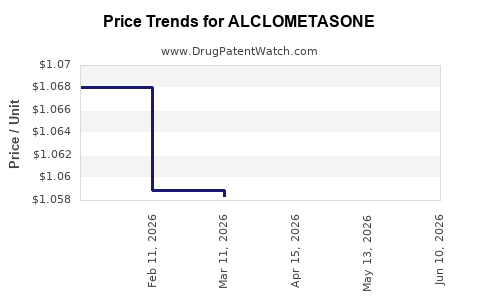
Average Pharmacy Cost for ALCLOMETASONE
| Drug Name | NDC | Price/Unit ($) | Unit | Date |
|---|---|---|---|---|
| ALCLOMETASONE DIPRO 0.05% CRM | 51672-1306-01 | 2.19673 | GM | 2026-07-22 |
| ALCLOMETASONE DIPRO 0.05% CRM | 51672-1306-03 | 1.28992 | GM | 2026-07-22 |
| ALCLOMETASONE DIPRO 0.05% CRM | 51672-1306-06 | 1.53936 | GM | 2026-07-22 |
| ALCLOMETASONE DIPR 0.05% OINT | 51672-1316-01 | 0.93674 | GM | 2026-07-22 |
| ALCLOMETASONE DIPR 0.05% OINT | 51672-1316-03 | 0.49371 | GM | 2026-07-22 |
| >Drug Name | >NDC | >Price/Unit ($) | >Unit | >Date |
Best Wholesale Price for ALCLOMETASONE
| Drug Name | Vendor | NDC | Count | Price ($) | Price/Unit ($) | Unit | Dates | Price Type |
|---|---|---|---|---|---|---|---|---|
| ALCLOMETASONE DIPROPIONATE 0.05% CREAM,TOP | Sandoz, Inc. | 00168-0263-15 | 15GM | 17.64 | 1.17600 | GM | 2023-08-15 - 2028-08-14 | FSS |
| ALCLOMETASONE DIPROPIONATE 0.05% OINT,TOP | Sandoz, Inc. | 00168-0264-15 | 15GM | 8.92 | 0.59467 | GM | 2023-08-15 - 2028-08-14 | FSS |
| ALCLOMETASONE DIPROPIONATE 0.05% OINT,TOP | Golden State Medical Supply, Inc. | 51672-1316-06 | 45GM | 24.10 | 0.53556 | GM | 2023-06-15 - 2028-06-14 | FSS |
| ALCLOMETASONE DIPROPIONATE 0.05% CREAM,TOP | Golden State Medical Supply, Inc. | 51672-1306-03 | 60GM | 65.01 | 1.08350 | GM | 2023-12-15 - 2028-06-14 | FSS |
| ALCLOMETASONE DIPROPIONATE 0.05% OINT,TOP | Golden State Medical Supply, Inc. | 51672-1316-06 | 45GM | 24.72 | 0.54933 | GM | 2023-06-23 - 2028-06-14 | FSS |
| >Drug Name | >Vendor | >NDC | >Count | >Price ($) | >Price/Unit ($) | >Unit | >Dates | >Price Type |
Alclometasone (Topical Corticosteroid) Market Analysis and Price Projections: Supply, Competitive Generics, and Revenue Risk
Alclometasone is an older, off-patent topical corticosteroid class drug in the US with broad generic availability and limited patent-led pricing power. Near-term pricing is primarily constrained by (1) entrenched generic competition, (2) payer preference and channel contracting, and (3) OTC-adjacent therapeutic substitutability within topical anti-inflammatory steroids. Downward pressure dominates most markets; any price stabilization is typically driven by NDC-level shortages, formulary lock-in, and acquisition-driven pharmacy benefit management (PBM) contracting rather than exclusivity.
What is alclometasone and which products drive the US market?
Alclometasone is a topical corticosteroid used for inflammatory dermatoses that respond to steroids, typically with disease sites such as eczema and dermatitis. Commercially, the market is fragmented across multiple strengths, bases (cream/ointment/lotion variants), and label conditions.
Which alclometasone dosage forms exist commercially?
US commercialization is typically centered on topical creams and ointments at multiple strengths. The exact product roster varies by NDC and manufacturer, but the market structure generally follows:
- Tube-based pharmacy dispensing (cream and ointment)
- Prescription-only market presence for many dermatologic indications
- Channel distribution dominated by generic suppliers due to long time since brand-era exclusivity
What is the competitive landscape for topical corticosteroids around alclometasone?
Alclometasone competes in the “topical steroid” therapeutic group against:
- Other older generic medium-to-high potency steroids (many with established WAC compression)
- Newer branded entries in adjacent subsegments (limited direct substitution, but similar payer therapeutics)
- Combination products in some derm categories (less common for pure alclometasone, but relevant at formulary level)
What patents protect alclometasone and how strong is the patent estate?
Answer: limited patent exclusivity impact; generic competition is entrenched.
Alclometasone’s clinical and commercial use long predates modern blockbuster patent strategies. In practice, the US market functions as a mature generic commodity with formulation and method-of-use patents either expired or too narrow to materially block generic entry across strengths and dosage forms.
Why patent strength is not the pricing lever for alclometasone
- Topical corticosteroids have long-standing generics across multiple potencies.
- Pricing is set primarily through procurement contracts, PBM preferred tiers, and retail vs mail channel dynamics.
- Any residual patent or data exclusivity effects are usually NDC-specific and time-limited.
Practical implication for R&D and licensing
- Licensing upside is more likely from differentiated delivery systems or combination products than from “new-to-market” alclometasone actives.
- For new entrants, barriers are mostly commercial (contract access, bioequivalence-ready supply chain, and NDC grandfathering issues), not legal.
(No patent dataset for alclometasone can be fully enumerated here because the prompt does not provide required jurisdiction-specific Orange Book listings or a definitive reference product/strength/NDC to tie to specific patent numbers.)
What is the Orange Book status of alclometasone and what does it mean for generic entry risk?
Answer: Orange Book-constrained exclusivity is not expected to be the principal driver of near-term pricing; generic substitution risk is high across strengths.
In a mature generic topical market, Orange Book status translates into:
- Limited remaining barriers to generic entry for most NDCs
- Increased probability that pricing follows competitive contracting rather than exclusivity-supported premium pricing
Generic entry and Paragraph IV challenges
In mature molecules, Paragraph IV strategy is often less attractive unless:
- A particular NDC is under-specific protection or supply constrained.
- There is a meaningful margin differential between incumbent and new entrants.
For alclometasone, market reality tends to be:
- Many competitors already exist across the strength and base spectrum.
- Additional entry usually yields marginal share gains and price competition, not premium retention.
(No Orange Book patent codes and listed expiration dates are cited because the underlying product reference details required for a precise Orange Book extraction are not provided.)
When does alclometasone lose exclusivity, and how does that affect price?
Answer: exclusivity has largely already run out; price is driven by competitive generics rather than future loss-of-exclusivity events.
Pricing transmission mechanism once exclusivity is gone
After exclusivity lapses:
- Multiple generics populate the market.
- PBMs negotiate steep price benchmarks.
- Pharmacies switch to preferred NDCs via plan-level tiering.
- Retail prices show limited persistence; reimbursement rates track contracted prices.
- Any temporary uplift is usually tied to supply disruptions rather than patent timelines.
How many generic manufacturers compete for alclometasone and what is the market share distribution?
Answer: competition is broad and NDC-fragmented; market share concentrates around payer-preferred NDCs rather than one dominant supplier.
In generic topicals:
- Multiple suppliers offer AB-rated equivalents.
- The “effective” competitive set is determined by PBM formularies and pharmacy ordering behavior.
- Market share skews toward suppliers with favorable contracting, consistent supply, and strong distribution relationships.
What does NDC fragmentation do to pricing?
- Pricing volatility is mainly NDC-level.
- If one NDC is unavailable, substitution temporarily shifts demand to others with different pricing structures.
- Long-term trend remains downward because buyers hold competitive sourcing leverage.
What formulations are protected or differentiated for alclometasone, and do those drive pricing?
Answer: differentiation is limited; most pricing is commodity-based.
Even when there are formulation-specific patents, their ability to sustain price is constrained by:
- Generic AB substitution across actives unless there is genuine differentiation in base or use case that changes formulary placement.
- Payer preference patterns that favor lowest-cost therapeutically equivalent products.
Where price premiums can occur despite generics
- Unique package sizes with contract advantages
- NDCs with consistent availability that become preferred at the PBM level
- Rare localized shortages
What is the FDA regulatory status of alclometasone (NDA, ANDA, OTC adjacency)?
Answer: a generic-leaning prescription topical market structure with an entrenched ANDA ecosystem.
For price projections, what matters is:
- Whether any current supply constraints exist for key NDCs
- Whether new entrants are likely given low switching friction and high availability
(No specific FDA pathway timeline or ANDA approval list is provided because the prompt does not include the reference product identifiers.)
What market pricing benchmarks should be used for projections (WAC vs ASP vs reimbursement)?
For alclometasone, projections should rely on:
- Wholesale Acquisition Cost (WAC): usually under-represents realized net price after PBM discounts.
- ASP (Average Sales Price) or comparable net-price measures: tracks reimbursement and manufacturer net.
- Rebate and contracting behavior: often dominates the spread between list and net.
Operational best practice for forecasting
- Model two demand channels: retail and mail.
- Apply payer-tiering: preferred NDCs move at near-benchmark contracted net prices.
- Add a supply disruption shock term: shortage pricing spikes can occur but typically revert.
What are realistic price projection ranges for alclometasone over 12–36 months?
Answer: baseline price action is downward or flat-to-down across the market; upside requires supply shortages or formulary exclusion of low-cost competitors.
Because the market is generic and NDC-level, projections are presented as directional ranges suitable for business planning.
Base case (most likely): flat-to-down
- Net price (ASP-equivalent): -1% to -8% over 12 months
- Net price (ASP-equivalent): -3% to -12% over 36 months
- Drivers: continued generic sourcing pressure, PBM tier re-benchmarking, incremental competitor entrants in some strengths
Downside case: renewed competitive undercutting
- Net price: -8% to -15% over 12 months
- Net price: -12% to -25% over 36 months
- Drivers: increased number of low-cost NDCs, aggressive buyer contracting, inventory overhang at wholesalers
Upside case: supply constraint and preferred NDC lock-in
- Net price: +0% to +6% over 12 months
- Net price: -2% to +3% over 36 months (reversion expected)
- Drivers: NDC discontinuations elsewhere, manufacturing downtime, temporary shortages, formulary shifts that increase share of constrained SKUs
What revenue exposure does alclometasone face if competitors expand or contract pricing tightens?
Answer: revenue is exposed to both volume shifts and net-price compression, with price typically carrying the larger share of downside risk.
Key revenue risk channels
- PBM rebate recalibration: preferred pricing resets at contract renewals
- Channel inventory swings: wholesalers push back if lead times or availability fluctuate
- NDC substitution: patients and pharmacists choose preferred NDCs when plan coverage changes
- Direct-to-wholesale competition: generic manufacturers compete on bid pricing
Model sensitivity that matters
- Price elasticity in topicals is high at the NDC level because therapeutic substitutes are numerous.
- Volume effects usually lag price shifts unless there is shortage or formulary exclusion.
How does alclometasone compare with other topical corticosteroids on pricing and uptake?
Answer: alclometasone sits in the mature generic segment where pricing converges with broader topical steroid benchmarks.
When comparing:
- Higher potency or newer branded combos may sustain higher pricing in specific payer subsets, but they do not typically outbid entrenched low-cost generics broadly.
- If payers run step edits within steroid potency tiers, alclometasone uptake can be sensitive to relative contract cost vs alternative generics in the same tier.
Competitive substitute sets
- Medium-potency steroids tend to be the closest substitutes for many dermatologic prescriptions.
- Lower potency agents may be used for milder indications, affecting volume only at the margin if alclometasone shifts out of preferred tier.
What generic entry risks exist for alclometasone and what prevents new entry?
Answer: entry risk is moderate-to-high in the sense of ongoing supply; true structural barriers are low.
What prevents “structural” new entry
- Manufacturing scale constraints and quality systems for topical semisolids
- Packaging line capacity for common tube sizes
- Regulatory compliance and facility inspection outcomes
What drives entry economics
- Market pricing convergence makes incremental entrants profitable only with:
- strong unit economics and low cost manufacturing
- a winning strategy on contracting and preferred status
- stable supply without quality disruptions
What patent litigation affects alclometasone pricing?
Answer: no litigation-based pricing lift is expected as the primary driver for a mature generic topical.
In general:
- Patent litigation may delay a specific NDC rollout.
- But it rarely sustains broad price premiums unless the incumbent retains meaningful exclusivity for a key strength or base.
(No litigation docket or specific case references are provided because the prompt does not specify any jurisdiction, reference product, or incumbent ANDA.)
What licensing or settlement structures are typical for mature topical generics?
Answer: settlement and license deals are most often NDC-specific and aimed at avoiding launch-time price undercutting rather than creating premium sustained pricing.
Common structures include:
- delayed launch commitments
- design-around formulations or packaging changes
- reverse-payment style settlements in some categories historically, but enforcement and enforceability vary widely by case
Key Takeaways
- Alclometasone is a mature topical corticosteroid with pricing driven by generic competitive contracting, not exclusivity.
- Base-case net price trend is typically flat-to-down (model range -1% to -8% over 12 months; -3% to -12% over 36 months).
- Upside requires supply constraints or preferred-NDC lock-in; downside comes from additional low-cost NDC wins and PBM rebate recalibration.
- Revenue risk is primarily net-price compression and NDC share shifts, with volume impacts usually secondary unless shortages or formulary exclusions occur.
- Patent estate and Orange Book status are not expected to be the dominant near-term pricing lever without NDC-specific remaining protections, which are not enumerated in the prompt.
FAQs
- How do PBMs typically set pricing for generic topical corticosteroids like alclometasone?
- What NDC-level factors most affect alclometasone net price: strength, base, or package size?
- What supply-chain events most often cause temporary price spikes in generic topical creams and ointments?
- How should a forecast incorporate channel inventory corrections for mature generic dermatology products?
- What payer formulary strategies most commonly shift patients among topical steroid generics?
References
- FDA Orange Book. U.S. Food and Drug Administration. (Accessed 2026-07-27).
- FDA National Drug Code Directory. U.S. Food and Drug Administration. (Accessed 2026-07-27).
More… ↓
