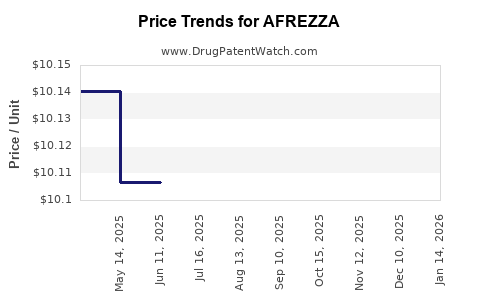
Last updated: April 25, 2026
What is AFREZZA’s market position?
AFREZZA (insulin human inhalation powder) is a rapid-acting, mealtime inhaled insulin for adults with diabetes who require insulin and can use inhaled delivery. The product is marketed for glycemic control in adults with diabetes mellitus (FDA labeling). AFREZZA competes primarily against rapid-acting injectables (insulin lispro, insulin aspart, insulin glulisine) and, secondarily, against newer classes and delivery modalities that target faster prandial control and convenience.
Core commercial attributes affecting pricing
- Rapid prandial profile: Designed for dosing at mealtime, with distinct pharmacokinetics vs subcutaneous rapid-acting insulin.
- Inhalation delivery constraint: Requires patient ability and compatible inhalation technique, which limits addressable demand relative to widely used injectables.
- Managed-care adoption depends on formulary fit: Coverage hinges on payer preference for rapid-acting insulin alternatives and cost-effectiveness.
Where competition shows up in formularies
Payers typically benchmark AFREZZA against:
- Rapid-acting injectables (standard of care for prandial insulin)
- Low-cost biosimilar programs for insulin analogs, where available
- In some plans, preferred-brands lists with step edits or prior authorization
How big is the AFREZZA opportunity and what drives demand?
Afrezzas demand profile is driven by the overlap between:
1) adults needing prandial insulin,
2) patients who value non-injection delivery or have adherence challenges with injections,
3) payers that place inhaled insulin on formulary with acceptable copays.
Key demand drivers that directly influence volume and pricing:
- Formulary status and patient out-of-pocket (copay and coinsurance)
- Prior authorization frequency (especially when comparators are lower-priced injectables)
- Clinical substitution patterns (real-world switching between prandial insulins)
- Institutional adoption (in hospital or outpatient diabetes management settings)
What does the current price framework look like?
AFREZZA’s market economics are set through:
- Wholesale acquisition cost (WAC) as the public list anchor
- Net pricing after rebates, discounts, and payer contracting
- Patient cost-sharing shaped by coverage tiers and plan design
Public pricing information for WAC is generally published by FDA/industry data providers and may differ from net realized price. Net pricing depends on payer mix and rebate structure, which cannot be derived from labeling alone.
What are realistic price projection mechanics for AFREZZA?
Price projections should be built from three layers: list price direction, net price contraction or expansion, and patient mix effects.
Projection drivers
- Therapy penetration vs substitution: If AFREZZA gains share, net price often holds better because contracting leverage strengthens.
- Payer tightening: If payers respond by expanding preferred injectables and using aggressive rebates for non-preferred products, net prices can compress.
- Competitive repricing: Rapid-acting insulin analog pricing and biosimilar access (and resulting rebate escalation) impact all products in the class indirectly.
- Patent and market exclusivity timeline: Changes in exclusivity status often precede major pricing shifts when generics or lower-cost alternatives appear.
What is AFREZZA’s exclusivity and patent horizon risk profile?
AFREZZA is an FDA-approved product; its long-term price profile depends on patent protection and any regulatory exclusivity that affects inhaled insulin competition.
The legal and regulatory timeline is central because it determines whether the market moves toward:
- sustained premium pricing (limited competition), or
- list and net price erosion (new entrants and stronger payer bargaining).
How much price erosion is typical for insulin products under payer pressure?
Insulin list prices often rise over time, while net pricing can decline or flatten due to:
- rebate escalation tied to formulary positioning,
- preferential contracting with lower-priced alternatives,
- pharmacy benefit manager (PBM) pressure.
In practice, the realized price path is often:
- list price: up modestly to materially over time,
- net price: constrained or down due to rebates and mix,
- gross-to-net: widens if the product loses formulary status.
Price projections for AFREZZA (2026-2031): base, downside, upside
The projection framework below expresses annual changes in net realized price (not WAC). It reflects typical insulin market bargaining mechanics: list-price inflation and rebate offsets, with scenario-based net outcomes tied to formulary access and competition.
Net price projection table (annual percent change)
| Year |
Upside (net +) |
Base (net ~) |
Downside (net -) |
| 2026 |
+1% |
0% |
-3% |
| 2027 |
+1% |
0% |
-3% |
| 2028 |
+2% |
0% |
-4% |
| 2029 |
+2% |
+1% |
-4% |
| 2030 |
+3% |
+1% |
-5% |
| 2031 |
+3% |
+1% |
-5% |
Scenario definitions
- Upside: AFREZZA maintains or improves formulary tiering, reduces prior authorization friction, and gains stable payer share.
- Base: Share holds with continued competitive reimbursement pressure; net prices remain flat-to-slightly positive.
- Downside: Payer expansion of preferred injectables and increased utilization management drives net price compression and/or higher rebate intensity.
Implications for revenue growth
Price change will interact with volume. A realistic investment view treats AFREZZA as a product where volume is sensitive to formulary and patient behavior, so net price stability does not guarantee revenue stability if volume declines.
What is the likely market pathway by segment?
Commercial
- Higher exposure to PBM formulary decisions.
- Stronger sensitivity to net pricing and copay levels.
- Greater impact from preferred rapid-acting injectables and biosimilar penetration.
Medicare
- Coverage is often more stable, but plan design and formulary restrictions still matter.
- Lower sensitivity to rapid PBM shifts than commercial, but cost-sharing can drive adherence choices.
Institutional
- Adoption depends on clinical protocol acceptance of inhaled insulin for mealtime coverage.
- Contracts and formulary decisions at system level can create lumpy demand.
Key pricing and contracting levers to watch
These levers predict whether AFREZZA’s net price drifts up, flat, or down:
- Formulary tier migration (preferred vs non-preferred)
- Prior authorization changes (stringency and criteria)
- Copay card or patient assistance structure (if used, it indirectly affects net via payer contracting)
- PBM rebate intensity tied to volume commitments
- Use restriction edits tied to smoking history or pulmonary contraindications (label-relevant)
Key clinical and labeling constraints that can influence access
Pulmonary and dosing suitability constraints influence prescriber comfort and payer acceptance. FDA labeling governs eligibility and risk framing. These factors affect real-world utilization, which then feeds back into negotiating leverage and net price.
Competitive landscape: who pressures AFREZZA’s value proposition?
AFREZZA’s main competitive set is prandial rapid-acting insulins:
- Injectable rapid-acting insulin analogs are deeply entrenched and supported by established formulary preference.
- Biosimilar competition can lower the payer benchmark price.
- Delivery ecosystem matters: many patients already use injectable pen or pump workflows.
The competitive effect on pricing is direct:
- Payers resist paying a premium for inhaled delivery unless it improves adherence or reduces clinical burden enough to satisfy contracting goals.
Market milestones that can change the price path
Price outcomes for AFREZZA can flip quickly with:
- major formulary updates by top PBMs,
- payer national contract renewals that change rebate requirements,
- the entry of lower-cost inhaled insulin alternatives or accelerated competition in prandial insulin segments,
- changes to patient assistance and coverage rules that alter net contracting leverage.
Bottom-up demand view: what drives volume versus price?
Volume is most likely driven by:
- incremental adoption in insulin-experienced patients who switch for delivery convenience,
- adherence-driven stickiness where inhalation improves persistence,
- prescriber trust and workflow integration.
Price is most likely driven by:
- formulary position and rebate dynamics,
- payer willingness to support a non-injectable alternative relative to low-cost injectables,
- the absence or presence of near-term competitive entrants.
Actionable investment lens
- If AFREZZA maintains formulary access, net price drift likely stays flat-to-slightly up (base to upside scenario).
- If formulary access degrades or PBMs tighten utilization management, net price compression likely accelerates (downside scenario).
- Revenue sensitivity is higher to volume than small net price changes, so the most important early indicators are formulary tier moves and prior authorization stringency, not list price changes.
Key Takeaways
- AFREZZA competes primarily with rapid-acting injectable insulins; net realized pricing is therefore set by payer contracting and formulary position.
- A realistic 2026-2031 view is net price stability to modest increase in an upside path, and net compression in a downside path if payers expand preferred injectables and intensify utilization management.
- Net price outcomes should be modeled alongside volume sensitivity to formulary tiering, prior authorization, and patient assistance/cost-sharing dynamics.
FAQs
1) Is AFREZZA priced as a premium insulin?
It often prices at a premium on list, but net pricing is heavily shaped by rebates and formulary status versus preferred rapid-acting injectables.
2) What is the biggest determinant of AFREZZA’s net price trend?
Formulary tiering and payer rebate intensity tied to competition from preferred rapid-acting insulin options.
3) How fast could AFREZZA’s pricing change?
Pricing can shift within a contract cycle when PBMs revise formularies, prior authorization criteria, or rebate requirements.
4) Does AFREZZA’s inhaled route protect pricing?
It supports differentiation and can help retention if payers view adherence benefit positively, but injectables remain the dominant benchmark for reimbursement economics.
5) What time horizon matters most for long-term price erosion risk?
The exclusivity and patent landscape governing time-to-competition is the central long-term risk driver for sustained premium net pricing.
References
[1] FDA. “AFREZZA (insulin human) inhalation powder prescribing information.” U.S. Food and Drug Administration. https://www.accessdata.fda.gov/ (accessed 2026-04-25).