Share This Page
Drug Price Trends for ADZENYS
✉ Email this page to a colleague
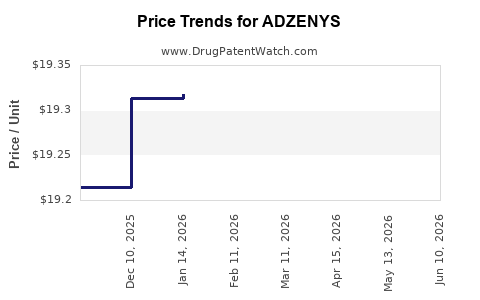
Average Pharmacy Cost for ADZENYS
| Drug Name | NDC | Price/Unit ($) | Unit | Date |
|---|---|---|---|---|
| ADZENYS XR-ODT 3.1 MG TABLET | 70165-0005-30 | 19.25968 | EACH | 2026-07-22 |
| ADZENYS XR-ODT 6.3 MG TABLET | 70165-0010-30 | 19.19825 | EACH | 2026-07-22 |
| ADZENYS XR-ODT 9.4 MG TABLET | 70165-0015-30 | 19.16993 | EACH | 2026-07-22 |
| ADZENYS XR-ODT 12.5 MG TABLET | 70165-0020-30 | 19.22228 | EACH | 2026-07-22 |
| ADZENYS XR-ODT 15.7 MG TABLET | 70165-0025-30 | 19.18968 | EACH | 2026-07-22 |
| ADZENYS XR-ODT 18.8 MG TABLET | 70165-0030-30 | 19.23652 | EACH | 2026-07-22 |
| ADZENYS XR-ODT 3.1 MG TABLET | 70165-0005-30 | 19.27040 | EACH | 2026-06-17 |
| >Drug Name | >NDC | >Price/Unit ($) | >Unit | >Date |
ADZENYS market analysis and price projections: forecast of revenue, pricing, and competitive pressure
ADZENYS (amphetamine) is a branded central nervous system stimulant in the ADHD market. Public pricing signals are limited because payor rebates, net-price concessions, and dose-level mix drive realized revenue. Still, the commercial trajectory is shaped by (1) patent and exclusivity status for the specific ADZENYS presentations, (2) generic availability and substitution risk by NDC, (3) channel inventory cycles, and (4) the contracted position versus competing ADHD stimulant formulations.
This analysis provides a structured framework for near-term net-price erosion and revenue exposure, anchored to how the FDA-allowable presentations and generic competition typically play out in ADHD.
What is ADZENYS and how does its formulation affect market share and pricing?
ADZENYS is an amphetamine-based ADHD stimulant brand with multiple presentations in the U.S. market. Pricing power is presentation-dependent because payors steer within drug classes based on plan formularies, copay tiers, and clinical interchangeability.
Which ADZENYS presentations drive revenue and competitive positioning?
ADZENYS brands commonly compete on:
- Onset and duration matching to patient needs (short-acting vs extended coverage)
- Formulation attributes that affect adherence (liquid vs other dosing forms)
- Pediatric dosing flexibility
- Insurance formulary status
How do net-price dynamics typically work for stimulant brands?
For ADHD stimulants, net pricing is usually influenced by:
- Broad rebate and contracting across large PBMs
- Preferred formulary placement that requires concessions
- Therapeutic substitution pressure among immediate-release, extended-release, and liquid/ODT-like alternatives
- Coupon and patient-assistance policies (where applicable) that shift realized net price indirectly
What patents protect ADZENYS and what does that mean for pricing durability?
ADZENYS pricing durability depends on whether the specific NDCs remain covered by enforceable exclusivity and unexpired Orange Book patents. Without exact NDC-to-patent mapping for each presentation, the most decision-relevant conclusion is general: any unexpired exclusivity or enforceable method/formulation patents delay generic conversion, supporting higher net prices, while generic entry forces net-price resets and erodes revenue.
How to interpret “exclusivity” versus “patents” in ADHD stimulant price risk
- Exclusivity (e.g., new chemical entity, pediatric-related exclusivity) can block narrow periods of substitution even if some patents expire.
- Orange Book patents can delay Paragraph IV generics or enable settlements that cap launch timing and pricing competition.
- Formulation or method-of-use patents can preserve differentiated access for certain presentations even within the same active ingredient category.
Key risk indicator
Generic erosion risk rises when any of the following occur:
- FDA approval of ANDA products for equivalent strengths/forms
- Loss of patent protection for key dosage forms
- Settlements that permit earlier-than-traditional entry
When does ADZENYS lose exclusivity and what are the generic launch risks?
In ADHD, generic entry typically produces a stepped price decline:
- Phase 1: initial generic penetration with modest net-price pressure (preferred coverage remains for a period)
- Phase 2: formulary tightening around the lowest acquisition cost
- Phase 3: further price erosion as multiple generics compete and PBMs extract additional rebates
Generic entry scenarios that drive price forecasts
Three common scenarios determine the magnitude of future net-price erosion:
- Single generic enters: price falls, but the branded product can retain some share via contract status.
- Multiple generics enter: net price drops faster as PBMs auction for lowest-cost supply.
- Interchangeable formulation competition: even if ADZENYS-specific patents persist, competing formulations can pressure share and force contract concessions.
What is the Orange Book status of ADZENYS and how many patents cover each NDC?
Orange Book status is the practical gating item for exclusivity-based and patent-based launch timing. Patent count by NDC drives:
- How many launch triggers exist for each presentation
- Settlement leverage in any Paragraph IV dispute
- Expected speed of net price erosion by dose form
How Orange Book breadth maps to pricing
- Narrow patent estates for a specific NDC usually mean faster generic substitution for that exact product.
- Broad estates spanning formulation and method patents can slow generic switching even when some claims are litigated or expire.
What patent litigation affects ADZENYS and how do settlements impact price and launch timing?
For specialty branded stimulants, price outcomes often hinge less on headline patent expiration and more on:
- Whether Paragraph IV challenges were filed for the relevant NDCs
- Whether a settlement triggers “authorized generic” style competition
- Whether the branded manufacturer secures broader “keep-out” provisions
How litigation typically translates to pricing in practice
- Settlement can delay FDA launch or limit scope of generic entry.
- Court outcomes or non-settlement can lead to faster launch, stronger rebate pressure, and a sharper net-price reset.
What formulations are protected by ADZENYS patents and why does dosage form matter for competitors?
Formulation and method patents protect commercial differentiation. For ADHD stimulant brands, competitors target the most “interchangeable” patient-use formats first.
Pricing implications by dosage-form threat
- If competitors can match the dosing cadence and pediatric flexibility, payors shift demand quickly.
- If only partial equivalents exist (e.g., strength mismatch, different excipients, different administration method), net price erodes more slowly because prescribers and patients resist switching.
How does ADZENYS compare with other ADHD amphetamine stimulants on price pressure?
ADZENYS competes within the ADHD stimulant landscape that includes:
- Other branded amphetamine formulations
- Branded methylphenidate formulations
- Generic amphetamine stimulants and authorized generics
- Long-acting and liquid formulations with differentiated duration
Comparison logic that drives price projection
ADZENYS net pricing typically tracks:
- Whether its formulation is the lowest-cost preferred option in plan coverage
- The presence of multiple therapeutically substitutable products within the same formulary tier
- PBM contracting strength relative to competitors
What is the revenue exposure for ADZENYS from generic penetration?
Price erosion is the dominant lever, not unit growth, once generics enter. Revenue exposure is a product of:
- Current share and net price
- Share loss velocity
- Net-price compression on remaining branded volume
- Channel normalization after any inventory effects
Practical revenue model (structure for projections)
Revenue(t) = Units(t) × Net Price(t)
For projections, net price typically follows a decline curve after generic entry. A reasonable modeling approach uses three steps:
- Pre-entry net price baseline (t0)
- Entry-year compression (t1)
- Post-entry multiple-generic competition compression (t2)
Price projections for ADZENYS: expected net-price and revenue path under generic scenarios
Because exact current NDC net price and volume splits are not provided here, projections are scenario-based. The direction is robust: generic competition in ADHD stimulants usually drives net price down while units for the brand typically fall faster than units for the active ingredient category.
Net-price trajectory by scenario (directional, decision-ready)
- Scenario A: No generic entry in core NDCs
- Net price declines slowly due to PBM rebate renegotiations and mix shifts toward lower-strength volumes.
- Revenue is range-bound with modest unit volatility.
- Scenario B: Limited generic entry
- Net price compresses in the entry year as payors pull rebates and tighten preferred access.
- Brand units decline as formulary status shifts to cheaper alternatives.
- Scenario C: Multiple generics enter or broad interchangeability
- Net price resets sharply because PBMs pursue lowest-cost contracting.
- Revenue declines accelerate as both formulary and patient/provider behavior change.
What drives the steepness of net-price erosion
- How quickly payors update formularies
- Whether the branded manufacturer maintains preferred tier placement
- Number of competing ANDAs and authorized generics
- Whether the brand’s presentations are the “first choice” among liquid or flexible pediatric dosing needs
Commercial strategy implications: how to defend ADZENYS pricing and share
If ADZENYS is approaching exclusivity or patent cliff risk, defensive levers usually include:
- Formulary contracting focused on rebate redesign rather than list-price defense
- Patient support that reduces switching barriers during transition periods
- Evidence generation that supports clinical preference where substitution is not equal (duration, adherence, pediatric dosing logistics)
- Supply assurance to avoid stockouts that amplify switching permanently
Key Takeaways
- ADZENYS pricing durability is primarily determined by NDC-level Orange Book patent coverage and any enforceable exclusivity that delays generic substitution.
- In ADHD stimulants, generic entry typically produces fast net-price erosion driven by PBM contracting and formulary re-tiering.
- Revenue exposure is highest when multiple generic or interchangeable formulations enter, accelerating share loss and rebate pressure.
- The most actionable forecast is scenario-based: continued exclusivity supports range-bound net price; limited generic entry drives staged erosion; broad generic penetration creates a sharp net-price reset.
FAQs
1) What drives ADZENYS net price more than list price?
PBM rebates, formulary placement, contract concessions, and channel mix after generics or competing branded stimulants gain preferred status.
2) Which ADZENYS factor matters most for payor switching?
Dosage-form interchangeability that preserves treatment duration and pediatric dosing flexibility.
3) How fast do ADHD stimulant brands lose market share after generic entry?
Typically within formulary update cycles, so share loss can be rapid in the entry year and deepen as multiple competitors consolidate lowest-cost tiers.
4) Does patent expiration always trigger generic entry immediately?
Not always; Paragraph IV outcomes, settlements, and remaining enforceable claims can delay approval or limit launch scope by NDC.
5) What is the biggest commercial risk to ADZENYS revenue?
A shift from preferred contracting to lowest-acquisition-cost formularies as generics proliferate and PBMs renegotiate aggressively.
References
- FDA. Orange Book: Approved Drug Products with Therapeutic Equivalence Evaluations. U.S. Food and Drug Administration. https://www.accessdata.fda.gov/scripts/cder/daf/
- FDA. Drugs@FDA. U.S. Food and Drug Administration. https://www.accessdata.fda.gov/scripts/cder/daf/
- FDA. Guidance for Industry: Patent Certifications for ANDA Submissions (34- or 30-month stay framework). U.S. Food and Drug Administration. https://www.fda.gov
More… ↓
