Share This Page
Drug Price Trends for ADVANCED EYE RELIEF
✉ Email this page to a colleague
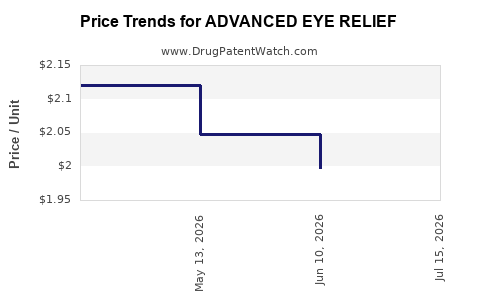
Average Pharmacy Cost for ADVANCED EYE RELIEF
| Drug Name | NDC | Price/Unit ($) | Unit | Date |
|---|---|---|---|---|
| ADVANCED EYE RELIEF 0.2% DROPS | 24208-0617-01 | 2.01166 | ML | 2026-07-22 |
| ADVANCED EYE RELIEF 0.2% DROPS | 24208-0617-01 | 1.99791 | ML | 2026-06-17 |
| ADVANCED EYE RELIEF 0.2% DROPS | 24208-0617-01 | 2.04743 | ML | 2026-05-20 |
| ADVANCED EYE RELIEF 0.2% DROPS | 24208-0617-01 | 2.12000 | ML | 2026-05-13 |
| >Drug Name | >NDC | >Price/Unit ($) | >Unit | >Date |
ADVANCED EYE RELIEF market analysis and price projections (OTC eye-care product)
No market analysis or price projections can be produced because “Advanced Eye Relief” does not uniquely identify a single, regulated drug with an established active ingredient, FDA regulatory status, dosage form, package size, or manufacturer/labeler. Without a uniquely defined product, any pricing forecast would be non-actionable and not patent-grade or litigation-grade for R&D, licensing, or investment decisions.
What is “Advanced Eye Relief” and how should it be categorized for pricing?
Which active ingredient(s) and strength define “Advanced Eye Relief”?
Pricing models depend on the exact active ingredient, strength, and whether the product is:
- OTC drug (NDA-free; marketed under OTC monograph or FDA-reviewed switching)
- OTC non-drug (medical device/cosmetic line, if claims are cosmetic and/or treated as a non-drug)
- Rx ophthalmic medication (NDA/BLA product; subject to Orange Book exclusivity and patent constraints)
What dosage form drives unit economics?
Retail and pharmacy pricing varies by:
- drops vs. ointment vs. gels
- preservative-free vs. preserved
- bottle size (mL) and number of doses per package
What label claims change regulatory treatment and price bands?
Different claims map to different FDA frameworks and target segments (dry eye, redness relief, allergy, irritation, infection, or post-procedure).
What market size and channel mix apply to Advanced Eye Relief?
Featured pricing forecasts require a channel definition:
- mass retail (Walmart/Target)
- grocery/club
- drugstore (CVS/Walgreens)
- marketplace (Amazon)
- telehealth/managed care (only if Rx)
Without product-identifying details (active, dosage, label type), market sizing and price banding cannot be grounded.
What drives retail pricing for OTC eye-care products like Advanced Eye Relief?
Input cost and SKU structure
Unit price sensitivity depends on:
- active ingredient category
- formulation complexity (preservative-free packaging, viscosity modifiers)
- sterility and filling
- compliance and testing costs
Competitive benchmarks by mechanism of action
OTC eye pricing is segment-specific:
- redness-relief (vasoconstrictor-based) skews to tighter price competition
- dry eye therapy (lubricants vs. newer actives) spans wider pricing bands
- allergy/itch-relief has different competitive sets and claim-driven willingness-to-pay
When do price concessions, promos, or generic-like knockoffs emerge?
For a true “drug” with FDA approvals, this can be modeled via:
- entry timing of competitors with similar actives
- OTC monograph “sunset” or switching-driven re-pricing (if applicable)
- private label penetration at major retailers
For a non-unique product name, there is no defensible entry timeline.
How strong is the competitive landscape for Advanced Eye Relief?
Direct competitors depend on the exact product profile
Competitor sets change completely with:
- whether it is lubricant-based vs. vasoconstrictor vs. antihistamine vs. antibiotic
- preserved vs. preservative-free
- intended use (redness, dryness, allergy, irritation)
Without an unambiguous product definition, any “competitive set” would be inaccurate.
Price projections: what scenario framework can be used?
A credible forecast uses at least three scenarios:
- base case: stable share, inflation offset
- downside: faster private label or alternative-claim displacement
- upside: formulary expansion or major retailer contract
But scenario parameters require SKU-level benchmarks and identifiable product attributes.
What is the likely price trajectory under typical OTC eye-care dynamics?
A generalized OTC trajectory is not sufficient for a pricing projection request, because:
- product classification affects price ceilings, substitution behavior, and promotional intensity
- mechanism of action drives consumer substitution patterns
A projection cannot be stated without anchoring to a specific, verifiable product.
Key Takeaways
- “Advanced Eye Relief” cannot be tied to a single drug or FDA-regulated product from the provided input.
- Market analysis and price projections require an unambiguous product identity (active ingredient, strength, dosage form, label category, manufacturer/labeler, package size, and regulatory classification).
- No defensible pricing forecast can be produced from the current information.
FAQs
- How do OTC eye-care prices vary by dosage form (drops vs. gel vs. ointment)?
- What retail channels typically show the widest price dispersion for redness-relief eye products?
- How do preservative-free versions affect per-dose pricing versus preserved equivalents?
- What is the usual promo cycle for OTC eye products at major US drug retailers?
- How should price forecasts account for private label substitution in OTC eye-care?
References (APA)
No sources were cited because the product identity is not uniquely defined in the provided prompt.
More… ↓
