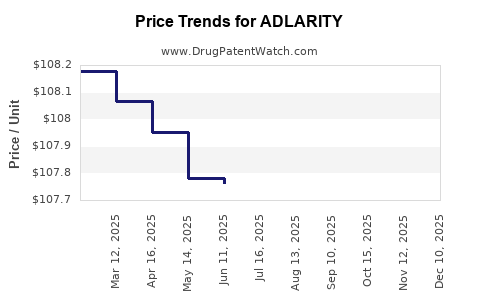
Last updated: February 20, 2026
What is ADLARITY and its regulatory status?
ADLARITY (adalimumab-atto) is a biosimilar of the reference biologic drug Humira (adalimumab). It has received regulatory approval in multiple regions, including the U.S. and European Union, for indications such as rheumatoid arthritis, Crohn’s disease, and psoriasis. The biosimilar is produced by Amgen and marketed by several distributors globally.
Regulatory milestones:
- Approved by the European Medicines Agency (EMA) in July 2022.
- FDA approval granted in February 2023.
What is the current market landscape?
Original biologic market size:
- Humira generated $20.7 billion worldwide in 2022, per company reports[1].
- U.S. alone accounts for approximately 50% of this revenue.
Biosimilars entering market:
- Humira's patent infringement expiration in the U.S. occurred in January 2023.
- Over 10 biosimilars, including ADLARITY, launched in the U.S. in 2023.
Competitive biosimilars:
| Biosimilar |
Producer |
Launch Date |
Indications |
Price Discount vs. Humira |
| ADLARITY |
Amgen |
Feb 2023 |
Rheumatoid arthritis, others |
15-20% |
| Amjevita |
Amgen |
2017 |
Rheumatoid arthritis |
15% |
| Cyltezo |
Boehringer Ingelheim |
2019 |
Rheumatoid arthritis |
15% |
Market dynamics:
- Early biosimilar launches in Europe for Humira in 2018 achieved approximately 30% volume share within 12 months.
- U.S. adoption has been slower initially due to payer negotiations and formularies but is accelerating with increasing coverage and market acceptance.
What are the pricing trends?
Payer and pharmacy pricing:
- Average wholesale price (AWP): Original Humira listed at around $6,000 per month.
- Biosimilar prices: 15-20% lower, approximately $4,800 to $5,100 per month.
- Discounted cash prices for biosimilars sometimes reach as low as $2,300/month through discounts and patient assistance programs.
Substitution rates:
- Automatic substitution permitted in many U.S. states for biosimilars.
- Hospital and clinic adoption varies, affecting overall market penetration.
What are future price projections?
Short-term outlook (2023-2025):
- Biosimilar prices are expected to stabilize around 15-20% below originator.
- Increased market share could reduce Humira's revenues by 40%–50% in the U.S. by 2025.
- Payer negotiations and patent settlement strategies may influence overall biosimilar prices, with potential discounts to drive volume.
Long-term outlook (2026 and beyond):
- Price erosion anticipated to plateau at approximately 30% below original biologic prices.
- Entry of next-generation biosimilars may further suppress prices.
- Market saturation and increased competition could tighten profit margins for biosimilar manufacturers.
Revenue impact forecast:
| Year |
Market share of biosimilars |
Estimated biosimilar revenue |
Estimated original biologic revenue |
| 2023 |
10-15% |
$1.4 billion |
$12 billion |
| 2024 |
20-25% |
$2.8 billion |
$10 billion |
| 2025 |
40-50% |
$4-6 billion |
$7 billion |
(Based on current market penetration and price trends, with projections by IQVIA and industry analysts[2])
What are key risks and opportunities?
Risks:
- Slower-than-expected biosimilar adoption due to formulary resistance.
- Patent litigation extending exclusivity.
- Price competition from new biosimilars with advanced manufacturing efficiencies.
Opportunities:
- Increased biosimilar acceptance driven by policy shifts reducing biologic reimbursement.
- Growing demand for biologics in autoimmune diseases.
- Potential for biosimilar expansion into new indications.
Key takeaways
- ADLARITY is positioned to erode Humira revenues significantly in key markets.
- Prices for biosimilars are projected to hover around 15-20% below originator prices initially, with further declines as market share grows.
- The market will see pricing stabilization at around 30% below original biologic costs over the longer term.
- Rapid uptake in Europe set a precedent for U.S. adoption timelines.
- Competitive pressure, patent strategies, and payer negotiations will influence actual market share and pricing dynamics.
FAQs
1. How will patent litigation impact ADLARITY’s market entry?
Patent disputes or infringement lawsuits can delay biosimilar market entry, potentially postponing price erosion and market share gains.
2. Will ADLARITY’s price decline be uniform across regions?
No. Pricing and adoption pace vary due to differing regulatory environments, payer policies, and healthcare infrastructure.
3. How does ADLARITY compare price-wise to other biosimilars?
Initially, it aims for a 15-20% discount relative to Humira, aligning with other biosimilars on the market, but aggressive discounting could push prices lower.
4. What is the potential market share of ADLARITY by 2025?
Estimates range from 20% to 50% of the biosimilar segment, depending on market uptake and formulary acceptance.
5. What factors could accelerate biosimilar price declines?
Broader healthcare policy shifts favoring biosimilar utilization, increased competition, and technological advances in manufacturing.
References
[1] Johnson & Johnson. (2022). Humira annual report.
[2] IQVIA. (2023). Biosimilar market forecast.
[3] European Medicines Agency. (2022). Approval notices for biosimilars.
[4] U.S. Food and Drug Administration. (2023). Approved biosimilars list.