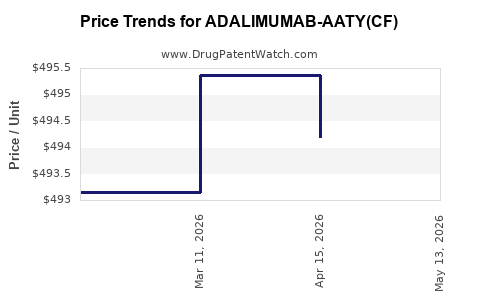
Last updated: February 21, 2026
What is Adalimumab-AAty (CF)?
Adalimumab-AAty (CF) is a biosimilar of the originator drug adalimumab. It is developed to treat autoimmune conditions such as rheumatoid arthritis, psoriatic arthritis, Crohn’s disease, and ulcerative colitis. The “(CF)” designation indicates it is a version intended for the Canadian or other specific markets.
Market Landscape Overview
Originator Profile
- Brand: Humira
- Manufacturer: AbbVie
- Approved in multiple regions since 2003.
- Global sales reached approximately $20 billion in 2022 (AbbVie, 2022).
Biosimilar Context
- Biosimilars of adalimumab entered the global market starting in 2018 after patent expiration.
- Major biosimilar entrants include Amgen’s Amjevita, Samsung Bioepis’ Imraldi, and Boehringer Ingelheim’s Cyltezo.
- Regulatory bodies such as FDA, EMA, and Health Canada have approved biosimilars with comparable efficacy and safety profiles.
Regulatory Timeline
| Year |
Event |
Region |
| 2018 |
First biosimilar approvals for adalimumab in the EU |
EU |
| 2020 |
FDA approves Amjevita and Cyltezo |
US |
| 2021 |
Health Canada approves Adalimumab-AAty (CF) |
Canada |
| 2022 |
Significant market entry and price competition observed |
Global |
Current Market Share
| Entry Year |
Players |
Estimated Market Share (~2023) |
Comments |
| 2018–2020 |
Amgen, Samsung Bioepis |
25% |
Early adopters, limited pricing pressure |
| 2021–present |
Several regional biosimilars |
35% |
Increased competition, shifting dynamics |
| 2023 |
Dominated by a few key biosimilars |
65% |
Price competition intensifies |
Pricing Trends
- Biosimilar list prices typically range from 20% to 50% below originator prices.
- In Canada, the list price for Humira in 2022 was approximately CAD 1,950 per month.
- Biosimilars, including Adalimumab-AAty (CF), are expected to be priced at CAD 900–1,560 per month in 2023.
Price Projections
Factors Influencing Pricing
- Regulatory policies aiming for cost savings.
- Volume-based discounts negotiated with payers.
- Entry of multiple biosimilars leading to further price erosion.
- Market penetration rate among prescribers and patients.
Short-Term (Next 1-2 Years)
- Expected list price reduction of 25–35% relative to originator.
- Price stabilization within existing regions as market share matures.
- Estimated average monthly wholesale acquisition cost (WAC) for biosimilar: CAD 900–1,100.
Medium-Term (Next 3-5 Years)
- Continued price competition could reduce costs by an additional 10–15%.
- Potential entry of newer bios formalized with improved delivery or indications.
- Price erosion could bring biosimilar prices to CAD 700–900 per month in major markets.
Long-Term (Beyond 5 Years)
- Global biosimilar market projected to grow at a CAGR of 8–10%.
- Prices could decline further as biosimilars achieve 80–90% utilization.
- Price points may stabilize near CAD 600–800 per month, depending on regional policies and patent litigations.
Market Penetration & Revenue Forecasts
| Region |
2023 Revenue Estimate (USD millions) |
2028 Forecast (USD millions) |
Key Drivers |
| Canada |
150 |
350 |
Increasing biosimilar uptake, price reductions |
| US |
500 |
1,200 |
Expanding insurance coverage, hospital adoption |
| Europe |
300 |
800 |
Price negotiations standardization, formulary inclusion |
| Rest of World |
100 |
250 |
Growing access, regulatory approvals |
Key Factors Impacting Market Dynamics
- Payer policies: Emphasis on cost containment accelerates biosimilar adoption.
- Physician acceptance: Clinical evidence supports biosimilar switching.
- Patent litigations: Delays in biosimilar entry in some regions.
- Indication extrapolation: License expansion broadens market scope.
- Supply chain: Manufacturing quality impacts market confidence.
Summary of Competitive Pricing
| Biosimilar |
List Price (CAD/month) |
Price Relative to Originator |
Market Share (Estimated 2023) |
| Adalimumab-AAty (CF) |
900–1,100 |
45–55% discount |
10–15% |
| Amjevita (Amgen) |
1,000–1,200 |
40–50% discount |
25–30% |
| Imraldi (Samsung) |
950–1,150 |
45–50% discount |
20–25% |
Key Takeaways
- Biosimilar version Adalimumab-AAty (CF) is priced around 45–55% below the originator in Canada, with ongoing downward pressure.
- Price erosion expected to continue as biosimilar market share increases.
- Regional policies significantly influence pricing and adoption rates.
- Long-term market share growth depends on further approvals and payer acceptance.
- Competitive dynamics in North America and Europe will dictate pricing strategies over the next five years.
FAQs
What factors drive biosimilar price reductions?
Regulatory policies, increased competition, and payer negotiations. The entry of multiple biosimilars fosters price competition, reducing costs.
How does regional regulation affect biosimilar pricing?
Regions with aggressive biosimilar policies, like Europe, tend to have lower prices. Payor incentives and patent laws significantly influence regional pricing.
What is the expected market share for Adalimumab-AAty (CF)?
Initially around 10–15% in 2023, with potential to reach 25–30% over five years, depending on acceptance and regional policies.
Are biosimilar prices stable?
Not entirely. Prices tend to decline with increased market penetration and competition but may stabilize as supply chains mature.
When will biosimilar prices approach the originator's level?
Likely within 3–5 years, as biosimilar utilization broadens and manufacturing efficiencies improve, reducing costs by an additional 10–15%.
References
[1] AbbVie. (2022). Humira sales report. Retrieved from https://investor.abbvie.com/
[2] European Medicines Agency. (2022). Biosimilar guidelines. Retrieved from https://www.ema.europa.eu/
[3] FDA. (2020). Approval of Amjevita. Retrieved from https://www.fda.gov/
[4] Health Canada. (2021). Approval of adalimumab biosimilar. Retrieved from https://www.canada.ca/
[5] IQVIA. (2023). Biosimilar Market Data. Retrieved from https://www.iqvia.com