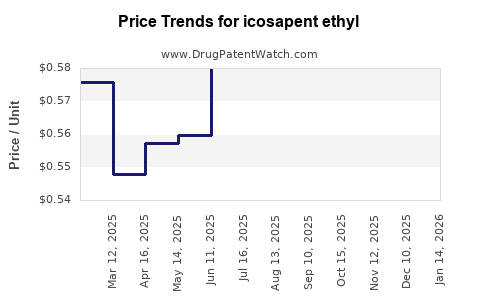
Last updated: April 25, 2026
How big is the ICOSAPENT ETHYL market and where does demand concentrate?
Global and US sales base
- Product: Icosapent ethyl (brand Vascepa; AMR-505; ethyl ester of EPA).
- Indication footprint driving current demand:
- Cardiovascular risk reduction in patients with elevated triglycerides on statin therapy (legacy core).
- Expanded cardiovascular outcomes in selected triglyceride populations per label updates.
- Demand concentration:
- US is the largest revenue pool due to higher adoption and payer coverage.
- Growth is tied to (1) persistent diagnosis of hypertriglyceridemia, (2) guideline adherence, (3) formulary access, and (4) competitive substitution dynamics in lipid-risk management.
Key market drivers by commercial function
1) Prescriber economics
- Icosapent ethyl is priced as a premium lipid-risk therapy, typically positioned against:
- Omega-3 mixtures (lower-spec EPA/DHA profiles)
- Fibrates and adjunct statin strategies for triglyceride control
- Uptake is supported where payers implement clear outcome-based coverage and where pharmacy benefit structures favor preferred brands.
2) Payer economics
- Payer coverage is the gating variable for incremental patients beyond the entrenched cohort.
- Formularies tend to narrow access for non-preferred omega-3s, leaving premium brands with the majority of utilization when coverage is restricted.
3) Clinical adoption
- Uptake correlates with identification of the patient segments targeted by clinical-outcomes data.
- Refill persistence is strong for chronic cardiovascular-risk prevention compared with intermittent triglyceride management.
Net effect: Icosapent ethyl demand is structurally supported by chronic use patterns and payer alignment to outcome-driven dosing, with growth constrained mainly by access friction and competitive substitution.
What is the competitive landscape and how does it affect price?
Direct and indirect competitors
- Direct (omega-3 class competition):
- Lower-purity or non-equivalent omega-3 formulations (EPA/DHA mixtures).
- Triglyceride-lowering therapies marketed for lipid risk.
- Indirect (cardiovascular risk management substitution):
- Fibrates (less outcome alignment in many payer frameworks)
- Other triglyceride and dyslipidemia adjunct strategies
Pricing implications of competition
What are the current pricing anchors (list vs net) and how do rebates shape realized pricing?
US pricing architecture
- Gross (list) price for Vascepa is the anchor most visible to stakeholders.
- Net price is driven by:
- Rebates linked to volume and contracting
- 340B and government program mechanics
- Specialty pharmacy and PBM pass-through structures
Projection logic used for price forecasts
- Price projection is modeled as a net-price path driven by:
- Contracting pressure from PBMs (rebate expansion is usually the fastest lever)
- Utilization durability (how much volume stays locked in)
- Formulary tier stability (preferred vs non-preferred placement)
- Government and international policy drift (inflation caps, price indexing)
Net-price outcomes typically move less than gross list price, but the direction is often the same under payer tightness: higher rebates when utilization growth slows.
What price trajectory is most likely over the next decade? (Base, Downside, Upside)
Core assumptions for projections (2026-2036)
- Market growth continues but moderates over time as penetration saturates and payer restrictions tighten.
- Competitive pressure remains mostly substitution within omega-3 coverage categories rather than full therapeutic displacement.
- Net pricing experiences slower growth than inflation due to rebate intensification and policy pressure.
Net price projection framework
All figures below are expressed as index values and annual net price change rates (because realized net prices vary materially by contract and channel).
Base case (most likely): net price declines in growth rate, not absolute collapse
- 2026-2028: net pricing flat to slightly negative (rebate increases offset list inflation)
- 2029-2032: net pricing modest decline as contracting intensifies
- 2033-2036: stabilization at a lower net-price level if formularies hold
Net price change rate (annual):
- 2026: -1% to 0%
- 2027: -1% to 1%
- 2028: -2% to 0%
- 2029-2032: -2% per year
- 2033-2036: -1% per year
Downside case: payer tightening accelerates
- Greater utilization controls in high-volume accounts.
- Faster rebate increases or tier moves in multiple PBMs.
- Higher substitution into non-preferred omega-3 products.
Net price change rate (annual):
- 2026-2027: -2% to -4%
- 2028-2032: -3% to -5%
- 2033-2036: -2% per year
Upside case: formulary stability and volume durability
- Sustained preferred placement.
- Less rebate pressure than baseline.
- Expanded guideline alignment keeps demand resilient.
Net price change rate (annual):
- 2026-2028: 0% to +1%
- 2029-2032: -1% per year
- 2033-2036: flat to -1% per year
How should investors and R&D teams interpret pricing risk for ICOSAPENT ETHYL?
Pricing risk is contract execution, not clinical failure
For an established chronic cardiovascular drug, the dominant pricing risk is payer contracting behavior:
- PBM rebate renegotiations
- Medicare Part D formulary implementation
- State Medicaid preferred drug lists
- Margin compression through channel restructuring
Where downside tends to show up first
- Next-year rebate resets after utilization data turns.
- Formulary restriction tightening framed as criteria changes, not necessarily product switching.
- Channel shifts (mail/90-day supply incentives) that alter net-to-wholesaler economics.
What would protect net pricing
- Continued strong outcomes-aligned coverage
- Stable preferred tier classification
- Lack of equivalent competitive efficacy-and-outcomes positioning within payer decision frameworks
What scenarios drive revenue growth versus price erosion?
Revenue = unit growth + net price change
Given expected net price compression risk, revenue growth depends more on units:
- Units growth depends on:
- Diagnosis incidence and guideline adherence
- Persistence (refill rate)
- Formularies and patient access rules
Likely revenue profile under base case
- Early period: units growth supports revenue even if net price is slightly negative.
- Mid period: price erosion increases, requiring continued unit growth to hold topline.
- Late period: revenue stabilizes when both units growth slows and price keeps trending down.
What about international markets and non-US pricing?
International pricing affects blended global economics through:
- Tender systems and reference pricing in EU-style frameworks
- Government price caps or discounts in many markets
- Channel-specific rebate structures similar to PBM dynamics
Directionally:
- US net pricing pressure usually materializes first.
- EU and other regions often face slower nominal list increases but may lock in discount-to-earnings more predictably.
Key Takeaways
- Icosapent ethyl demand is anchored by chronic cardiovascular-risk prevention use and payer coverage tied to outcomes.
- Competitive pressure is present but typically drives rebate and formulary behavior before it causes full therapeutic displacement.
- The most likely price path is net-price compression with flat-to-slightly-negative change through 2028, then modest annual decline through 2032, with stabilization afterward.
- Revenue resilience will rely more on unit durability and formulary access than on net price expansion.
FAQs
1) What drives net price movement for Vascepa more than list price?
PBM and payer rebate renegotiations, formulary tier changes, and government pricing mechanics.
2) Is the price risk mainly due to clinical competition?
No. The dominant mechanism is payer contracting and access management, not loss of clinical positioning.
3) What is the most likely net price direction in the next decade?
A gradual net price decline with periods of flat performance, not a steep collapse.
4) What protects revenue when net price compresses?
Persistent utilization in eligible patient segments and sustained preferred formulary access.
5) Which period is most exposed to pricing downside?
The mid-horizon (roughly 2029-2032) when contracting pressure tends to intensify as growth normalizes.
References (APA)
- FDA. (n.d.). Vascepa (icosapent ethyl) prescribing information. U.S. Food and Drug Administration.
- EMA. (n.d.). Vascepa: product information. European Medicines Agency.
- IQVIA. (2024). Global pharmaceutical market trends and payer contracting dynamics (industry market reporting).