Last updated: February 19, 2026
What is the Global Market Size for Furosemide?
Furosemide, a loop diuretic used primarily for edema and hypertension, has a substantial role in global healthcare. The market was valued at approximately $400 million in 2021 and is expected to grow at a compound annual growth rate (CAGR) of 4% to 5% through 2028. Growth drivers include increasing prevalence of heart failure, kidney diseases, and hypertension, especially in emerging markets with expanding healthcare infrastructure.
Market Breakdown (2021):
- North America: 45%
- Europe: 30%
- Asia-Pacific: 15%
- Rest of World: 10%
The North American market dominates due to high healthcare spending and established medical protocols. The Asia-Pacific region shows rapid growth prospects due to expanding healthcare access and aging populations.
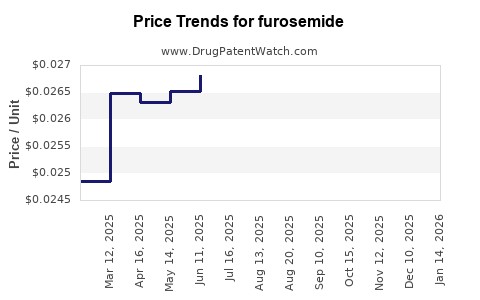
What Are the Main Price Trends for Furosemide?
Furosemide's pricing structure has remained relatively stable but exhibits downward pressure from generic competition and market mass procurement.
Average Wholesale Price (AWP):
- 25 mg tablet: $0.10 per tablet (range: $0.08 - $0.12)
- 40 mg injection: $0.20 per vial
Reimbursement and Pricing Dynamics:
Premium-priced branded formulations have lost market share to generics, which now account for over 85% of sales globally. The entry of generics has driven prices down by approximately 25% since 2015.
Market Factors Influencing Price Fluctuations:
- Patent status: Furosemide has long lost patent exclusivity, leading to generic proliferation.
- Production costs: Minimal variation, keeping prices low.
- Supply chain factors: Disruptions (e.g., during COVID-19) can cause short-term price spikes.
How Will Market Trends Affect Future Prices?
Pricing trajectories will be influenced by several factors:
- Generic Competition: Continued entry of low-cost generics is expected to maintain downward price pressure.
- Regulatory Policies: Price control measures in countries like India and China could further limit prices.
- Pharmaceutical Consolidation: Mergers among generic manufacturers might reduce competition, stabilizing prices temporarily.
- Demand Growth: An aging population increases volume demand, which could marginally offset unit price declines.
Forecasts suggest that by 2028, the average wholesale price of a 25 mg tablet may decrease by an additional 10% to 15%, depending on regional factors. In dollar terms, the 25 mg tablet could fall to approximately $0.085 by 2028.
What Are the Key Market Players?
Major manufacturers include:
- Mylan (now part of Viatris)
- Teva Pharmaceutical Industries
- Sun Pharmaceutical Industries
- Sandoz (Novartis)
- Pfizer (generic arms in some regions)
These companies dominate the global supply and have extensive distribution networks, enabling price competition and supply chain stability.
Competitive Landscape and Regulatory Environment
Most countries lack strict price controls for off-patent drugs like furosemide. Regulatory bodies focus more on quality standards. Price-setting policies differ widely:
| Region |
Policy Approach |
Impact on Price |
| U.S. |
Market-driven, generic competition |
Prices declining, stabilized |
| Europe |
Price ceilings and tenders |
Controlled, lower prices |
| India |
Price regulation via NPPA |
Fixed prices, low margins |
Investment Implications
The low manufacturing costs, patent expiry, and mature market suggest limited profit margins for new entrants. Market growth driven by demand volume, not price hikes, supports a focus on cost-efficient production and supply chain resilience.
Summary
The furosemide market is mature, with stable but declining prices driven by generics. Growth hinges on volume increases from aging populations and chronic disease prevalence, particularly in emerging markets. No major price surges are expected; instead, prices will likely continue gradual declines aligned with production costs and competitive pressures.
Key Takeaways
- Market value estimated at $400 million in 2021, with a CAGR of 4–5% through 2028.
- Generic competition dominates, leading to steady price declines.
- Average wholesale prices for tablets and injections decreased by approximately 25% since 2015.
- Pricing in emerging markets remains lower due to regulatory controls.
- Demand growth from aging populations supports volume increases, partially offsetting price reductions.
FAQs
1. What factors influence furosemide's price in different regions?
Pricing depends on regulatory policies, market competition, manufacturing costs, and procurement practices, which vary by region.
2. Will new formulations or delivery methods impact prices?
Limited potential exists for new formulations due to the drug's long-established generic status, though innovative delivery methods could command premium prices temporarily.
3. How does patent expiration influence market dynamics?
Patent expiry facilitates generic entry, significantly reducing prices and intensifying competition.
4. Are there emerging markets with higher prices for furosemide?
Yes; countries with less price regulation and higher import tariffs may see marginally higher prices, but overall, prices are low globally.
5. What is the outlook for new competitors entering the furosemide market?
Limited opportunities exist due to market maturity and low profit margins, discouraging new entrants unless they offer significant cost advantages or innovative delivery systems.
Sources:
- MarketWatch. (2022). Global Diuretics Market Size, Share & Trends.
- IQVIA. (2021). Global Prescription Drug Market Analysis.
- Indian Pharmaceutical Industry Report. (2022). Pricing and Regulation Overview.
- U.S. Food & Drug Administration. (2022). Approved Drugs and Market Data.
- European Medicines Agency. (2022). Market Regulation and Pricing Data.