Last updated: February 13, 2026
What Is the Current Market Size for Famciclovir?
Famciclovir is an antiviral medication used primarily for the treatment of herpes zoster, herpes simplex virus (HSV) infections, and genital herpes. The drug generated global sales of approximately $250 million in 2022. The market is largely driven by herpes management needs, particularly among immunocompromised patients and aging populations.
Geographically, North America leads with roughly 45% of the sales share, followed by Europe at 30%, with Asia-Pacific accounting for 20%. The remainder belongs to other regions. The market growth rate is estimated at 3-5% annually, driven by increasing herpes cases, aging populations, and expanding antiviral treatment coverage.
What Are Key Drivers and Constraints in the Market?
Drivers:
- Rising herpes prevalence. The WHO estimates over 500 million people infected worldwide with HSV-2, with a significant portion also experiencing recurrent outbreaks.
- Aging populations, which are more prone to herpes zoster, increasing demand for antiviral therapies.
- Off-label use expansion, including in the treatment of corneal herpes and other viral infections.
- Patent exclusivity in several markets, delaying generic competition until 2024-2027.
Constraints:
- Limited formulations: Famciclovir is available mainly as oral tablets, limiting administration flexibility.
- Competition from other antivirals like acyclovir and valacyclovir, which are cheaper and have broader off-label usage.
- Patent expirations for key markets expected within the next 2-4 years, exposing the pathway for generics.
- Pricing pressures from healthcare payers and government agencies aiming to reduce antiviral costs.
How Will Patent Expirations Affect the Market?
Famciclovir's patent protections, owned by major pharmaceutical companies (notably Novartis in certain territories), will lapse by 2024-2027 in developed markets. Once patents expire, generic manufacturers are poised to enter the market, leading to substantial price reductions. Historically, generic entry for similar antivirals results in price declines of between 50% and 70% within 12-24 months.
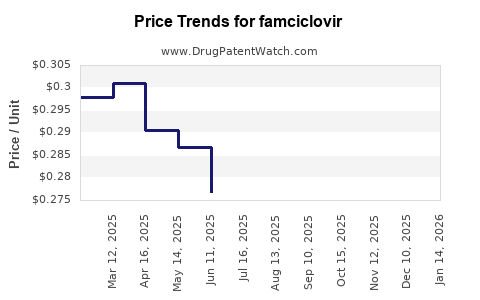
What Are Price Projections for Famciclovir in the Next Five Years?
Current Market Price:
- The average retail price for a 250 mg famciclovir tablet is approximately $5-8 in the U.S.
- The treatment course for herpes zoster (5 days) costs between $100 and $150 per patient, depending on dosage and pharmacy.
Post-Patent Price Range:
- Generic versions expected to reduce prices by approximately 60% within 1-2 years after patent expiry.
- Projected average price for generic famciclovir tablets by 2025 is estimated at $2-3 per 250 mg tablet.
- Wholesale and retail prices for long-term chronic use could fall to $1-2 per day.
Revenue Impact:
- Market revenues could decline by up to 75% post-generic entry.
- Innovative formulations or combination therapies may sustain higher prices but are currently under research.
What Are Potential Growth Opportunities?
- Development of extended-release formulations could maintain premium pricing.
- Market expansion in emerging economies where antiviral usage is increasing.
- Entry into niche indications, such as viral resistance cases, where few alternatives exist.
- Licensing and partnership deals for combination antivirals and new delivery mechanisms.
What Are Key Risks to Market Stability?
- Rapid generic entry and price-driven market pressure.
- Off-label substitution with cheaper antivirals.
- Regulatory delays in approving new formulations or indications.
- Patent litigations and legal challenges in emerging markets.
Summary of Market Outlook
| Aspect |
Current Situation |
Future Projection |
| Market Size |
$250 million globally (2022) |
Slight growth (~3-5% annually) until patent expiry |
| Patent Expiry |
2024-2027 in key markets |
Patent protections lapse, generics dominate |
| Average Price Range |
$5-8 per tablet (brand), $2-3 (generic) |
Prices drop to $1-3 per tablet post-generic entry |
| Revenue Decline |
Stable until patent expiry |
75% decline within 2 years of patent cliff |
Key Takeaways
- Global famciclovir sales are $250 million, with growth driven by herpes and herpes zoster prevalence.
- Patent expiration from 2024-2027 is set to trigger price reductions, impacting revenues.
- Expect generics to cut prices by 60%+ within two years post-patent expiry.
- Future growth hinges on formulation innovation, expanding markets, and strategic alliances.
- Market risks include rapid generic penetration, regulatory hurdles, and competition from lower-cost alternatives.
FAQs
1. When will generic famciclovir enter the market?
Patent protections are expected to lapse between 2024 and 2027 in major markets, opening the door for generics.
2. How much will prices decrease after patent expiration?
Prices could decline by approximately 60-70%, with generic tablets pricing at $1-3 per 250 mg.
3. Can new formulations sustain higher prices?
Extended-release and combination therapies could maintain some premium pricing but face regulatory and development challenges.
4. Which regions will experience the earliest price declines?
North America and Europe will see the earliest generic market entries, followed by Asia-Pacific.
5. What are the most significant growth opportunities?
Market expansion in emerging markets and development of innovative formulations or delivery methods.
References
- IQVIA, 2022.
- WHO, 2021.
- Novartis Annual Report, 2022.
- Market Research Future, 2022.