Share This Page
Drug Price Trends for entacapone
✉ Email this page to a colleague
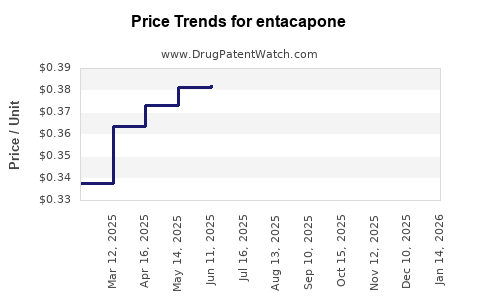
Average Pharmacy Cost for entacapone
| Drug Name | NDC | Price/Unit ($) | Unit | Date |
|---|---|---|---|---|
| ENTACAPONE 200 MG TABLET | 00527-1830-37 | 0.33366 | EACH | 2026-07-22 |
| ENTACAPONE 200 MG TABLET | 00781-5578-01 | 0.33366 | EACH | 2026-07-22 |
| ENTACAPONE 200 MG TABLET | 00904-6822-07 | 0.33366 | EACH | 2026-07-22 |
| >Drug Name | >NDC | >Price/Unit ($) | >Unit | >Date |
Best Wholesale Price for entacapone
| Drug Name | Vendor | NDC | Count | Price ($) | Price/Unit ($) | Unit | Dates | Price Type |
|---|---|---|---|---|---|---|---|---|
| ENTACAPONE 200MG TAB | Sandoz, Inc. | 00781-5578-01 | 100 | 63.47 | 0.63470 | EACH | 2023-08-15 - 2028-08-14 | FSS |
| ENTACAPONE 200MG TAB | Sandoz, Inc. | 00781-5578-01 | 100 | 64.16 | 0.64160 | EACH | 2024-01-01 - 2028-08-14 | FSS |
| >Drug Name | >Vendor | >NDC | >Count | >Price ($) | >Price/Unit ($) | >Unit | >Dates | >Price Type |
Entacapone Market Analysis and Price Projections
Entacapone, a catechol-O-methyltransferase (COMT) inhibitor, is primarily used in combination with levodopa and carbidopa to manage motor fluctuations in Parkinson's disease (PD). The drug's market is influenced by the prevalence of PD, patent expirations, generic competition, and the development of alternative treatments.
What is the Current Market Size and Growth Trajectory for Entacapone?
The global entacapone market size was estimated at approximately $750 million in 2023. The market is projected to grow at a compound annual growth rate (CAGR) of 3.2% from 2024 to 2030, reaching an estimated $940 million by the end of the forecast period. This growth is primarily driven by the increasing incidence of Parkinson's disease globally, particularly in aging populations, and the continued reliance on levodopa-based therapies as a first-line treatment for motor symptoms.
What are the Key Drivers of Entacapone Market Growth?
- Rising Prevalence of Parkinson's Disease: The World Health Organization (WHO) estimates that over 10 million people worldwide have Parkinson's disease, a number expected to increase due to an aging global population [1]. Entacapone's efficacy in managing motor fluctuations associated with levodopa treatment makes it a crucial component of care for a significant portion of PD patients.
- Established Efficacy of Levodopa/Entacapone Combination Therapy: The combination of entacapone with levodopa/carbidopa has demonstrated consistent efficacy in improving "on" time and reducing "off" time in PD patients, leading to sustained demand for this therapeutic approach.
- Generic Availability and Affordability: The expiry of key patents for entacapone has led to the availability of multiple generic versions. This has increased accessibility and affordability, expanding the market reach, especially in emerging economies.
- Limited Breakthrough Therapies for Motor Fluctuations: While research into novel Parkinson's disease treatments continues, significant breakthroughs that completely replace the need for levodopa-based therapies for motor symptom management have been limited. This sustains the demand for adjunctive treatments like entacapone.
What are the Restraints and Challenges for the Entacapone Market?
- Patent Expirations and Intense Generic Competition: The loss of market exclusivity for branded entacapone products has resulted in a fragmented market with numerous generic manufacturers, driving down prices and profit margins for individual companies.
- Development of Newer Parkinson's Disease Therapies: Ongoing research and development in the PD space are exploring alternative treatment modalities, including new drug targets, gene therapies, and advanced deep brain stimulation (DBS) techniques. These advancements could potentially reduce the reliance on conventional levodopa-based therapies over the long term.
- Side Effects and Tolerability: Like many Parkinson's medications, entacapone is associated with potential side effects, including dyskinesia, nausea, and urine discoloration. Patient tolerability and the need for dose adjustments can impact treatment adherence and overall market demand.
- Reimbursement Policies and Payer Pressure: Healthcare systems and insurance providers are increasingly scrutinizing drug costs. Stricter reimbursement policies and pressure to adopt cost-effective treatment options could impact the pricing and market penetration of entacapone, particularly branded formulations.
What is the Competitive Landscape of the Entacapone Market?
The entacapone market is characterized by the presence of several generic manufacturers alongside the originator product. Key players include:
- Orion Corporation: The originator of entacapone (Stalevo, in combination with levodopa and carbidopa).
- Teva Pharmaceutical Industries Ltd.
- Mylan N.V. (now Viatris Inc.)
- Sun Pharmaceutical Industries Ltd.
- Dr. Reddy's Laboratories Ltd.
- Torrent Pharmaceuticals Ltd.
- Accord Healthcare Ltd.
The market share is largely dominated by generic manufacturers due to price competition.
What are the Regional Market Dynamics for Entacapone?
| Region | Market Share (2023 Est.) | Growth Rate (CAGR 2024-2030 Est.) | Key Factors |
|---|---|---|---|
| North America | 35% | 3.0% | High prevalence of PD, strong healthcare infrastructure, established reimbursement frameworks, significant generic penetration. |
| Europe | 30% | 3.3% | Aging population, robust demand for PD treatments, stringent regulatory approvals, competitive generic market, varying national healthcare policies. |
| Asia-Pacific | 25% | 3.8% | Rapidly growing aging population, increasing diagnosis rates, expanding healthcare access, significant untapped potential, driven by affordability of generics. |
| Rest of World | 10% | 3.1% | Emerging economies with growing PD incidence, increasing access to essential medicines, price sensitivity driving generic adoption, limited availability of advanced therapies. |
What are the Price Projections for Entacapone?
The pricing of entacapone has been significantly impacted by patent expirations and the subsequent entry of generic products.
- Originator Product (e.g., Stalevo): Historically, branded combination products containing entacapone commanded premium pricing. However, with the availability of generics, the market price for branded formulations has seen a decline of approximately 40-60% since patent expiry. Current pricing for branded formulations is highly variable, often negotiated with payers and varies by dosage and geographic region.
- Generic Entacapone: The average wholesale price (AWP) for generic entacapone (50mg or 200mg tablets) has stabilized. In the US, the AWP for a bottle of 100 tablets typically ranges from $20 to $50, depending on the manufacturer and dosage strength. This represents a substantial decrease compared to the pre-patent expiry pricing of branded equivalents, which could exceed $300-$500 for a similar quantity.
- Price Trends:
- 2024-2026: Expect continued price stability for generic entacapone, with minor fluctuations driven by supply-demand dynamics and competition among generic manufacturers. The average price for a 30-day supply for a patient on a typical regimen is projected to remain between $30-$70.
- 2027-2030: As the market matures and new manufacturing efficiencies are realized, there may be a slight downward pressure on generic prices, potentially a 5-10% reduction. However, the increasing prevalence of PD and consistent demand will likely prevent drastic price drops. The focus will remain on cost-effectiveness for healthcare systems.
What are the Key Regulatory and Intellectual Property Considerations?
- Patent Landscape: The primary patents covering entacapone have expired in major markets like the US and Europe. For instance, key composition of matter patents have long since lapsed. Patents related to specific formulations, polymorphs, or methods of use may still exist but have had limited impact on the generic entry of the core molecule.
- Regulatory Approvals: Entacapone is approved by regulatory bodies such as the U.S. Food and Drug Administration (FDA) and the European Medicines Agency (EMA) as monotherapy (Comtan) and in combination with levodopa and carbidopa (Stalevo). Generic versions require Abbreviated New Drug Application (ANDA) approvals in the US and similar pathways in other regions, demonstrating bioequivalence to the reference listed drug.
- Manufacturing Standards: Manufacturers must adhere to Good Manufacturing Practices (GMP) for both active pharmaceutical ingredient (API) and finished dosage forms. Stringent quality control is essential to ensure product safety and efficacy.
What is the Outlook for Entacapone in Combination Therapies?
Entacapone's role is intrinsically linked to levodopa therapy. As long as levodopa remains a cornerstone for managing Parkinson's disease motor symptoms, entacapone will continue to be a relevant adjunctive therapy.
- "On" Time Extension: The primary benefit of entacapone is its ability to inhibit COMT, thereby preventing the peripheral breakdown of levodopa and extending its therapeutic effect. This leads to improved "on" time for patients experiencing motor fluctuations.
- Combination Products: Branded and generic combination products (levodopa/carbidopa/entacapone) will continue to be prescribed. The market for these fixed-dose combinations offers convenience for patients and prescribers.
- Emerging Competition: While entacapone is a well-established COMT inhibitor, other COMT inhibitors exist (e.g., tolcapone, opicapone). Opicapone, a once-daily COMT inhibitor, has shown promising results with potentially better efficacy and tolerability in some studies, posing a long-term competitive threat. However, opicapone's higher cost and specific indication for use (often after other options are exhausted) currently limit its widespread replacement of entacapone in existing treatment protocols.
Key Takeaways
The entacapone market is mature, characterized by robust generic competition and stable demand driven by the persistent prevalence of Parkinson's disease. While growth is modest, the drug's established efficacy in managing motor fluctuations ensures its continued relevance. Price projections indicate stability for generic versions, with a slight downward trend anticipated in the long term. The market's future hinges on the sustained use of levodopa therapy and the competitive pressure from newer COMT inhibitors.
FAQs
- What is the primary therapeutic indication for entacapone? Entacapone is indicated for the management of motor fluctuations in patients with Parkinson's disease who are treated with levodopa and carbidopa.
- Has entacapone lost patent protection? Yes, the primary patents for entacapone have expired in major global markets, leading to the widespread availability of generic formulations.
- How has the entry of generic entacapone affected pricing? The entry of generic entacapone has led to a significant reduction in prices, making the drug more accessible. Branded formulations have seen price decreases of 40-60%, while generic prices are considerably lower.
- What is the projected market growth rate for entacapone? The global entacapone market is projected to grow at a CAGR of 3.2% from 2024 to 2030.
- Are there any newer drugs that could replace entacapone? Yes, newer COMT inhibitors like opicapone are emerging, offering potentially improved efficacy and dosing convenience, though their market penetration is currently limited by cost and indication.
Citations
[1] World Health Organization. (2023). Parkinson disease. Retrieved from https://www.who.int/news-room/fact-sheets/detail/parkinson-disease
More… ↓
