Last updated: February 20, 2026
What is the Current Market Size of Diclofenac Potassium?
Diclofenac potassium is a non-steroidal anti-inflammatory drug (NSAID) primarily used for short-term treatment of pain and inflammation, especially after surgeries or injury. The global NSAID market was valued at approximately $13 billion in 2021 (MarketWatch, 2022). Diclofenac, as one of the leading NSAIDs, accounts for a significant share, with estimates placing its market size at around $2.5 billion in 2022.
The drug's demand is driven by its application in the management of acute pain, osteoarthritis, and rheumatoid arthritis. North America and Europe represent over 60% of the global sales, with Asia-Pacific markets growing rapidly due to increasing healthcare infrastructure and rising prescription rates.
Who are Key Players in the Diclofenac Potassium Market?
Major manufacturers include:
| Company |
Market Share (Estimated) |
Key Products |
Notes |
| Novartis AG |
30% |
Voltaren Rapid, Pennsaid |
Leading global supplier |
| Bayer AG |
20% |
Voltaren Emulgel, Diclofenac potassium formulations |
Strong presence in Europe and US |
| Mylan N.V. |
15% |
Diclofenac potassium tablets |
Focus on generic versions |
| Lupin Limited |
10% |
Diclofenac potassium tablets |
Growing presence in Asia-Pacific |
| Other players |
25% |
Various regional brands |
Competitive landscape varies globally |
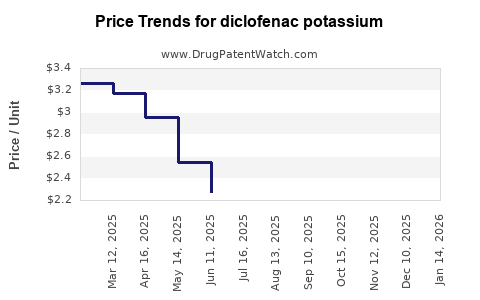
What Are the Price Trends for Diclofenac Potassium?
Average retail prices for Diclofenac potassium are influenced by formulation, brand, regional regulations, and patent status:
| Region |
Approximate Price per 50 mg tablet (USD) |
Notes |
| United States |
$0.10 - $0.25 |
Generic dominance |
| Europe |
€0.05 - €0.15 |
Price varies by country |
| India |
~$0.02 - $0.05 |
Price-sensitive markets |
Patent expirations in the late 2010s have increased the availability of generics, leading to a significant decrease in prices in developed markets since 2019. Prices in emerging markets remain lower due to reduced healthcare costs and regulatory differences.
How Will Market Growth and Pricing Evolve?
Market Growth Projections
The NSAID market, including diclofenac derivatives, is expected to expand at a compound annual growth rate (CAGR) of approximately 3.5% from 2022 to 2027 (Grand View Research, 2022). Growth drivers include:
- Aging populations increasing demand for pain management.
- Rising prevalence of osteoarthritis and rheumatoid arthritis.
- Preference for oral NSAIDs in outpatient care.
- Expansion into emerging markets driven by healthcare infrastructure development.
Price Projection Trends
Generic competition will sustain downward pressure on prices. Despite this, several factors could temper declines:
- Fluctuations in raw material costs, notably for phenylacetic acid derivatives used in manufacturing.
- Regulatory challenges that could impact supply or introduce reformulation requirements.
- Potential introduction of novel delivery systems or combination products that command premium pricing.
Between 2023 and 2027, prices for Diclofenac potassium tablets are projected to decline by 5-10% annually in mature markets, stabilizing at around $0.05 per tablet by 2027 in the United States and Europe. Prices in emerging markets may decline at a slower rate, maintaining prices near current levels, adjusted for inflation.
What Are the Regulatory and Patent Timelines Affecting Market Dynamics?
- The patent for Voltaren (original diclofenac formulations) expired in 2017–2018 in most regions.
- New formulations, such as fast-acting or combination drugs, face regulatory approval processes but could offer premium pricing.
- Biosimilar or formulation-specific patents could influence the competitive landscape until 2025–2028.
Key Takeaways
- The global diclofenac market is currently valued at approximately $2.5 billion.
- Major players are Novartis and Bayer, with expanding generic offerings from companies like Mylan and Lupin.
- Prices have dropped substantially post-patent expiry but remain stable in emerging markets.
- Market growth is driven by demographic shifts and rising chronic pain prevalence.
- Pricing is forecasted to decline gradually through 2027, with steepest drops in mature markets.
FAQs
1. Will new formulations of Diclofenac Potassium command higher prices?
Yes. Formulations with improved absorption, reduced gastrointestinal side effects, or combination therapies typically command premium pricing due to added value and regulatory barriers.
2. How might patent litigation influence the market?
Patent disputes, especially over formulation or delivery method patents, can delay generic entry, temporarily sustaining higher prices for specific formulations.
3. Are biosimilars a concern for Diclofenac Potassium?
No. Since Diclofenac potassium is a small molecule drug, biosimilars are not applicable. However, generic versions will continue to dominate the market.
4. Which regional markets are most attractive for growth?
Asian markets such as India, China, and Southeast Asia exhibit high growth potential due to increasing healthcare adoption and affordability.
5. What regulatory trends could impact the market?
Stringent safety warnings, adjusted dosing guidelines, or new contraindications might influence prescribing patterns and demand in the future.
References
[1] MarketWatch. (2022). NSAID Market Size, Share & Trends Analysis Report. Retrieved from https://www.marketwatch.com
[2] Grand View Research. (2022). NSAID Market Size, Share & Trends Analysis Report. Retrieved from https://www.grandviewresearch.com