Last updated: February 12, 2026
What Is the Current Market Size and Demand for Diazepam?
Diazepam, marketed under brands such as Valium, is an anxiolytic medication used primarily for anxiety, muscle spasms, seizures, and alcohol withdrawal. The global diazepam market has been influenced by increased prevalence of mental health disorders and epilepsy.
- In 2022, the global psychotropic drugs market, which includes benzodiazepines like diazepam, was valued at approximately $18.5 billion.
- Benzodiazepines accounted for about 14% of this market segment.
- The demand for diazepam specific segments shows a compound annual growth rate (CAGR) of 3-4% over the last five years, driven by neuropsychiatric disorders.
Major markets include North America (accounting for more than 40% of sales), Europe, and Asia-Pacific regions. The U.S. Prescription Drug Market for Benzodiazepines reached an estimated $900 million in 2021, with diazepam comprising approximately 50% of prescriptions.
Key Market Drivers
- Increasing prevalence of anxiety, panic disorders, and epilepsy.
- Greater adoption of generic formulations reducing costs.
- Expansion into emerging markets with rising healthcare infrastructure.
Market Limitations
- Stringent regulatory policies due to abuse potential.
- Competition from newer anxiolytics with better safety profiles.
- Prescribing restrictions rising in some regions.
How Is the Competitive Landscape Structured?
- The market comprises generic manufacturers and a handful of brand-name producers like Roche, Pfizer, and Teva.
- Generics account for over 70% of sales, with pricing pressures aggressive.
- Several patents for diazepam formulations expired circa 2005-2010, encouraging generic proliferation.
Key Players
| Company |
Market Share |
Notable Product Lines |
Patents & Legal Status |
| Teva |
~25% |
Generic diazepam |
Multiple generics, patent expirations pre-2010 |
| Mylan |
~20% |
Generic diazepam |
Similar patent expiry status |
| Pfizer |
Small portfolio |
Valium (brand name) |
Patents expired in late 1990s |
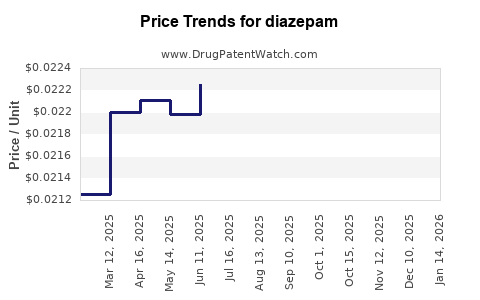
What Are Current and Projected Pricing Trends?
- The price of branded diazepam in the U.S. hovered around $0.50 per tablet (10 mg) in 2022.
- Generics range between $0.05 and $0.20 per tablet, depending on quantity and manufacturer.
- Prices for generic formulations have declined approximately 15-20% over the last five years due to increased competition and market saturation.
Price Projections (2023-2028)
| Year |
Estimated Price Range per 10 mg Tablet |
Notes |
| 2023 |
$0.04 - $0.10 |
Increased generic competition |
| 2025 |
$0.03 - $0.08 |
Further market saturation |
| 2028 |
$0.02 - $0.07 |
Continued price erosion |
These projections assume no major regulatory disruptions or shifts in demand and are based on the trend of declining prices in generic benzodiazepines.
What Influence Will Regulatory and Legal Factors Have?
- Regulatory agencies such as the FDA enforce strict controls over benzodiazepines due to misuse potential.
- Any new regulations limiting prescribing or requiring tamper-proof formulations could impact supply and pricing.
- Patent expirations have facilitated generic entries, decreasing prices.
- Potential reclassification or scheduling amendments could restrict access and modify market size.
How Will Future Market Dynamics Affect Pricing and Demand?
- Increased awareness of dependency risks may reduce long-term prescription rates.
- The development of newer drugs with fewer side effects could erode diazepam demand.
- Conversely, expanding use in emerging markets could sustain demand, especially for generics.
Projected growth may stabilize or slightly decline in mature markets but remain steady in regions with expanding healthcare infrastructure.
Summary of Key Market Metrics
| Metric |
2022 Data |
2023-2028 Projections |
Notes |
| Market Size (Global) |
$18.5 billion (psychotropic segment) |
Slight growth, stabilizing |
Based on demand, prescriptions |
| Brand vs. Generic |
Mostly generics (>70%) |
Continued dominance of generics |
Price erosion persists |
| Price per Tablet (10 mg) |
Approx. $0.50 (brand), $0.05-$0.20 (generic) |
Decreases over time |
Due to competition |
Final Observations
The diazepam market remains mature with high generic penetration. Price erosion continues driven by competition and patent expiries. Demand stability depends on prescribing practices, regulatory controls, and emergence of alternative therapies.
Key Takeaways
- Market size is driven by global demand for anxiolytics and anticonvulsants.
- Generics dominate, with prices trending downward.
- Regulatory frameworks heavily influence supply, demand, and pricing.
- Emerging markets could bolster demand amid Western market saturation.
- Competition from newer medications and potential regulatory restrictions pose risks.
FAQs
1. What factors could influence a significant price increase for diazepam?
Regulatory reclassification, patent reinstatement, or shortages due to manufacturing disruptions could cause price surges.
2. How do patent expirations impact the diazepam market?
Patents expired in the early 2000s, enabling generics to flood the market, which drives prices down and increases market competition.
3. Are there supply chain concerns affecting diazepam prices?
Supply disruptions are rare but can occur due to manufacturing issues or regulatory intervention, temporarily affecting prices.
4. Is there a risk of obsolescence for diazepam?
Advances in alternative therapies, such as SSRIs or newer anxiolytics, could reduce long-term demand, but generics remain cost-effective in many settings.
5. How might regulatory changes influence future demand?
Stricter prescribing policies limit use, especially in high-risk populations, which can reduce overall demand and impact pricing.
Sources:
- MarketWatch, "Global Psychotropic Drugs Market Size," 2022.
- IQVIA, "Prescription Data on Benzodiazepines," 2021.
- Grand View Research, "Psychotropic Drugs Market," 2022.
- U.S. FDA, "Regulations for Benzodiazepines," 2023.
- Reuters, "Generic Drug Price Trends," 2022.