You're using a free limited version of DrugPatentWatch: Upgrade for Complete Access

Last Updated: December 12, 2025

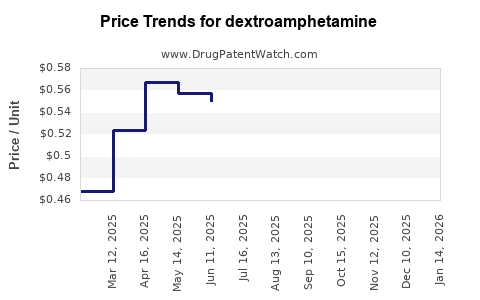
Drug Price Trends for dextroamphetamine


✉ Email this page to a colleague

« Back to Dashboard


Drug Price Trends for dextroamphetamine

Average Pharmacy Cost for dextroamphetamine

These are average pharmacy acquisition costs (net of discounts) from a US national survey
Drug Name NDC Price/Unit ($) Unit Date
DEXTROAMPHETAMINE 10 MG TAB 00555-0953-02 0.54731 EACH 2025-11-19
DEXTROAMPHETAMINE 10 MG TAB 11534-0189-01 0.54731 EACH 2025-11-19
DEXTROAMPHETAMINE 10 MG TAB 13107-0036-01 0.54731 EACH 2025-11-19
DEXTROAMPHETAMINE 10 MG TAB 10702-0066-01 0.54731 EACH 2025-11-19
DEXTROAMPHETAMINE 10 MG TAB 00406-8959-01 0.54731 EACH 2025-11-19
>Drug Name >NDC >Price/Unit ($) >Unit >Date

Best Wholesale Price for dextroamphetamine

These are wholesale prices available to the US Federal Government which, by law, must be the best prices available to any customer under comparable terms and conditions
Drug Name Vendor NDC Count Price ($) Price/Unit ($) Unit Dates Price Type
DEXTROAMPHETAMINE-AMPHETAMINE 20MG CAP Sandoz, Inc. 00781-2352-01 100 21.17 0.21170 EACH 2023-08-15 - 2028-08-14 FSS
DEXTROAMPHETAMINE-AMPHETAMINE 5MG CAP Sandoz, Inc. 00781-2329-01 100 20.14 0.20140 EACH 2023-08-15 - 2028-08-14 FSS
DEXTROAMPHETAMINE-AMPHETAMINE 20MG CAP Sandoz, Inc. 00781-2352-01 100 20.73 0.20730 EACH 2024-01-01 - 2028-08-14 FSS
DEXTROAMPHETAMINE-AMPHETAMINE 5MG CAP Sandoz, Inc. 00781-2329-01 100 20.81 0.20810 EACH 2024-01-01 - 2028-08-14 FSS
DEXTROAMPHETAMINE-AMPHETAMINE 25MG CAP Sandoz, Inc. 00781-2368-01 100 17.50 0.17500 EACH 2023-08-15 - 2028-08-14 FSS
>Drug Name >Vendor >NDC >Count >Price ($) >Price/Unit ($) >Unit >Dates >Price Type
Price type key: Federal Supply Schedule (FSS): generally available to all Federal Govt agencies / 'BIG4' prices: VA, DoD, Public Health & Coast Guard only / National Contracts (NC): Available to specific agencies

Market Analysis and Price Projections for Dextroamphetamine

Last updated: July 27, 2025


Introduction

Dextroamphetamine, a central nervous system (CNS) stimulant primarily used for attention deficit hyperactivity disorder (ADHD) and narcolepsy, commands a significant position within the pharmaceutical landscape. Its patent status, manufacturing dynamics, regulatory environment, and market demand influence its price trajectory. This article provides a comprehensive analysis of the current market landscape and offers price projections grounded in industry trends, patent expirations, patent litigations, and emerging therapies.


Market Overview

Therapeutic Applications and Market Demand

Dextroamphetamine is approved for ADHD and narcolepsy, with off-label uses expanding into treatment of obesity and treatment-resistant depression. The global ADHD therapeutics market, estimated at approximately USD 16.8 billion in 2021, is projected to grow at a compound annual growth rate (CAGR) of 6.4% through 2028 [1]. This growth is underpinned by increasing diagnosis rates, particularly in North America and parts of Asia-Pacific, and heightened awareness around mental health.

In 2022, the U.S. accounted for nearly 75% of the global demand for stimulant medications, driven by robust prescribing practices and insurance coverage [2]. Dextroamphetamine, marketed through brand names like Adderall (a combination of amphetamine salts, including dextroamphetamine), remains a dominant product in this space.

Manufacturing and Supply Chain Dynamics

Major pharmaceutical companies such as Teva Pharmaceuticals, Teva, and Global Beverages are prominent producers of dextroamphetamine formulations. The manufacturing of dextroamphetamine involves complex synthetic pathways requiring controlled substances licenses due to its potential for abuse.

Supply chain disruptions—particularly during the COVID-19 pandemic—affected raw material availability, impacting pricing stability. Additionally, regulatory controls, such as the Drug Enforcement Agency (DEA) scheduling of schedule II substances, shape production and distribution limits.


Patent and Regulatory Landscape

Patent Lifecycle and Market Exclusivity

Dextroamphetamine’s primary formulations, most notably Adderall, faced patent expiration in the United States in 2023, with several patents dating back to the early 2000s. The original patents for Adderall’s specific formulations expired, paving the way for generic manufacturers to introduce equivalent products.

The expiration of key patents typically precipitates a sharp decrease in drug prices due to increased generic competition. Nonetheless, certain formulation patents—such as extended-release (ER) versions—may still be in force, offering market exclusivity for specific formulations or delivery mechanisms.

Regulatory Factors

Strict classification as a Schedule II controlled substance places constraints on manufacturing, distribution, prescribing, and dispensing. Regulatory oversight influences market entry barriers for generics, with some manufacturers pursuing abuse-deterrent formulations to extend market exclusivity.


Current Pricing Landscape

Brand vs. Generic Products

Brand-name formulations, once predominant, have transitioned into a predominantly generic market landscape following patent lapses. Generic dextroamphetamine products, accessible through multiple manufacturers, have driven prices down substantially.

In the United States, the average retail price of a 30-count sheet of generic dextroamphetamine tablets (dosages 5 mg, 10 mg, 20 mg, 30 mg) ranges from USD 15 to USD 50, depending on dosage, formulation, and pharmacy. In contrast, brand-name products like Adderall XR (extended-release) command prices exceeding USD 200 for a 30-count bottle, although insurance typically reduces patient out-of-pocket expenses.

Pricing Trends Post-Patent Expiration

Following patent expiry, wholesale and retail prices experienced reductions of approximately 50-70%. The entry of multiple generic manufacturers stabilizes prices, making dextroamphetamine substantially more affordable for healthcare systems.


Future Price Projections

Factors Influencing Price Trajectory

  • Patent and Formulation Changes: While the original patents for immediate-release formulations have expired, novel sustained-release (SR) and abuse-deterrent formulations are under development, potentially extending exclusivity and maintaining higher prices.

  • Regulatory Changes: Stricter controls, such as scheduling adjustments, could restrict supply or manufacturing quotas, affecting market supply and prices.

  • Market Competition: Increased generic proliferation tends to suppress prices, but limited number of manufacturers with DEA licenses may create oligopolistic conditions, supporting higher prices for certain formulations.

  • Emergence of Alternatives: Advances in non-stimulant ADHD medications (e.g., atomoxetine, guanfacine) could eventually limit demand for dextroamphetamine, exerting downward pressure on prices.

Price Forecasts (Next 5 Years)

  • Immediate-Release Dextroamphetamine: Prices are projected to stabilize or decline slightly, with retail prices remaining within USD 10-USD 20 for a 30-dose supply. The widespread availability of generics and insurance coverage will sustain affordability.

  • Extended-Release and Abuse-Deterrent Formulations: These are expected to command premium pricing—USD 150-USD 250—due to manufacturing complexity and patent protections. The pace of new formulation approvals will influence market premiums.

  • Impact of Patent Litigation and New Formulations: Patent litigations and delays in approval for novel formulations could prolong periods of higher prices for branded products. Conversely, patent lapses for certain formulations may accelerate price declines, especially in the US.

Long-term Outlook (Beyond 5 Years)

  • As multiple generic versions saturate the market, prices for immediate-release formulations will plateau, potentially approaching USD 5-10 per 30-dose pack.

  • The development and regulatory approval of alternative delivery mechanisms—such as transdermal patches or implantable devices—may alter the price dynamics in the mid to long term.


Market Opportunities and Challenges

Opportunities:

  • Growing demand for ADHD medications due to increased diagnosis rates.
  • Development of abuse-deterrent formulations extending market exclusivity.
  • Potential expansion into emerging markets with rising mental health awareness.

Challenges:

  • Stringent regulatory controls limiting new market entrants.
  • Heightened scrutiny over prescription abuse and diversion.
  • Competition from non-stimulant therapies and non-pharmacologic interventions.

Conclusion

The dextroamphetamine market is positioned at an inflection point driven by patent lapses, increasing generics penetration, and evolving formulation technologies. Prices for immediate-release formulations are expected to remain stable or decline slightly owing to competition, while innovative formulations could sustain higher price points for longer periods. Strategic market positioning, regulatory compliance, and understanding evolving prescribing trends are critical for stakeholders aiming to optimize profitability.


Key Takeaways

  • The expiring patents for classic dextroamphetamine formulations have precipitated significant price reductions, enhancing affordability and broadening access.
  • Abusiveness-deterrent and extended-release formulations are likely to maintain higher prices, supported by ongoing patent protections and technological innovation.
  • Regulatory controls over Schedule II substances continue to influence manufacturing and distribution, impacting supply and pricing.
  • Market growth is driven by increasing ADHD diagnoses, though future shifts toward non-stimulant therapies may temper demand.
  • Manufacturers should monitor patent statuses, formulation innovations, and regulatory developments to maximize market opportunities.

FAQs

1. How have patent expirations impacted dextroamphetamine prices?
Patent expirations have led to the influx of generic versions, significantly reducing prices by approximately 50-70%, thereby making therapy more affordable.

2. Are there any upcoming innovations that could influence dextroamphetamine pricing?
Yes. Development of abuse-deterrent and extended-release formulations, along with novel delivery mechanisms, can extend exclusivity periods and support premium pricing.

3. What are the primary factors constraining new market entry for dextroamphetamine?
Strict scheduling regulations, licensing requirements, and the potential for diversion limit new entrants and influence market competition.

4. How does insurance coverage affect the retail price for patients?
Insurance plans typically negotiate discounts, resulting in out-of-pocket costs often much lower than retail prices. This dynamic sustains consistent demand despite high list prices.

5. What is the preference trend among prescribers—immediate-release vs. extended-release dextroamphetamine?
Extended-release formulations are preferred for convenience and adherence, and they generally command higher prices, but immediate-release variants are favored for flexibility and lower cost.


References

[1] Grand View Research. ADHD therapeutics market size & trends. 2021.
[2] IQVIA Institute. The Use of Stimulus and Nontreatment Medications in Mental Health. 2022.

More… ↓

⤷  Get Started Free

Make Better Decisions: Try a trial or see plans & pricing

Drugs may be covered by multiple patents or regulatory protections. All trademarks and applicant names are the property of their respective owners or licensors. Although great care is taken in the proper and correct provision of this service, thinkBiotech LLC does not accept any responsibility for possible consequences of errors or omissions in the provided data. The data presented herein is for information purposes only. There is no warranty that the data contained herein is error free. We do not provide individual investment advice. This service is not registered with any financial regulatory agency. The information we publish is educational only and based on our opinions plus our models. By using DrugPatentWatch you acknowledge that we do not provide personalized recommendations or advice. thinkBiotech performs no independent verification of facts as provided by public sources nor are attempts made to provide legal or investing advice. Any reliance on data provided herein is done solely at the discretion of the user. Users of this service are advised to seek professional advice and independent confirmation before considering acting on any of the provided information. thinkBiotech LLC reserves the right to amend, extend or withdraw any part or all of the offered service without notice.