You're using a free limited version of DrugPatentWatch: Upgrade for Complete Access

Last Updated: December 12, 2025

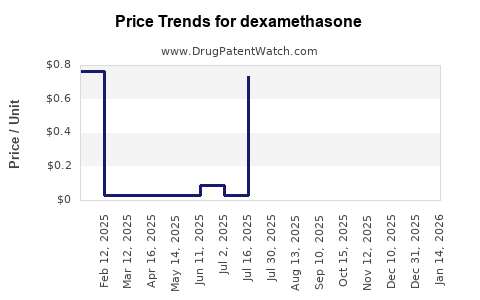
Drug Price Trends for dexamethasone


✉ Email this page to a colleague

« Back to Dashboard


Drug Price Trends for dexamethasone

Average Pharmacy Cost for dexamethasone

These are average pharmacy acquisition costs (net of discounts) from a US national survey
Drug Name NDC Price/Unit ($) Unit Date
DEXAMETHASONE 6 MG TABLET 47781-0916-01 0.58802 EACH 2025-11-26
DEXAMETHASONE 0.5 MG TABLET 60505-6249-01 0.09034 EACH 2025-11-19
DEXAMETHASONE 0.5 MG TABLET 70954-0398-10 0.09034 EACH 2025-11-19
DEXAMETHASONE 0.5 MG TABLET 00054-8179-25 0.09034 EACH 2025-11-19
DEXAMETHASONE INTENSOL 1 MG/ML 00054-3176-44 0.73686 ML 2025-11-19
DEXAMETHASONE 0.1% EYE DROP 24208-0720-02 8.38056 ML 2025-11-19
>Drug Name >NDC >Price/Unit ($) >Unit >Date

Best Wholesale Price for dexamethasone

These are wholesale prices available to the US Federal Government which, by law, must be the best prices available to any customer under comparable terms and conditions
Drug Name Vendor NDC Count Price ($) Price/Unit ($) Unit Dates Price Type
MAXIDEX 0.1% SUSP,OPH Harrow Eye, LLC 00998-0615-05 5ML 55.40 11.08000 ML 2024-03-15 - 2029-03-14 FSS
MAXITROL 0.1% SUSP,OPH Harrow Eye, LLC 00998-0630-06 5ML 64.08 12.81600 ML 2024-03-15 - 2029-03-14 FSS
MAXIDEX 0.1% SUSP,OPH Harrow Eye, LLC 00078-0925-25 5ML 55.40 11.08000 ML 2024-03-15 - 2029-03-14 FSS
TOBRADEX ST Harrow Eye, LLC 71776-0035-05 5ML 178.08 35.61600 ML 2024-03-15 - 2029-03-14 FSS
DEXAMETHASONE 0.1%/TOBRAMYCIN 0.3% SUSP,OPH Sandoz, Inc. 61314-0647-05 5ML 10.50 2.10000 ML 2024-01-01 - 2028-08-14 FSS
MAXITROL OINT OPH Sandoz, Inc. 00078-0771-01 3.5GM 145.86 41.67429 GM 2023-09-29 - 2028-08-14 FSS
>Drug Name >Vendor >NDC >Count >Price ($) >Price/Unit ($) >Unit >Dates >Price Type
Price type key: Federal Supply Schedule (FSS): generally available to all Federal Govt agencies / 'BIG4' prices: VA, DoD, Public Health & Coast Guard only / National Contracts (NC): Available to specific agencies

Market Analysis and Price Projections for Dexamethasone: A Strategic Overview

Last updated: July 27, 2025

Introduction

Dexamethasone, a potent synthetic corticosteroid, is widely used in treating inflammatory conditions, autoimmune disorders, and certain cancers. Its recent prominence surged due to robust evidence indicating its efficacy in reducing mortality among severely ill COVID-19 patients. This comprehensive analysis explores the current market landscape, key drivers, competitive environment, regulatory considerations, and future price trajectories for dexamethasone, equipping stakeholders with strategic insights.

Market Landscape and Key Drivers

Global Demand Dynamics

The global dexamethasone market exhibits robust growth, driven by its diverse therapeutic applications. As of 2022, the market was valued at approximately $740 million, with projections estimating a Compound Annual Growth Rate (CAGR) of 4.2% through 2030 [1].

COVID-19 Pandemic Impact:
The emergency authorization of dexamethasone for severe COVID-19 cases in multiple countries catalyzed a significant spike in demand, particularly in hospitals and intensive care units. Notably, the RECOVERY trial's findings in June 2020 cemented dexamethasone's role in COVID-19 treatment protocols, leading to increased procurement and stockpiling [2].

Chronic Conditions and Autoimmune Disorders:
Beyond infectious diseases, dexamethasone remains a frontline therapy for conditions such as rheumatoid arthritis, asthma exacerbations, and certain hematological malignancies. The rising prevalence of autoimmune conditions globally sustains consistent demand, especially in markets with expanding healthcare infrastructure.

Key Market Segments

  • Therapeutic Applications:

    • COVID-19 management (acute care)
    • Inflammatory and autoimmune diseases
    • Oncology (as adjunct therapy)
    • Endocrinology (adrenal insufficiency)
  • Formulations:

    • Injectable
    • Oral tablets
    • Topical formulations
  • End-User Sectors:

    • Hospital pharmacies
    • Retail pharmacies
    • Institutional healthcare providers

Competitive Landscape

Prominent manufacturers include Mylan (Viatris), Pfizer, Teva Pharmaceutical Industries, Sandoz, and regional players in emerging markets. The market is characterized by:

  • Generic Dominance:
    The patent expirations of several corticosteroids have facilitated intense generic competition, exerting downward pressure on prices.

  • Manufacturing Concentration:
    High-volume production centers in India, China, and Europe ensure supply chaining and cost efficiencies.

  • Regulatory Approvals:
    Given its status as an off-patent medication, regulatory hurdles are less restrictive, enhancing global accessibility.

Pricing Trends and Factors Influencing Prices

Historical Pricing Patterns

Historical pricing shows significant variability based on formulation, country, and purchase channels. For example, in the United States, oral dexamethasone tablets ranged from $0.02 to $0.10 per tablet in 2022, reflecting generic market pressures [3]. Conversely, injectable formulations for hospital use command higher per-dose prices, often exceeding $10 per vial.

Determinants of Price Fluctuations

  • Generic Competition:
    Lowered prices with increased market entries, particularly in emerging markets.

  • Regulatory Approvals:
    Fast-track approvals or additional indications can influence demand and pricing.

  • Supply Chain Stability:
    Disruptions, as seen in the COVID-19 pandemic, initially caused price surges but subsequently stabilized.

  • Manufacturing Costs:
    Raw material prices, especially corticosteroid intermediates, impact wholesale pricing.

  • Healthcare Policy and Reimbursement:
    Policies favoring cost-effective therapeutics exert downward pressure on prices, especially in public healthcare systems.

Price Projections through 2030

Forecast Methodology

Projections integrate current demand trends, manufacturing capabilities, regulatory trajectories, and potential therapeutic expansions. They consider the impact of global health crises, policy shifts, and technological advancements.

Projected Trends

  • Average Unit Price Decline:
    Due to ongoing generic competition, the average per-unit price is expected to decline by 1-2% annually after 2024, stabilizing at lower levels.

  • COVID-19-Related Demand Decay:
    As COVID-19 treatment protocols evolve and new therapeutics emerge, COVID-related demand for dexamethasone is anticipated to decline gradually by 2025, shifting focus to chronic and autoimmune indications.

  • Market Expansion in Emerging Economies:
    Increased healthcare expenditure and expanding pharmacopeia access in Asia-Pacific, Latin America, and Africa could sustain or slightly elevate prices.

  • Innovative Formulations:
    Development of sustained-release or targeted delivery formulations may command premium pricing, though such products are still under clinical development.

Estimated Price Range (2023-2030):

  • Oral tablets: $0.02-$0.05 per tablet by 2030.
  • Injectable vials: $5-$12 per vial depending on formulation and region.

Regulatory and Ethical Considerations

Approval for new indications and formulations could influence market stability. Additionally, cost-containment policies and the proliferation of biosimilars or alternative corticosteroids might further influence pricing strategies.

Strategic Implications for Stakeholders

  • Pharmaceutical companies should monitor patent expirations and regulatory pathways to optimize generic commercialization.

  • Healthcare providers should assess cost-effective formulations aligned with treatment protocols.

  • Investors should evaluate the impact of market saturation and potential innovations on long-term profitability.

Key Takeaways

  • The dexamethasone market remains resilient, driven by its wide therapeutic applications and increased demand from the COVID-19 pandemic.

  • Market competition among generics has historically suppressed prices, a trend expected to continue through 2030, barring new formulations or indications.

  • Price stability will be influenced by supply chain dynamics, healthcare policies, and emerging global health challenges.

  • Opportunities exist for innovation in formulation and delivery methods to command premium pricing, especially in specialty markets.

  • Stakeholders should adopt flexible strategies that accommodate evolving regulatory landscapes and demand profiles.

Conclusion

Dexamethasone’s market landscape is dynamic, molded by pandemic-driven demand, declining patent protections, and ongoing healthcare needs. While generic competition restricts upside in base formulations, innovations and strategic positioning in emerging markets present avenues for growth. Price forecasts suggest a gradual decline, emphasizing the importance of operational efficiency and diversification for manufacturers aiming to sustain profitability.


Frequently Asked Questions (FAQs)

1. How will the COVID-19 pandemic influence dexamethasone pricing long-term?
While the pandemic caused a surge in demand, especially in 2020-2021, the subsequent stabilization and emergence of alternative therapies are likely to normalize demand. Prices may decline or stabilize as COVID-specific demand diminishes, emphasizing its role in broader therapeutic areas.

2. What are the key factors limiting dexamethasone price increases in the future?
Predominantly, intense generic competition, regulatory approvals for widespread off-patent use, and price sensitivity in healthcare systems limit upward price pressure. Additionally, the proliferation of biosimilars and alternative corticosteroids further constrains pricing premiums.

3. Are there upcoming formulations or indications that could affect price projections?
Yes, research into sustained-release formulations, targeted delivery systems, and new indications such as autoimmune or neoplastic conditions could enable premium pricing if clinically validated and approved.

4. How do regional healthcare policies impact dexamethasone pricing?
Pricing is heavily influenced by policies promoting generics, price caps, and reimbursement frameworks. Countries with strong price regulation tend to have lower retail prices, while markets with less regulation may see higher variability.

5. What role do biosimilars play in the future of dexamethasone pricing?
Biosimilars and advanced corticosteroid alternatives could introduce further competition, leading to sustained price discounts and increased access, especially in resource-limited settings.


Sources

[1] MarketWatch. "Dexamethasone Market Size, Share, and Forecast 2022-2030."

[2] RECOVERY Trial. "Dexamethasone in Hospitalized Patients with COVID-19."

[3] GoodRx. "Dexamethasone Prices and Savings."

More… ↓

⤷  Get Started Free

Make Better Decisions: Try a trial or see plans & pricing

Drugs may be covered by multiple patents or regulatory protections. All trademarks and applicant names are the property of their respective owners or licensors. Although great care is taken in the proper and correct provision of this service, thinkBiotech LLC does not accept any responsibility for possible consequences of errors or omissions in the provided data. The data presented herein is for information purposes only. There is no warranty that the data contained herein is error free. We do not provide individual investment advice. This service is not registered with any financial regulatory agency. The information we publish is educational only and based on our opinions plus our models. By using DrugPatentWatch you acknowledge that we do not provide personalized recommendations or advice. thinkBiotech performs no independent verification of facts as provided by public sources nor are attempts made to provide legal or investing advice. Any reliance on data provided herein is done solely at the discretion of the user. Users of this service are advised to seek professional advice and independent confirmation before considering acting on any of the provided information. thinkBiotech LLC reserves the right to amend, extend or withdraw any part or all of the offered service without notice.