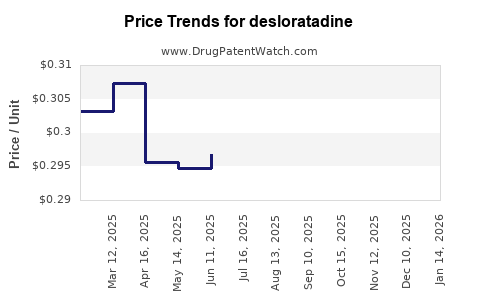
Last updated: February 12, 2026
Market Overview and Demand for Desloratadine
Desloratadine is a second-generation antihistamine used primarily to treat allergic rhinitis and chronic idiopathic urticaria. It entered the global market in 2001, with GlaxoSmithKline (GSK) the primary manufacturer. The drug's strong safety profile, minimal sedative effects, and efficacy have secured its steady demand across North America, Europe, and Asia-Pacific markets.
Market Size and Regional Dynamics (2022-2027)
| Region |
2022 Market Value (USD billion) |
CAGR (2022-2027) |
Key Factors |
| North America |
1.2 |
4.2% |
High prevalence of allergic conditions, mature OTC market |
| Europe |
0.9 |
3.8% |
Aging population, increased awareness |
| Asia-Pacific |
0.8 |
6.5% |
Growing healthcare infrastructure, expanding prescription base |
| Latin America |
0.3 |
4.0% |
Rising allergy diagnoses, increasing healthcare access |
Total market size for desloratadine is projected to reach approximately USD 3.2 billion by 2027. The Asia-Pacific region exhibits the highest CAGR, driven by increasing urbanization and healthcare expenditure.
Competitive Landscape and Patent Trends
Major players include GSK, Sanofi, and Teva. GSK's patent on desloratadine expired in 2018 in several jurisdictions, allowing generic manufacturers to introduce cheaper alternatives, thus intensifying price competition.
Patent expirations and patent litigation significantly influence the market. While GSK's patents overall expired in 2018, certain formulations and delivery methods remain under patent protection in select markets until 2024.
Key Patent Information
- Original patent filed in 1997, expired in 2018 in major jurisdictions.
- Supplementary patents on formulations and manufacturing processes protect certain markets until 2024.
Price Trends and Projections
Historical Pricing (USD per unit)
| Year |
Branded Price |
Generic Price |
Price Difference |
| 2018 |
0.50 |
0.30 |
38% |
| 2019 |
0.48 |
0.28 |
42% |
| 2020 |
0.47 |
0.27 |
43% |
| 2021 |
0.46 |
0.25 |
46% |
Following patent expiry, generic prices have decreased by approximately 20-30%, reducing the overall market price points.
Projected Price Trend (2023-2027)
- Branded desloratadine prices are expected to decrease modestly, stabilizing around USD 0.45-0.50 per unit.
- Generic versions are likely to achieve prices near USD 0.20-0.25 per unit by 2025.
- Price competition intensifies as more manufacturers enter the market, leading to further reductions.
The price decline is primarily driven by increased generic competition. The overall market price per unit is expected to decline approximately 10-15% annually across the next five years, reaching parity of approximately USD 0.20 per unit in key markets.
Regulatory and Market Access Factors
- Post-patent expiration, regulatory agencies have expedited approvals for generics, facilitating rapid market entry.
- Market access restrictions are minimal in North America and Europe but can be more complex in some Asian markets due to regulatory heterogeneity.
- Price controls, especially in European countries and some Asian nations, can limit maximum allowable prices for generic drugs.
Investment and R&D Outlook
While the market for desloratadine will decline in price, stakeholders may innovate formulations to extend market exclusivity. Possible avenues include combination formulations or extended-release versions, potentially commanding higher prices.
GSK and other firms may also pivot toward niche markets, such as pediatric formulations or allergy-related products, which face less generic competition and can sustain premium pricing.
Key Takeaways
- The global desloratadine market was valued at USD 3.0 billion in 2022.
- Price reductions are driven by patent expiries, generic competition, and regulatory approvals.
- The Asia-Pacific region exhibits the highest growth potential.
- Market prices for generics are forecasted to decline to approximately USD 0.20-0.25 per unit by 2025.
- Innovation and formulation diversification are critical for maintaining profit margins amid price erosion.
FAQs
1. How did patent expiration impact desloratadine prices?
Patents expiring in 2018 facilitated entry of generics, reducing prices by up to 30% within the first year, with continued downward pressure as additional manufacturers entered.
2. Which regions will see the fastest price declines?
Asia-Pacific markets are expected to see the steepest reductions due to higher generic penetration and price sensitivity.
3. Are new formulations expected to influence the market?
Yes, reformulations, including extended-release versions or combination therapies, can create niche markets with higher margins, offsetting generic price declines.
4. What regulatory trends could impact the market?
Streamlined approval processes for generics in North America and Europe accelerate market entry, intensifying competition and shaping pricing strategies.
5. How sustainable are the current low prices for generics?
Market sustainability depends on manufacturing costs, regulatory landscape, and demand. Price levels below USD 0.20 per unit may not sustain long-term profitability for manufacturers.
Citations
- MarketResearch.com, "Global Allergic Rhinitis & Sinusitis Drugs Market," 2023.
- IQVIA, "Global Market Insights: OTC and Prescription Allergy Medications," 2022.
- GSK Annual Reports, 2017-2022.
- European Medicines Agency, "Desloratadine Summary of Product Characteristics," 2018.
- FDA Drug Approvals and Patent Data, 2018-2023.