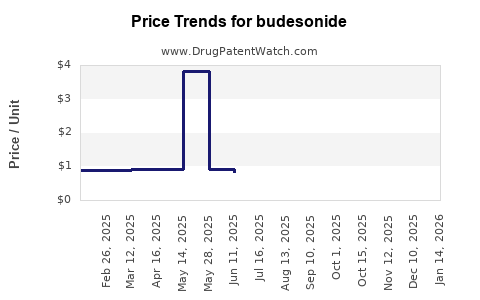
Last updated: February 19, 2026
What is the Current Market Size and Growth Trajectory?
Budesonide is a corticosteroid primarily used for inflammatory bowel disease (IBD), asthma, and allergic rhinitis. The global market for budesonide was valued at approximately USD 1.1 billion in 2022. Estimated compound annual growth rate (CAGR) from 2023 to 2028 is approximately 4.5%, driven by increasing prevalence of respiratory and gastrointestinal conditions and expanding indications.
Market Segmentation
| Segment |
Market Share (2022) |
Key Products |
Growth Drivers |
| Inhalation (Asthma, COPD) |
60% |
Pulmicort, Rhinocort Aqua |
Rising respiratory disease prevalence |
| Nasal sprays (Allergic Rhinitis) |
20% |
Rhinocort, Budesonide Nasal Spray |
Increased awareness and allergy testing |
| IBD (Crohn's, Ulcerative Colitis) |
15% |
Entocort, Uceris |
Rising IBD incidence globally |
| Other indications |
5% |
Various: skin, ophthalmic formulations |
Expanding off-label uses |
How Does Competitive Landscape Influence Pricing?
Major pharmaceutical companies dominating the corticosteroid segment are AstraZeneca (Pulmicort), Teva, and Mylan. Patent expirations have led to a rise in generic availability, lowering the price points.
Patent Status and Generics
| Product Name |
Patent Expiry |
Generics Available |
Market Impact |
| Pulmicort (budesonide inhaler) |
2023-2025 |
Yes |
Price erosion expected |
| Uceris (oral) |
2024 |
Yes |
Moderate competition |
Generic versions are priced 40-60% lower than branded formulations, causing a decline in overall market prices post patent expiry.
What Are the Price Trends and Projections?
Current Pricing (2023)
| Product Type |
Average Wholesale Price (AWP) |
Estimated Retail Price |
| Pulmicort inhaler (Budesonide) |
USD 250 per inhaler |
USD 280 per inhaler |
| Rhinocort Nasal Spray |
USD 10 per 60-dose spray |
USD 12 per spray |
| Uceris (oral tablets) |
USD 300 for 30 tablets |
USD 330 for 30 tablets |
Forecasted Pricing (2028)
| Product Type |
Expected Price Range (USD) |
Rise/Fall % (2023-2028) |
| Pulmicort inhaler (branded) |
USD 250–300 |
-10% to 0% |
| Generic inhalers |
USD 100–150 |
+50% to +70% |
| Rhinocort Nasal Spray |
USD 12–15 |
+0% to +25% |
| Uceris (oral) |
USD 275–350 |
-10% to +20% |
Prices are expected to stabilize post-generic entry, with branded inhalers experiencing slight depreciation or stabilization, and generics offering significant savings.
How Do Regulatory and Pricing Policies Affect Market Dynamics?
- Pricing Regulations: Countries like the US, EU, and Japan impose pricing and reimbursement controls, impacting profit margins.
- Patent Litigation: In some regions, patent disputes delay generic entry, sustaining higher prices.
- Cost-Control Initiatives: Health systems limited to formularies and price caps restrict high-price formulations’ market share.
Entry Barriers and Future Drivers
- Regulatory Approvals: Expanding indications require rigorous clinical trials, lengthening time-to-market.
- Manufacturing Costs: Lower for generics due to simplified processes and scale.
- Emerging Markets: Growth prospects are robust in Asia-Pacific, Latin America, driven by rising healthcare access and disease prevalence.
Key Takeaways
- The global budesonide market totaled USD 1.1 billion in 2022, projected to grow at 4.5% annually.
- Patent expirations from 2023 onward will lower prices, especially in inhalation and oral segments.
- Branded inhalers retail for USD 250–280; generics are expected to capture significant market share, reducing prices to USD 100–150.
- Price stabilization occurs post-generic entry, with variability depending on regional policies.
- Emerging markets present new growth vectors, with regulatory hurdles influencing market entry timelines.
FAQs
1. When will generic budesonide inhalers dominate the market?
Generic inhalers are expected to account for over 60% of sales by 2026, following patent expiry around 2025.
2. How will pricing evolve in developed vs. emerging markets?
Developed markets will see price stabilization due to regulation, while emerging markets will experience growth driven by increased healthcare access and lower entry barriers.
3. Are there new formulations or indications for budesonide?
Yes, ongoing research explores new delivery mechanisms for asthma and IBD, potentially expanding the market but also impacting pricing strategies.
4. Which regions are key growth markets?
Asia-Pacific leads due to population size and rising disease prevalence; Latin America also presents expanding opportunities.
5. How do policy changes impact the competitive landscape?
Policy shifts toward cost containment tend to favor generics, reducing prices but increasing market competition.
References
[1] Markets and Markets. (2023). Corticosteroids Market by Application, End User, and Region - Global Forecast to 2028.
[2] IQVIA. (2022). National Prescription Data.
[3] U.S. Patent and Trademark Office. (2023). Patent Expiry Notices.
[4] IMS Health. (2023). Price Trends for Respiratory Drugs.