Last updated: July 27, 2025
Introduction
Bortezomib, marketed under the brand name Velcade among others, is a pioneering proteasome inhibitor primarily used to treat multiple myeloma and mantle cell lymphoma. Since its approval by the U.S. Food and Drug Administration (FDA) in 2003, bortezomib has established itself as a foundational therapy in oncology, fostering significant market growth. This analysis explores the current market dynamics, competitive landscape, pricing trends, and future projections, offering actionable insights for stakeholders.
Market Overview
The global bortezomib market has experienced robust expansion driven by increasing prevalence of multiple myeloma and mantle cell lymphoma, advancements in drug delivery mechanisms, and growing adoption in emerging markets. The increasing aging population, which correlates with higher cancer incidence, further fuels market expansion. According to market intelligence reports, the oncology therapeutics sector anticipates a compound annual growth rate (CAGR) of approximately 7-9% over the next five years, with proteasome inhibitors like bortezomib contributing prominently.
Market Segmentation and Geographical Distribution
- By Indication: Multiple myeloma remains the primary indication, accounting for approximately 70% of sales, followed by mantle cell lymphoma (around 15%) and other hematological malignancies.
- By End-user: Hospitals constitute the largest segment due to the intravenous administration route, with specialty clinics and outpatient centers following.
- By Geography: North America dominates the market owing to advanced healthcare infrastructure and high diagnosis rates. Europe follows, with Asia-Pacific emerging rapidly owing to increasing healthcare expenditure and pharmaceutical penetration.
Key Market Drivers
- Rising Incidence of Hematologic Cancers: WHO estimates indicate over 160,000 new multiple myeloma cases worldwide annually, with incidence rising in aging populations [1].
- Advances in Combination Therapies: Bortezomib's incorporation into combination regimens (e.g., with dexamethasone, lenalidomide) enhances treatment efficacy and broadens its application.
- Regulatory Approvals and Line of Therapy Expansion: Extended indications and approvals in multiple lines of therapy improve market penetration.
- Market Expansion in Emerging Economies: Increased healthcare access and regulatory approvals have spurred growth.
Competitive Landscape
Key competitors include second-generation proteasome inhibitors—carfilzomib and ixazomib—as well as emerging novel agents. Rational drug design has driven the development of therapies with improved safety profiles and efficacy. Teva, Sandoz, and several biosimilar firms are entering the market, threatening pricing and market share of originator products like Velcade.
Pricing Trends
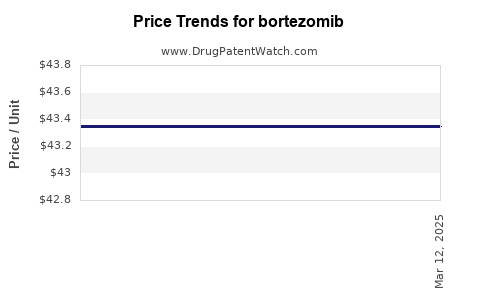
- Historical Pricing: In the U.S., the average wholesale price (AWP) of bortezomib was approximately $4,500–$5,000 per 3.5 mg vial in the early 2010s.
- Current Pricing Dynamics: With the entry of biosimilars, prices have declined by approximately 20–30% in mature markets. However, branded formulations maintain premium pricing owing to established efficacy and brand recognition.
- Pricing in Emerging Markets: Prices are considerably lower—ranging from $1,000 to $3,000 per vial—reflecting different economic conditions and patent status.
Future Price Projections
- Influence of Biosimilar Competition: Biosimilars are projected to intensify price competition, potentially reducing prices by up to 50% over the next 5 years in the U.S. and Europe.
- Pricing in Developed Markets: Despite biosimilar penetration, branded prices may stabilize due to brand loyalty and patent protections until exclusivity expiry (expected around 2027–2028).
- Emerging Markets: Continued price erosion is expected as regulatory harmonization and local manufacturing increase accessibility.
- Impact of Newer Agents: The entry of second- and third-generation proteasome inhibitors with superior safety and efficacy could influence bortezomib pricing by shifting market share, prompting price adjustments to maintain competitiveness.
Market Outlook and Growth Projections
The global bortezomib market is forecasted to reach approximately $2.5 billion by 2028, up from approximately $1.2 billion in 2022, reflecting a CAGR of around 11%. Growth will largely stem from increased diagnosis rates, expansive indications, and the uptake of biosimilars, balanced against competitive pressures from newer agents.
Regulatory and Patent Landscape
Patent expirations in key markets are set to unlock biosimilar entry. Regulatory bodies, such as the FDA and EMA, are establishing frameworks for biosimilar approval, facilitating market entry. Companies investing strategically in biosimilar development could capitalize on the lower price points to expand access, particularly in low- and middle-income economies.
Strategic Implications for Stakeholders
- Pharmaceutical Companies: Focus on biosimilar development post-patent expiry to capture emerging markets and maintain revenue streams.
- Healthcare Providers: Optimize treatment regimens balancing efficacy, safety, and cost; consider biosimilar options where appropriate.
- Investors: Monitor patent cliffs, regulatory developments, and biosimilar launch timelines to inform investment decisions.
Conclusion
Bortezomib remains a vital anti-cancer agent with a dynamic market landscape characterized by technological innovation, increased biosimilar activity, and expanding indications. While pricing in developed countries may stabilize due to patent protections, significant downward pressure is anticipated from biosimilar competition and generics, especially in emerging markets. Stakeholders must navigate this complex environment through strategic planning, timely biosimilar development, and adaptive pricing models.
Key Takeaways
- The global bortezomib market is expected to grow at a CAGR of approximately 11% through 2028, driven by increasing cancer incidence and expanding indications.
- Biosimilar entry, beginning around 2027–2028 upon patent expiry, will likely reduce prices by up to 50% in mature markets.
- Price stabilization in developed markets will be challenged by emerging biosimilar competition, whereas low-income regions will see more aggressive price erosion.
- Innovative combination therapies and regulatory approvals in new indications may sustain revenue streams, even amid generics and biosimilars.
- Strategic investments in biosimilar manufacturing and market entry are essential for capturing growth opportunities in the evolving landscape.
FAQs
1. When is the patent for branded Velcade expected to expire?
Patent protections for Velcade are expected to expire around 2027–2028 in key markets like the U.S. and Europe, opening the door for biosimilar competitors.
2. How will biosimilar competition impact bortezomib pricing?
Biosimilars are projected to reduce the price of bortezomib by approximately 30–50%, especially in mature markets, leading to more cost-effective treatment options.
3. What are the major emerging markets for bortezomib?
China, India, and Brazil are key emerging markets, where expanding healthcare infrastructure and regulatory reforms are facilitating increased access and lower prices.
4. Are there newer drugs that threaten bortezomib’s market share?
Yes, second-generation proteasome inhibitors like carfilzomib and ixazomib offer alternative options with improved safety profiles, potentially impacting bortezomib’s market share.
5. What strategic actions should pharmaceutical companies consider for bortezomib?
Developing biosimilars pre- or post-patent expiry, optimizing combination therapies, and expanding indications to new hematologic cancers are key strategies for sustained market relevance.
Sources
[1] World Health Organization. "Cancer Fact Sheets." 2022.