Share This Page
Drug Price Trends for bortezomib
✉ Email this page to a colleague
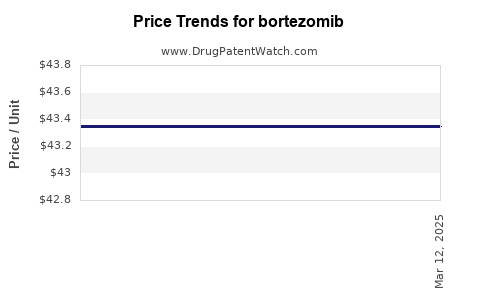
Best Wholesale Price for bortezomib
| Drug Name | Vendor | NDC | Count | Price ($) | Price/Unit ($) | Unit | Dates | Price Type |
|---|---|---|---|---|---|---|---|---|
| BORTEZOMIB (EQV-VELCADE) 3.5MG/VIL INJ | Sagent Pharmaceuticals | 25021-0244-10 | 1 | 19.10 | 19.10000 | EACH | 2024-05-01 - 2029-04-30 | FSS |
| >Drug Name | >Vendor | >NDC | >Count | >Price ($) | >Price/Unit ($) | >Unit | >Dates | >Price Type |
Bortezomib Market Analysis and Price Projections
Bortezomib, a proteasome inhibitor used primarily for treating multiple myeloma and mantle cell lymphoma, faces a dynamic market shaped by patent expirations, increasing generic competition, and evolving treatment landscapes. Current market valuation is estimated to be in the range of $2 billion to $2.5 billion globally, with growth projected to decelerate due to price erosion and market saturation.
What is the Current Market Size and Growth Trajectory for Bortezomib?
The global market for bortezomib, primarily driven by its brand-name originator Velcade (Millennium Pharmaceuticals/Takeda Oncology) and its subsequent generic versions, is substantial. In 2023, the market was valued at approximately $2.2 billion. Projections indicate a compound annual growth rate (CAGR) of 3% to 5% over the next five years. This modest growth is a significant deceleration from historical rates, attributed to intensified generic competition and pricing pressures that began following the expiration of key patents for Velcade in major markets.
| Year | Estimated Market Value (USD Billions) | Projected CAGR (2024-2028) |
|---|---|---|
| 2023 | 2.2 | N/A |
| 2024 | 2.3 | 4.5% |
| 2025 | 2.35 | 4.0% |
| 2026 | 2.4 | 3.5% |
| 2027 | 2.45 | 3.0% |
| 2028 | 2.5 | 2.5% |
What are the Key Drivers of Bortezomib Demand?
The continued demand for bortezomib is rooted in its established efficacy in treating relapsed or refractory multiple myeloma and mantle cell lymphoma. Clinical guidelines consistently recommend bortezomib, often as a first-line or second-line therapy, due to its proven track record in improving progression-free survival and overall survival for patients.
- Established Clinical Efficacy: Bortezomib's role in treating multiple myeloma, a hematological malignancy characterized by uncontrolled proliferation of plasma cells, remains central. It is particularly effective in combination regimens, enhancing treatment outcomes.
- Guideline Recommendations: Major oncology guidelines, such as those from the National Comprehensive Cancer Network (NCCN) and the European Society for Medical Oncology (ESMO), continue to list bortezomib as a preferred or alternative treatment option for specific patient populations.
- Patient Population Growth: The global incidence of multiple myeloma is increasing, driven by aging populations in developed countries. This demographic trend contributes to a growing base of eligible patients.
- Combination Therapies: Bortezomib is frequently used in combination with other agents like lenalidomide and dexamethasone, forming widely adopted treatment protocols (e.g., RVD regimen) that improve patient response rates.
What is the Impact of Patent Expirations and Generic Competition on Bortezomib Pricing?
The landscape of bortezomib pricing has been profoundly altered by the expiration of foundational patents for Velcade, initiating a significant shift towards generic availability. Key patents for Velcade expired in the United States in 2017 and in Europe shortly thereafter.
- Price Erosion: The entry of multiple generic manufacturers has led to substantial price reductions. Average selling prices (ASPs) for bortezomib have declined by an estimated 60% to 70% in developed markets since the peak of originator pricing.
- Generic Market Share: Generic bortezomib formulations now command over 80% of the market volume in the U.S. and Europe. This dominance puts downward pressure on the overall market value.
- Manufacturer Landscape: Major generic players include Teva Pharmaceutical Industries, Dr. Reddy's Laboratories, and Sun Pharmaceutical Industries, among others. These companies actively compete on price to gain and maintain market share.
- Biosimilar vs. Generic: Bortezomib is a small molecule drug, thus it is subject to generic competition rather than biosimilar competition, which applies to large-molecule biologics. The regulatory pathways and market dynamics for generics are distinct.
What are the Future Price Projections for Bortezomib?
Future price projections for bortezomib indicate a continued trend of price stabilization or marginal decline, rather than significant increases. The competitive generic market will likely maintain downward pricing pressure.
- Price Stabilization: While dramatic price drops are unlikely to continue at the same pace as in the initial post-patent expiration period, prices are expected to remain at current generic levels or see a slight decrease of 1-3% annually.
- Regional Variations: Pricing may vary geographically due to differences in regulatory approval processes, reimbursement policies, and local market competition. Emerging markets may see slightly higher initial prices before generic entry.
- Specialty Pharmacy Influence: The role of specialty pharmacies in managing drug distribution and negotiating prices with payers will continue to influence the final reimbursed price.
- Competition with Newer Agents: The increasing development and approval of novel therapeutic agents for multiple myeloma, such as CAR T-cell therapies and bispecific antibodies, may indirectly impact bortezomib pricing by offering alternative treatment options that could reduce demand for older, albeit effective, agents.
What is the Competitive Landscape for Bortezomib?
The competitive landscape for bortezomib is characterized by the coexistence of the originator product, multiple generic versions, and emerging novel therapies for multiple myeloma.
- Originator (Velcade): Takeda Oncology’s Velcade, while facing generic competition, still holds a significant market presence due to brand recognition and established payer contracts. However, its market share has diminished considerably.
- Generic Manufacturers: A crowded field of generic manufacturers actively competes, primarily on price. Companies like Teva, Dr. Reddy's, and Sun Pharma are key players in this segment.
- Newer Multiple Myeloma Therapies:
- Immunotherapies: Drugs such as daratumumab (Darzalex) and isatuximab (Sarclisa) are increasingly used, often in combination with or as alternatives to proteasome inhibitors.
- CAR T-cell Therapies: Cilta-cel (Carvykti) and ide-cel (Abecma) represent a new class of highly effective, albeit expensive, treatments for relapsed and refractory multiple myeloma.
- Bispecific Antibodies: Teclistamab (Tecvayli) and elranatamab (Elrexfio) are other novel agents targeting B-cell maturation antigen (BCMA) or other myeloma cell surface targets.
These newer agents, while not direct generics, represent significant competitive threats by offering different mechanisms of action and potentially superior outcomes in certain patient populations, which could cannibalize bortezomib usage over time.
What are the Key Regulatory and Reimbursement Considerations for Bortezomib?
Regulatory pathways and reimbursement policies are critical determinants of bortezomib access and pricing.
- Generic Approvals: Regulatory bodies like the U.S. Food and Drug Administration (FDA) and the European Medicines Agency (EMA) have approved multiple generic versions of bortezomib. The approval process ensures bioequivalence and therapeutic equivalence to the originator product.
- Reimbursement Policies: Payer policies, including Medicare and private insurers in the U.S., and national health systems in Europe, significantly influence which bortezomib formulations are covered and at what price. Cost-effectiveness analyses play a crucial role.
- Value-Based Pricing: While less prevalent for established generics like bortezomib, trends towards value-based pricing for newer therapies may indirectly influence how older drugs are perceived and reimbursed in the future.
- Market Access: Securing market access in different countries involves navigating distinct regulatory requirements and reimbursement landscapes, impacting sales volumes and pricing strategies for both originator and generic manufacturers.
What are the Future Outlook and Strategic Implications for Bortezomib Stakeholders?
The future outlook for bortezomib is one of sustained, albeit modest, demand primarily driven by its established role in treating multiple myeloma and mantle cell lymphoma, coupled with continued price competition from generic manufacturers.
- Generics: Generic manufacturers will focus on optimizing manufacturing costs and supply chain efficiency to maintain profitability in a price-sensitive market. Differentiation may occur through formulation (e.g., lyophilized powder vs. ready-to-use solutions) or packaging.
- Originator (Takeda): Takeda Oncology will likely focus on maintaining Velcade's market share in specific niche indications or geographies where brand loyalty or preferred payer contracts exist. Emphasis may shift towards newer, higher-margin oncology products in their portfolio.
- Payers: Payers will continue to leverage the availability of generics to control healthcare costs. They will monitor the uptake of newer, more expensive therapies and adjust formulary placements accordingly.
- Healthcare Providers: Clinicians will balance efficacy, cost, and patient access when selecting treatment regimens. Bortezomib will likely remain a cost-effective option for a significant patient segment, particularly in settings where newer agents are not yet accessible or indicated.
The strategic implications for stakeholders revolve around managing costs, optimizing market access, and adapting to the evolving treatment paradigms in hematological malignancies.
Key Takeaways
- The global bortezomib market is valued at approximately $2.2 billion and is projected to grow at a CAGR of 3-5% through 2028, primarily driven by demand in multiple myeloma and mantle cell lymphoma.
- Patent expirations have led to significant price erosion, with generic versions now dominating the market volume and average selling prices having declined by 60-70%.
- Future pricing is expected to stabilize or see marginal declines due to ongoing generic competition and the availability of newer therapeutic options.
- The competitive landscape includes the originator Velcade, numerous generic manufacturers, and a growing array of novel agents for multiple myeloma, such as CAR T-cell therapies and bispecific antibodies.
- Regulatory approvals for generics and payer reimbursement policies are critical factors influencing market access and pricing.
Frequently Asked Questions
-
Will new patents be filed for bortezomib formulations or delivery methods? While foundational patents for the molecule have expired, new patents could potentially be filed for novel formulations, delivery systems, or specific combination therapies involving bortezomib. However, the commercial impact of such patents is likely to be limited compared to the original molecule patents.
-
What is the typical lifespan of a generic drug's market exclusivity? For small molecule generics like bortezomib, market exclusivity is typically established by the first generic to enter the market after patent expiry. Subsequent generics then enter, leading to price competition. There is no fixed "lifespan" of exclusivity beyond the initial period granted by patent expiry.
-
How do manufacturing costs for generic bortezomib compare to the originator? Generic manufacturers generally achieve lower manufacturing costs through economies of scale, optimized processes, and less expenditure on research and development compared to the originator. This cost advantage enables them to offer lower prices.
-
Are there specific geographical regions where bortezomib pricing differs significantly? Yes, pricing differences exist due to varying regulatory approval timelines, reimbursement policies, local competition levels, and healthcare infrastructure. Developed markets (e.g., US, EU) typically see earlier and more aggressive generic price competition than many emerging markets.
-
What is the average cost of a course of bortezomib treatment for a patient? The average cost can vary significantly based on the formulation (injectable), dosage, treatment duration, and whether it is originator or generic. In the U.S., for example, the cost for a generic course of treatment can range from approximately $5,000 to $15,000, depending on these factors, whereas the originator was significantly higher.
Citations
[1] National Comprehensive Cancer Network. (n.d.). NCCN Clinical Practice Guidelines in Oncology (NCCN Guidelines®). Retrieved from [NCCN website for specific guidelines on Multiple Myeloma] (Access to specific guidelines often requires registration). [2] European Society for Medical Oncology. (n.d.). ESMO Clinical Practice Guidelines. Retrieved from [ESMO website for specific guidelines on Multiple Myeloma] (Access to specific guidelines often requires registration). [3] Market research reports from firms specializing in pharmaceutical market analysis (e.g., IQVIA, GlobalData, Evaluate Pharma). Specific report titles and publication dates are proprietary and not publicly disclosed. These reports are based on sales data, clinical trial outcomes, patent filings, and industry expert interviews. [4] U.S. Food and Drug Administration. (n.d.). Drug Approvals and Databases. Retrieved from [FDA website] [5] European Medicines Agency. (n.d.). Human Medicines. Retrieved from [EMA website]
More… ↓
