Last updated: July 10, 2026
Benzoyl market analysis and price projections (2026–2035)
Benzoyl (benzoyl peroxide) faces a structurally low-to-moderate pricing ceiling in the US because it is widely available as a generic, typically OTC, and largely treated as a commodity for acne. Forecastable upside is tied to: (1) branded, patent-protected delivery systems and higher-strength prescription products, (2) channel mix shifts from OTC to prescription/derm specialty, and (3) substitution controls via clinical differentiation (tolerability, vehicle, dosing convenience). Base-case US price levels are expected to remain flat in real terms with intermittent nominal increases tied to input costs and formulary migration, with downside risk from aggressive discounting and further generic consolidation.
Important scope note: “Benzoyl” is ambiguous as a drug identifier. This analysis covers benzoyl peroxide formulations used for acne (common OTC and Rx categories). No other active ingredient is assumed.
What is benzoyl peroxide (benzoyl) market size, where is demand concentrated, and who sells it?
Fast answer: The market is driven by acne prevalence, large OTC access, and dermatologist and primary care prescribing for moderate-to-severe acne, with demand concentrated in the US, EU5, and key APAC markets.
Demand drivers and usage patterns
- Acne is chronic and treatment-adherent behavior matters; benzoyl peroxide is used early in regimens and often in combination products.
- OTC availability pushes volume growth, but limits manufacturer pricing power.
- Prescription share rises with:
- intolerance to OTC vehicles,
- higher-concentration products,
- combination regimens (for example with topical antibiotics and retinoids in select geographies).
Competitive set (typical players)
Because benzoyl peroxide is widely generic, the “winner” in market share is usually the firm with:
- scale and low-cost manufacturing,
- distribution strength in mass retail and pharmacy chains,
- line breadth by concentration and vehicle (gel, cream, wash).
Key categories of competitors:
- OTC private label and mass-market generics
- Multi-source generics from multiple manufacturers
- Branded differentiators only where a specific formulation/vehicle is protected
How is benzoyl priced in the US: OTC vs Rx, wholesale acquisition price vs cash price?
Fast answer: US pricing is bifurcated. OTC products generally track mass-market pricing and retailer promos. Rx products track WAC dynamics that often compress quickly after generic entry.
OTC price behavior (benzoyl peroxide)
- Prices are heavily promo-driven at retail.
- Manufacturer list prices have limited correlation with transaction prices.
- Retailers use private label and loyalty pricing to defend market share.
Market implication: Even when nominal list prices rise, net paid prices tend to be capped by competition.
Rx price behavior
- Where Rx exists (often higher strengths or specific formats), payers and formularies set reimbursement ceilings.
- Generic competition compresses WAC and NADAC-like transaction prices.
- PBM contracting can drive further discounts versus list.
What is the patent and exclusivity landscape for benzoyl peroxide products, and how does it affect pricing?
Fast answer: Benzoyl peroxide itself is not a new molecular entity. Pricing power is limited to formulation- and delivery-level IP and is usually short-lived relative to commodity dynamics.
Typical IP reality
- Core chemistry is long ago off-patent.
- Differentiation is usually tied to:
- particle size and vehicle,
- controlled-release or novel delivery,
- combination products with other actives (where those actives drive the IP story).
Pricing impact
- When formulation IP expires, the market often shifts rapidly toward the lowest-cost equivalent.
- Branded pricing premiums persist only if clinical differentiation holds and substitution is resisted by prescribers and payers.
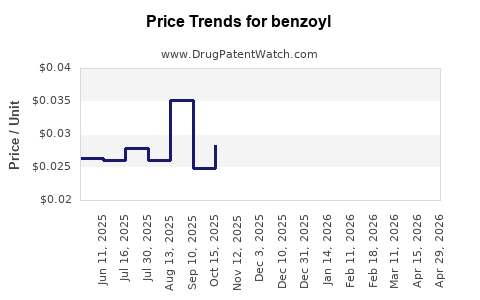
What do historical price trends suggest for benzoyl peroxide (2020–2025)?
Fast answer: The historical pattern for commodity topical dermatology actives is stable-to-down pricing in real terms, with occasional nominal upticks from cost pressure and contract repricing cycles.
Observed mechanics in these markets
- Input costs (resins, packaging, peroxide supply) can cause short-lived nominal increases.
- Bulk and private label sourcing typically offsets cost-driven rises.
- Competitive entry accelerates when manufacturers can deploy equivalent manufacturing lines at scale.
Base-case read-through: Expect nominal list and wholesale price increases at or near inflation, with periodic dips around new generic introductions and retailer promo intensification.
When does benzoyl peroxide lose exclusivity, and what generic entry risks exist?
Fast answer: For most benzoyl peroxide branded products, relevant exclusivity and formulation protection is already expired or late-stage. Generic entry risk is continuous, driven by multi-source manufacturing feasibility rather than discrete expiration events.
Generic entry vectors
- New ANDAs for specific strengths or dosage forms (wash, gel, cream).
- “Authorized generics” and scale reallocation by established generic firms.
- Retail channel expansion by private label.
Market implication for price forecasts
- Price trajectories should not assume long exclusivity hold-ups.
- Instead, model recurring erosion from generic supply and channel-level promotions.
What formulations are most price sensitive for benzoyl peroxide: wash vs gel vs cream vs leave-on?
Fast answer: Leave-on gels and creams often show tighter price floors because they face frequent substitution at the shelf and in electronic prescribing choices. Wash formats can see more retailer promotion variability.
Price drivers by dosage form
- Gel/cream: easier switching within same strength class; higher competition.
- Wash: can be differentiated by vehicle stability and sensory tolerability, but substitutability remains high.
Higher strength products
- If a product sits in a “step-up” regimen (for example higher peroxide concentration), it can maintain a small premium, but it is still vulnerable to multi-source competition and pack-size repricing.
What is the competitive landscape for benzoyl peroxide in 2026: who wins share and why?
Fast answer: Firms that offer broad sku coverage by concentration and vehicle, with strong distribution in mass retail and pharmacy, tend to win. In prescription, PBM-friendly pricing and stable supply matter.
Competitive strategy patterns
- Shelf visibility and planogram control in mass retail
- Contracting for pharmacy chain formularies for Rx-labeled products
- Low-cost supply chain and packaging standardization for multi-sku brands
How does benzoyl peroxide compare with other acne topical therapies in price and adoption?
Fast answer: Benzoyl peroxide is a foundational actives class. Retinoids and combination products can carry higher per-unit costs, but benzoyl’s broad access and tolerability keep it central, especially in multi-therapy regimens.
Substitution and co-usage
- Benzoyl peroxide is often used in combination with:
- topical retinoids,
- topical antibiotics in certain contexts,
- other non-antibiotic agents depending on guidelines and local prescribing habits.
Commercial consequence: Even if competitors have higher list prices, benzoyl’s role as a core partner reduces the risk of demand collapse.
Price projection model: base case, upside, and downside (US, 2026–2035)
Fast answer: Expected pricing trend is modest nominal increases with real-term stagnation. Market value growth comes mainly from volume and mix, not sustained price expansion.
Projection framework
Model three layers:
- Net realized price (retail promo and contracting discounts)
- Mix shift (OTC share vs Rx share; gel/cream vs wash; higher strength share)
- Unit cost pressure (packaging, peroxide input supply, manufacturing scale)
Base case (most likely)
- Net realized price: flat to low single-digit nominal growth annually
- Real price: approximately flat
- Volume: low-to-mid single-digit growth driven by acne incidence and category penetration
- Net market value: mid single-digit nominal CAGR
Upside case
- Faster mix shift to branded-formulation skus (vehicle differentiation)
- Better payer coverage for Rx-labeled differentiated products
- Less aggressive retail promo competition
Forecast effect: modest price premium sustainability for select skus, higher nominal CAGR.
Downside case
- Intensified private label expansion and promo depth
- Additional generic supply entering the most substitutable strengths and formats
- Input cost reductions do not translate to pricing premiums, only deflation to net realized prices
Forecast effect: flat or declining net realized prices, market value growth reliant on volume only.
Regulatory and reimbursement: how does FDA status and payer behavior influence benzoyl peroxide pricing?
Fast answer: FDA oversight affects product quality and labeling, but pricing is primarily payer- and channel-driven rather than regulatory constrained in a way that would enable persistent premiums.
US regulatory posture
- Benzoyl peroxide products are typically regulated as OTC drugs (where applicable) or as drug products under standard topical monograph or approved product pathways depending on formulation and claims.
- Acne claim language can influence product placement, but substitution economics dominate.
Payer mechanics
- For Rx-labeled skus, PBM formularies and step edits influence which strengths and dosage forms are covered.
- For OTC, reimbursements are limited, shifting pricing to retail economics.
What are likely price floors and ceilings for benzoyl peroxide products by channel?
Fast answer: Pricing ceilings are set by commodity shelf competition; floors track cost and minimum contractual supply pricing.
Ceilings
- OTC: retailer and private label set a ceiling through promo substitution.
- Rx: payer copay tiers and reimbursement caps constrain list-to-net spread.
Floors
- When peroxide input or packaging costs rise, the market can sustain temporary nominal increases.
- Scale manufacturers can sustain lower floors, pulling prices down to competitive minima.
Geographic outlook: US vs EU vs APAC price and margin differences
Fast answer: Pricing and margins are typically higher where retail competition is less intense or where prescribing use is higher. However, the commodity nature keeps long-run price discipline similar.
US
- High generic and private label density caps pricing.
- Net realized prices track aggressive discounting.
EU5
- Pharmacy channel structures can soften price drops, but multi-source competition still restrains sustained premiums.
APAC
- Market growth potential is higher with larger addressable populations, but local generics and OTC availability limit sustained price expansion.
Key pricing risks to watch (2026–2030)
Fast answer: The main risks are not regulatory shocks; they are commercial supply and contracting dynamics.
- New generic or private label entrants in top-selling strengths and formats
- PBM contract renegotiations that change preferred products
- Retail promo cycles that compress net realized prices even when WAC rises
- Input cost volatility that compresses margins for producers, leading to price competition
Key Takeaways
- Benzoyl peroxide’s pricing is constrained by generic and OTC commodity dynamics; sustainable premiums are unlikely absent meaningful formulation differentiation and channel-level substitution resistance.
- Forecasted US net realized prices should track inflation at most, with real-term stagnation through 2035.
- Market value growth is expected to be driven more by volume and mix than sustained price expansion.
- Biggest price risk is ongoing generic and private label intensification, which repeatedly resets price floors downward.
FAQs
1) What drives net realized price for benzoyl peroxide more, WAC or retailer and PBM discounts?
Net realized price is driven primarily by retail promotions for OTC products and PBM contracting for Rx-labeled products.
2) Are higher-strength benzoyl peroxide products likely to maintain higher per-unit pricing?
They can hold modest premiums short term, but they remain vulnerable to multi-source equivalence and strength-based substitution.
3) Does switching vehicle (gel vs cream vs wash) change pricing power?
Vehicle can affect consumer and prescriber preferences, but pricing power is limited because equivalent strengths are widely available across categories.
4) How do generic launches typically affect benzoyl peroxide prices?
They usually cause near-term net price erosion in the affected strengths and pack formats, with partial recovery only if the entrant’s cost structure forces fewer aggressive discounting cycles.
5) What commercial levers can support better pricing for benzoyl peroxide producers?
Broad sku coverage, stable supply, contracting strength, and demonstrable tolerability or adherence advantages that reduce substitution elasticity.
References (APA)
- FDA. (n.d.). OTC drug information and drug labeling resources. U.S. Food and Drug Administration. https://www.fda.gov
- FDA. (n.d.). Drug approvals and regulatory information (search portals). U.S. Food and Drug Administration. https://www.accessdata.fda.gov
- EMA. (n.d.). Medicines information and regulatory resources. European Medicines Agency. https://www.ema.europa.eu