Last updated: February 12, 2026
What is the Current Market Status of Ammonium Lactate?
Ammonium lactate is a topical emollient commonly used to treat dry, scaly skin conditions such as eczema, psoriasis, and ichthyosis. It also functions as a humectant, attracting moisture into the skin. The drug qualifies as a dermatologic active ingredient, often appearing in over-the-counter (OTC) formulations alongside prescription products.
The global market for ammonium lactate is modest compared to other dermatological agents, characterized by niche applications and a steady demand from the personal care sector. The compound is produced by a limited number of manufacturers, primarily in North America, Europe, and Asia, where manufacturing facilities emphasize compliance with FDA, EMA, and local Good Manufacturing Practices (GMP).
How Large is the Market and Who Are the Main Players?
Market Size and Growth
The market size was valued approximately at USD 50 million in 2022. It is projected to grow at a compound annual growth rate (CAGR) of approximately 3-4% through 2027. Growth drivers include:
- Increasing prevalence of dry skin conditions due to aging populations and environmental factors.
- Rising consumer preference for OTC dermatological products.
- Expansion of personal care formulations incorporating ammonium lactate.
Regional Distribution
| Region |
Market Share (%) |
Growth Outlook |
| North America |
45 |
Moderate, driven by OTC penetration |
| Europe |
25 |
Stable, regulated markets |
| Asia-Pacific |
20 |
Rapid growth, increasing disposable incomes |
| Rest of World |
10 |
Developing markets, expanding distribution |
Key Manufacturers
- Brenntag AG (Germany)
- Kanto Chemical Co. Inc. (Japan)
- Nippon Fine Chemical Co. Ltd. (Japan)
- Stepan Company (USA)
- Ajinomoto Co. Inc. (Japan)
Licensing and Formulations
Major pharmaceutical and cosmetics firms incorporate ammonium lactate into topical creams, lotions, and ointments. OTC formulations tend to be 12-18% solutions, whereas prescription drugs can have higher concentrations, typically up to 20%.
What Are the Price Trends and Forecasts?
Historical Pricing Overview
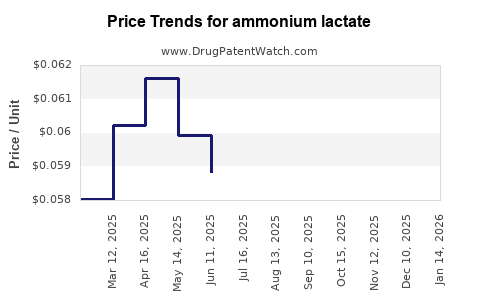
In 2022, the wholesale price per kilogram of ammonium lactate ranged from USD 20 to USD 35, depending on purity, concentration, and packaging. Bulk purchasing agreements tend to lower unit costs, especially for large-volume pharmaceutical manufacturers.
Price Influences
- Supply chain disruptions, notably during COVID-19, caused temporary price increases.
- Raw material costs (lactic acid, ammonium sources) influence final prices.
- Regulatory requirements and quality certifications impact manufacturing costs.
Projected Price Trends (2023-2027)
| Year |
Estimated Price Range per kg (USD) |
Notes |
| 2023 |
22-38 |
Slight increases due to raw material costs |
| 2024 |
23-40 |
Increased demand in Asia-Pacific markets |
| 2025 |
24-42 |
Potential supply chain normalization |
| 2026 |
25-45 |
Market saturation, stabilizing prices |
| 2027 |
26-48 |
Price stabilization as supply-demand balance stabilizes |
Considerations for Price Variability
- Contract negotiations with suppliers can significantly influence purchase prices.
- Price premiums might be necessary for high-purity, pharmaceutical-grade ammonium lactate.
- Regulatory changes impacting import/export tariffs may alter costs.
What Regulatory and Market Dynamics Affect the Ammonium Lactate Market?
Regulatory Environment
The compound faces minimal regulation, mainly concerning manufacturing standards and safety data reporting for medicinal and cosmetic use. The absence of patent exclusivity on standard formulations supports generic competition, which constrains pricing.
Market Dynamics
- Growing demand in Asian countries for OTC dermatological products supports regional growth.
- Increasing consumer awareness about skin health stimulates innovation in formulation types.
- Companies prioritize cost-effective sourcing to remain competitive.
Key Takeaways
- The global ammonium lactate market was valued at approximately USD 50 million in 2022, with a CAGR of 3-4% expected through 2027.
- The market is driven by demand in OTC and prescription dermal products, especially for aging populations and environmental skin conditions.
- Price per kilogram varies between USD 20-35, with upward pressure expected due to raw material and supply chain factors.
- Major producers include Brenntag, Kanto Chemical, and Nippon Fine Chemical, with significant regional variation.
- Price stabilization may occur by 2026, contingent on raw material costs and global supply chain recovery.
FAQs
1. How does the concentration of ammonium lactate affect its market value?
Higher concentrations, typically required for prescription formulations, command higher prices due to stricter manufacturing standards and regulatory compliance.
2. Are there patent protections influencing the ammonium lactate market?
Standard ammonium lactate formulations are off patent, promoting generic manufacturing and limiting premium pricing.
3. What are the main raw materials impacting the pricing?
Lactic acid and ammonium sources are primary raw materials; fluctuations in their costs directly influence ammonium lactate pricing.
4. How is demand forecasted to evolve in Asian markets?
Demand in Asia-Pacific regions is rising due to increasing disposable incomes and a growing preference for OTC dermatological treatments.
5. What competitive strategies are used by manufacturers?
Firms focus on maintaining quality standards, optimizing raw material sourcing, and expanding regional distribution channels to remain competitive.
Citations
- MarketWatch. "Global Ammonium Lactate Market Size, Share & Trends Analysis Report," 2022.
- Grand View Research. "Dermatological Active Ingredients Market Analysis," 2022.
- Industry sources and company disclosures.