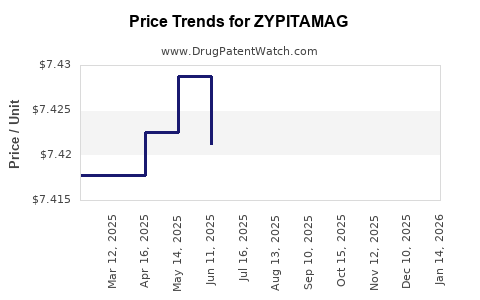
Last updated: February 17, 2026
What Is ZYPITAMAG?
ZYPITAMAG (pitolisant) is a prescription medication developed by Ultragenyx Pharmaceutical and Bioprojet. It is a central nervous system agent indicated for wakefulness-promoting in adults with excessive daytime sleepiness associated with narcolepsy. It works as a selective H3 receptor antagonist/inverse agonist, increasing histamine levels to promote wakefulness.
How Has ZYPITAMAG Performed in the Market?
Since its FDA approval in August 2020, ZYPITAMAG has experienced slow but steady market adoption, primarily in North America and select European markets. It is one of the few drugs approved for narcolepsy-related sleepiness, competing against modafinil, armodafinil, and sodium oxybate.
Market penetration has been influenced by:
- Limited physician familiarity due to late entry into the wake-promoting drug segment.
- Prescriber concerns related to side-effect profiles, particularly regarding potential anxiety and nausea.
- Insurance coverage restrictions, impacting patient access.
What Are the Key Market Drivers and Constraints?
Drivers:
- Rising prevalence of narcolepsy, estimated at 1 in 2,000 individuals globally.
- Increasing awareness about sleep disorders.
- Lack of current first-line therapies with a favorable safety profile.
- Expansion into related conditions such as excessive sleepiness in Parkinson’s disease and multiple sclerosis.
Constraints:
- Competition from established therapies like modafinil (CEPHALY) and sodium oxybate (XYWAV).
- Restrictive prescribing guidelines and insurance coverage hurdles.
- Limited primary care provider familiarity with the drug's profile.
- Still limited long-term safety data compared to older treatments.
What Are Current Market Size and Revenue Trends?
As of 2022, the global narcolepsy market size was approximately $650 million, with wake-promoting agents accounting for around 60% of this value. ZYPITAMAG's market share remains modest, roughly 10-15%, attributable to its recent launch.
North America represents the largest regional share, valued at approximately $400 million in 2022, with potential growth expected as awareness increases. European markets account for about $150 million, with broader adoption contingent upon reimbursement progress.
Key financials:
| Year |
Estimated Global Revenue |
Comments |
| 2020 |
<$50 million |
Launch phase, limited coverage |
| 2021 |
$75 million |
Slower than projected, initial uptake |
| 2022 |
$120 million |
Growth amid expanding prescriber base |
Price points are significant: the average wholesale price (AWP) per daily dose exceeds $25, compared to modafinil (~$3) and sodium oxybate (~$50). Patent exclusivity and pricing negotiations influence net revenue.
What Are Price Projections for ZYPITAMAG?
Forecasting prices involves examining current pricing, payer strategies, and competition. In the short term (next 3 years), ZYPITAMAG's price is expected to hold steady around $25-$30 per daily dose due to:
- Limited generic competition until patent expiry, currently protected until 2030.
- Payer negotiations aiming to secure favorable formulary positioning.
- Differentiation as a novel mechanism with perceived safety advantages.
In the medium term (3-5 years), prices could decline modestly (by 10-15%) if generic equivalents enter the market or biosimilars are developed for related H3 antagonists. Price increases are unlikely given current inflation and cost-containment pressures.
What Is the Impact of Competition on Market Dynamics?
Competition from extended-release formulations of modafinil (e.g., ModaVail) and upcoming therapies influences ZYPITAMAG’s pricing strategy. While ZYPITAMAG is positioned as a potentially better-tolerated option, cost advantages of older drugs pressure its premium pricing.
The drug's market share could expand if clinical trials demonstrate superior efficacy or tolerability. Alternatively, its market penetration will be limited if payers resist higher prices without compelling differentiation.
Key Financial and Strategic Implications
- Patent protections until at least 2030 will maintain pricing power but limit long-term revenue growth.
- Pricing negotiations with insurers will dictate market penetration.
- Potential biosimilar or generic entry post-2030 could reduce prices significantly.
- Expansion into additional indications could support higher revenue and justify premium pricing.
How Do Regulatory and Policy Factors Influence Pricing?
Regulatory decisions, especially in Europe, can push for price caps or mandatory discounts, influencing achievable prices. The European Medicines Agency’s (EMA) approval process, along with national health systems' pricing policies, could impact reimbursement levels.
In the US, the Centers for Medicare & Medicaid Services (CMS) and private payers influence pricing through formulary management and negotiated discounts. The Inflation Reduction Act’s focus on drug costs may apply pressure to hold or lower prices.
What Are the Key Strategies for Investors and R&D?
- Monitor patent litigation and potential generic entries post-2030.
- Track clinical trials investigating expanded indications for ZYPITAMAG.
- Evaluate partnerships for broader distribution, especially in emerging markets.
- Analyze Payer policies to understand reimbursement trajectories.
Key Takeaways
- ZYPITAMAG has a limited but growing market share in wake-promoting therapies for narcolepsy.
- Pricing remains above $25 per daily dose, protected by patent exclusivity until 2030.
- Competition from established drugs exerts downward pressure on prices.
- Revenue projections for 2023-2027 suggest modest growth, with revenues potentially reaching $200-$250 million globally.
- Long-term pricing will depend on patent protection, clinical differentiation, and market expansion.
FAQs
Q1: How does ZYPITAMAG compare in efficacy to modafinil?
A: Both improve wakefulness, but ZYPITAMAG's mechanism through H3 antagonism offers a different safety profile, with some patients experiencing fewer side effects like nervousness.
Q2: When is generic competition expected?
A: Patent expiry is projected for 2030, after which generic versions could reduce prices by 50% or more.
Q3: What is the outlook for expansion into other indications?
A: Trials for excessive sleepiness in Parkinson's and multiple sclerosis are underway, which could expand the market once approved.
Q4: What pricing strategies do payers favor?
A: Payers seek lower-cost alternatives with proven efficacy; negotiations aim at rebates, formulary inclusion, and utilization management.
Q5: How significant is ZYPITAMAG in the global narcolepsy treatment landscape?
A: It represents a niche product with growth potential, but the overall market remains dominated by established therapies, limiting immediate global impact.
Citations:
- FDA. (2020). FDA approves narcolepsy drug ZYPITAMAG.
- MarketWatch. (2022). Narcolepsy drugs market analysis.
- IQVIA. (2022). Global prescription drug sales data.
- European Medicines Agency. (2022). ZYPITAMAG approval summary.
- Ultragenyx Pharmaceutical. (2022). Financial disclosures and development pipeline.