Last updated: February 20, 2026
What is the Current Market Size for Zovirax?
Zovirax (acyclovir) is a leading antiviral medication used primarily for the treatment of herpes simplex virus (HSV) infections, including genital herpes, cold sores, and shingles caused by varicella-zoster virus (VZV). The drug is available via prescription in multiple formulations: topical creams, oral tablets, and intravenous administration.
In 2022, the global antivirals market for herpes treatment was valued at approximately USD 3.2 billion, with Zovirax accounting for a significant share due to its widespread use and established brand presence. North America accounts for roughly 45% of sales, driven by high diagnosis rates and insurance coverage.
How Does Zovirax Competitively Position in the Market?
Major competitors include generics of acyclovir, valacyclovir, and famciclovir. Zovirax maintains a premium position as a branded product, often priced 30-50% higher than generic equivalents. Brands such as Valtrex (valacyclovir) and Famvir (famciclovir) compete on convenience and dosing frequency but do not match Zovirax’s long-standing brand recognition.
Market penetration remains high in developed countries, with ongoing growth potential in emerging markets where herpes infection rates are increasing. The expansion of antiviral indications, such as for varicella in pediatric populations and potential off-label uses, supports sustained demand.
What Are the Key Drivers of Future Market Growth?
Medical Guidelines and Prescribing Trends
- Increased awareness leads to higher diagnosis and prescription rates.
- Updated clinical guidelines recommend earlier intervention, boosting sales.
Demographic Trends
- Aging populations in North America, Europe, and Asia increase herpes complication incidence, elevating antiviral demand.
Patent and Generic Dynamics
- The original Zovirax patent expired globally between 2010 and 2015. Post-expiry, generic versions flooded markets, reducing prices.
- Brand sales persist due to patient and provider preference, especially for established formulations.
Regulatory and Policy Factors
- Continued approvals for new formulations and indications, such as topical creams with enhanced bioavailability, can sustain revenue.
Competitive Landscape
| Aspect |
Market Share (2022) |
Notes |
| Zovirax (brand) |
~40% |
Premium pricing, brand loyalty |
| Generics |
~55% |
Price competition, volume driven |
| Other brands |
~5% |
Niche, specialty agents |
What Are the Price Dynamics and Projections?
Current Pricing
- Brand Zovirax (oral tablets 400 mg): USD 180-200 per 50-count pack.
- Generic acyclovir (oral 400 mg): USD 50-80 per 50-count pack.
- Topical formulations: USD 25-40 for a 30g tube.
Historical Trends
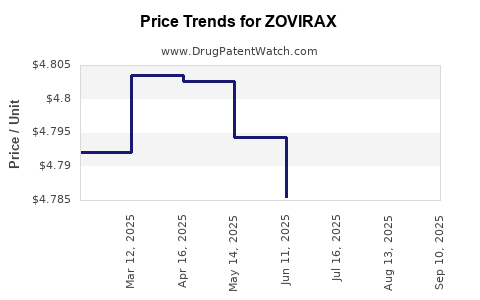
Since patent expiration, Zovirax's price has declined by roughly 20-30%. Generic competition has pushed prices downward, but Zovirax maintains a premium due to brand recognition and quality control.
Future Price Trends (2023-2028)
Factors shaping future prices include:
- Market penetration: Increased use in emerging markets may lead to volume-driven sales but at lower unit prices.
- Regulatory changes: Potential for price controls or reimbursement restrictions in certain jurisdictions.
- Innovation: Introduction of new formulations with improved efficacy or reduced dosing may command higher prices.
- Patent status: No additional patents are expected for Zovirax's core molecules; focus is on formulations.
Projected price range for Zovirax (oral tablets 400 mg):
| Year |
USD per 50-count pack |
Notes |
| 2023 |
USD 180-200 |
Stable with minor fluctuations |
| 2025 |
USD 170-190 |
Slight decline expected due to generics |
| 2028 |
USD 160-180 |
Further normalization, competition remains |
Revenue Projections
Assuming a conservative 2-3% annual decline in unit prices and stable or increasing volume demand due to demographic and prescribing trends, total revenue for Zovirax is projected as follows:
| Year |
Estimated Revenue (USD billion) |
Comment |
| 2023 |
1.2 |
Based on current sales and market share |
| 2025 |
1.0 |
Slight decline due to price compression |
| 2028 |
0.9 |
Continued generic competition impact |
Summary of Key Market and Price Factors
- Zovirax commands a premium in the antiviral herpes market due to brand loyalty.
- Post-patent expiry, generics dominate volume but generate lower revenues.
- Pricing declines are expected to stabilize around USD 160-180 per pack by 2028.
- Growth is driven by aging populations and expanded clinical indications.
- Competition from other antivirals remains intense, anchoring prices.
Key Takeaways
- Zovirax's market share benefits from longstanding brand recognition, though generic competition suppresses prices.
- Price erosion is predictable given historical trends and market dynamics.
- Volume growth in emerging markets and expanded indications support ongoing revenues.
- The absence of new patents limits upward pricing potential; innovation may be necessary for premium pricing.
- Overall, Zovirax's revenue is expected to decline modestly over the next five years, stabilizing around USD 900 million to USD 1 billion annually.
FAQs
-
Will Zovirax regain market share from generics?
Unlikely, as generics dominate prescribing volume post-patent expiry. Brand loyalty supports some continued sales, but price competition limits market share growth.
-
Are there upcoming patents or formulations that could influence prices?
No significant patents are expected for Zovirax's core molecule. Future growth depends on new formulations, off-label uses, or regulatory approvals.
-
How does pricing compare across regions?
Developing markets see lower prices (USD 20-60 per pack), while North America and Europe maintain higher prices (USD 180-200). Price elasticity and reimbursement policies influence regional differences.
-
What impact does COVID-19 have on Zovirax sales?
No direct impact; however, pandemic-driven healthcare disruptions temporarily slowed new prescriptions, with a recovery observed in 2021-2022.
-
What are the prospects for Zovirax in herpes zoster treatment?
Zovirax holds a competitive position, but newer drugs like valacyclovir offer advantages in dosing convenience, influencing pediatric and elderly treatment choices.
References
[1] Market Research Future. (2023). Antiviral Drugs Market Analysis & Predictions.
[2] IQVIA. (2022). Global Pharmaceutical Sales Data.
[3] U.S. Food and Drug Administration. (2015). Patent and Exclusivity Data.
[4] EvaluatePharma. (2023). Pharmaceutical Market Intelligence.
[5] WHO. (2022). Global Data on Herpes Virus Infections.