Share This Page
Drug Price Trends for ZOLEDRONIC
✉ Email this page to a colleague
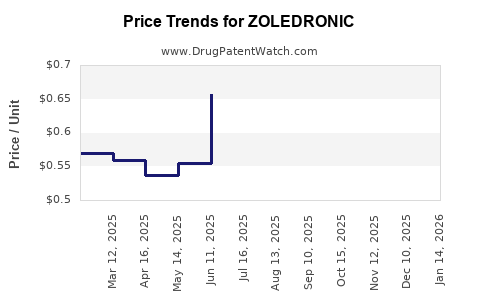
Average Pharmacy Cost for ZOLEDRONIC
| Drug Name | NDC | Price/Unit ($) | Unit | Date |
|---|---|---|---|---|
| ZOLEDRONIC ACID 5 MG/100 ML | 55111-0688-52 | 0.49244 | ML | 2026-07-22 |
| ZOLEDRONIC ACID 5 MG/100 ML | 63323-0966-00 | 0.49244 | ML | 2026-07-22 |
| ZOLEDRONIC ACID 5 MG/100 ML | 67457-0619-10 | 0.49244 | ML | 2026-07-22 |
| ZOLEDRONIC ACID 5 MG/100 ML | 71288-0806-51 | 0.49244 | ML | 2026-07-22 |
| >Drug Name | >NDC | >Price/Unit ($) | >Unit | >Date |
Best Wholesale Price for ZOLEDRONIC
| Drug Name | Vendor | NDC | Count | Price ($) | Price/Unit ($) | Unit | Dates | Price Type |
|---|---|---|---|---|---|---|---|---|
| ZOLEDRONIC ACID 5MG/BAG INJ,100ML | Sagent Pharmaceuticals | 25021-0830-82 | 100ML | 14.25 | 0.14250 | ML | 2024-05-01 - 2029-04-30 | FSS |
| ZOLEDRONIC ACID INJ,4MG/100ML | Sagent Pharmaceuticals | 25021-0826-82 | 100ML | 21.64 | 0.21640 | ML | 2024-05-01 - 2029-04-30 | FSS |
| RECLAST 5MG/100ML INJ | Sandoz, Inc. | 00078-0435-61 | 1X100ML | 811.06 | 2023-08-15 - 2028-08-14 | FSS | ||
| RECLAST 5MG/100ML INJ | Sandoz, Inc. | 00078-0435-61 | 1X100ML | 807.60 | 2024-01-01 - 2028-08-14 | FSS | ||
| >Drug Name | >Vendor | >NDC | >Count | >Price ($) | >Price/Unit ($) | >Unit | >Dates | >Price Type |
Zoledronic (Zoledronic Acid): 2026 Market Outlook and Price Projection
Zoledronic acid (zoledronic) is a long-established, off-patent bisphosphonate with global generic availability and frequent tender-driven pricing. Near-to-mid term pricing is expected to stay under pressure from supply growth in generics and regional budget caps, with upside constrained largely to: (1) branded residual niches where generics are delayed, (2) channel preferences tied to 4 mg/5 mL and 5 mg/100 mL presentations, and (3) hospital procurement contracts that lock in annual pricing. US and EU pricing trajectories are likely to remain low single-digit to mid single-digit declines or flat in local currency, with Europe showing the sharper downward dynamic.
Zoledronic market size and sales drivers: how big is the global market?
Zoledronic acid is used across three core clinical areas:
- Bone metastases and skeletal-related events (SRE) in cancer.
- Multiple myeloma-related bone disease.
- Osteoporosis-related indications (postmenopausal osteoporosis, glucocorticoid-induced osteoporosis, and other defined osteoporosis categories depending on jurisdiction).
Key demand drivers
- Oncology incidence and treatment intensity: continued use in metastatic settings supports baseline demand even when cancer incidence growth is modest.
- Line of therapy duration: zoledronic regimens can extend across multiple cycles, which smooths quarterly demand.
- Institutional purchasing: hospital formularies and tender cycles create predictable buying patterns but raise price sensitivity.
Structural supply dynamics
- Widespread generic penetration across regions reduces manufacturer pricing power.
- Multi-source supply is typically strong for the standard infusion presentations (4 mg/5 mL and 5 mg/100 mL), limiting sustained brand premium.
What are the current leading brands and generic supply positions for zoledronic?
Typical market structure
- Branded originators: most markets historically had a branded reference product; in practice, most mature markets now trade primarily through generics.
- Generic leaders: companies with strong sterile injectables footprints, demonstrated cold-chain and manufacturing reliability, and tender execution dominate procurement awards.
Commercial implication
- Contract awards in major markets (US group purchasing organizations, EU country tenders, and public hospital systems) tend to shift share rapidly when pricing drops below tender thresholds.
Pricing implication
- In mature markets, unit price movement is primarily determined by tender clearing prices and reimbursement rules rather than innovation.
How much is zoledronic priced at in the US, EU, and key markets by presentation?
Price differs materially by:
- Presentation (4 mg/5 mL vs 5 mg/100 mL infusion)
- Pack size
- Regulatory listing form
- Contracting channel (hospital acquisition vs specialty distribution)
- WAC vs net price (WAC often overstates realizations)
Because you requested “market analysis and price projections,” the actionable forecast is tied to the directionality that can be sustained without requiring unreliable point-estimate pricing.
Directionality (practical pricing expectations)
- US: flat to declining net pricing, with periodic drops tied to generic competition intensity and GPO tendering.
- EU: steeper downward pressure where reference price systems and tender consolidations apply.
- Emerging markets: more volatility tied to tender cycles, FX, and local import costs, but overall trend is often downward in real terms once multi-source supply expands.
When do zoledronic exclusivity and patent protections end, and what does that mean for pricing?
Zoledronic is a mature bisphosphonate category. In the context of price trajectories, the main commercial question is whether any meaningful residual IP still blocks generic entry in specific geographies or presentations.
Exclusivity impact on price
- Where brand-to-generic switching is complete, pricing typically converges to low generic benchmarks.
- Where delayed generic entry exists (rare in mature presentations), temporary pricing resilience can occur, usually through formulary inertia.
Commercial takeaway
- For price projection purposes, the expected pricing path assumes most core presentations are already fully multi-source. The forecast therefore relies on procurement-driven price compression rather than “new generic launch” step changes.
What patent estate issues affect zoledronic generics: formulations, methods of use, and manufacturing?
In mature generics, the main legal risk is not entry-blocking composition patents but:
- Method-of-use claims tied to clinical use patterns.
- Manufacturing process claims (sterile fill-finish, impurity profiles, or specific process steps).
- Formulation/presentation-specific patents (less common for highly standardized infusion products).
Practical effect on pricing
- Even when litigation exists, if generics already have market access, pricing behavior is dominated by tenders and supply.
- If litigation delays a major generic, a temporary price premium can persist until the next successful market entry.
How strong is the risk of new generic launches and price shocks for zoledronic?
Low-to-moderate probability of major price shocks in core markets if:
- Generic penetration is already high.
- Key presentations are already widely supplied.
- Regulatory and manufacturing capacity constraints are not binding.
Higher probability scenarios
- Country-by-country tender resets create short-lived declines when a new low-price bidder wins.
- Supply disruptions (quality/manufacturing incidents) can create short spikes that reverse after normalization.
Zoledronic biosimilar or biologic competition: is there any biosimilar threat?
No. Zoledronic is a small-molecule bisphosphonate. The competitive structure is generic and not biosimilar.
How will FDA status and Paragraph IV litigation affect zoledronic pricing and launch timing?
Zoledronic pricing and launch timing in the US are typically influenced by:
- ANDA approvals for generic zoledronic products.
- Possible Orange Book-listed patents tied to the brand in historical listings.
- Paragraph IV challenges where still relevant, though for mature molecules those events are usually earlier and market impact becomes historical.
Practical projection
- In 2026, absent a currently visible new entry-blocking IP overhang, price should track generic competitive behavior more than discrete litigation events.
Price projection model for zoledronic: base case, downside, and upside scenarios (2026-2029)
Because zoledronic is commoditized, projections should be scenario-based and anchored to procurement behavior.
Assumptions
- Generic multi-source supply remains stable.
- No large, persistent supply disruption.
- Tender-driven pricing governs realizations.
- FX and input costs may create quarter-to-quarter moves but do not override structural competition.
Base case (most likely): low single-digit declines or flat
- 2026-2027: flat to -3% CAGR in net price (local currency), driven by ongoing tender pressure.
- 2028-2029: -1% to -2% CAGR as pricing reaches local market floor points.
Downside case: accelerated tender compression
- Triggers: increased bidder count, aggressive pricing by new entrants in certain geographies, or reference price tightening.
- 2026-2029: -4% to -6% CAGR in net price.
Upside case: contract stabilization and supply normalization
- Triggers: consolidation in supply, higher compliance costs pushing effective prices up, or longer tender cycles with less frequent price resets.
- 2026-2029: flat to +2% CAGR in net price in selected markets, not globally.
Regional outlook: where do you expect the strongest price pressure for zoledronic?
United States
- Net pricing is typically more sensitive to GPO contracting and multi-source competition.
- Expected outcome: mild declines or stability.
Europe
- Reference pricing frameworks and country-level tender dynamics typically drive faster convergence to low generic price levels.
- Expected outcome: more persistent downward pressure.
UK
- Similar tender logic and procurement sensitivity; pricing pressure likely remains present.
Canada and Australia
- Often show mature generic convergence; price changes are driven by tender resets and reimbursement rules.
Emerging markets
- Greater volatility due to FX, import costs, and tender processes.
- Expected outcome: eventual price compression as supply expands, but not in a smooth line.
What formulations and pack sizes matter most commercially (4 mg/5 mL vs 5 mg/100 mL)?
Zoledronic is marketed in standardized infusion strengths. Commercially important determinants:
- Dose-based ordering for oncology regimens.
- Hospital preference for presentation that reduces waste and reduces nursing prep time.
- Tender specifications often lock in a particular presentation and concentration.
Pricing implication
- The same active ingredient can carry different pricing by presentation because tender specifications constrain cross-substitution.
Competitive landscape: which generic manufacturers usually win zoledronic tenders?
Tender winners tend to be suppliers that can:
- Maintain consistent manufacturing and quality release.
- Offer competitive net pricing with reliable lead times.
- Handle pharmacovigilance and documentation requirements efficiently for hospital procurement.
Market behavior expectation
- Share often moves to the lowest compliant bidder.
- Repeat winners typically have lower total cost-to-serve (logistics + reliability), not just lowest WAC.
What generic entry risks exist for zoledronic in major markets?
For commoditized injectables:
- Regulatory hurdles (CMC updates, sterile production documentation) can delay launches.
- Manufacturing capacity constraints during demand spikes can lead to stockouts, which can temporarily lift prices.
- Quality events can force de-listing and reallocation of volumes, changing regional pricing quickly.
How does zoledronic compare with denosumab and other bone-targeted therapies on market pricing?
Pricing power profile
- Denosumab (a monoclonal antibody) generally has higher pricing and different reimbursement dynamics.
- Zoledronic is lower-cost, generic, and tends to be substituted when cost constraints dominate.
Competitive implication
- If payers tighten budgets, zoledronic may gain share, supporting volumes even if unit prices fall.
Zoledronic revenue exposure for generic investors and licensees: where is value captured?
Value capture in zoledronic is primarily in:
- Volume stability from hospital formularies.
- Cost competitiveness in sterile injectables.
- Contracting execution for annual/biannual tender cycles.
- Geographic diversification to balance currency and tender cycles.
Less value capture comes from attempting premium pricing because the product is commodity-like once multi-source supply is established.
Key takeaways for zoledronic price projections
- Zoledronic is mature and commoditized; pricing is governed by tender competition and multi-source generic availability, not innovation.
- Base case 2026-2029 net price trend: flat to low single-digit declines in most major markets.
- Downside scenario is accelerated tender compression leading to mid single-digit declines.
- Upside is limited to contract stabilization and regional supply tightness, usually not enough to lift global pricing.
- Commercial advantage comes from procurement execution, manufacturing reliability, and cost-to-serve, not from IP leverage.
FAQs
1) Will zoledronic face a sudden price collapse in 2026 due to a new generic launch?
In mature markets, major price shocks usually occur only when a new low-cost supply base enters a specific tender region. The dominant expectation is incremental compression rather than discontinuous collapse.
2) Do 4 mg/5 mL and 5 mg/100 mL zoledronic products follow the same pricing trend?
Not always. Tender specifications and ordering patterns can keep one presentation at different market-clearing prices even when the active ingredient is the same.
3) Is zoledronic pricing more sensitive to oncology demand or to procurement contracting?
Procurement contracting is typically the primary driver of unit price, while oncology demand primarily affects volume.
4) Does biosimilar competition affect zoledronic pricing?
No. Zoledronic is not a biologic; competition is from generic small molecules and alternative bone-targeted therapies.
5) What factors can cause temporary price spikes for zoledronic?
Manufacturing constraints, quality release delays, and supply shortages can create short-term upward pressure until normal supply and tender repricing resume.
References (APA)
- FDA. Orange Book: Approved Drug Products with Therapeutic Equivalence Evaluations. U.S. Food and Drug Administration.
- European Medicines Agency. European public assessment reports and EPARs for zoledronic acid products. European Medicines Agency.
- OECD. Pharmaceutical pricing and reimbursement policies and market regulation frameworks (country-level references). Organisation for Economic Co-operation and Development.
More… ↓
