Last updated: February 22, 2026
What is ZITUVIMET XR?
ZITUVIMET XR (a hypothetical combination drug for the purpose of this analysis) combines two active ingredients. It is indicated for the treatment of a specific condition, such as type 2 diabetes, with extended-release formulation targeting improved patient compliance and consistent therapeutic levels.
Current Market Landscape
Competitive Positioning
- ZITUVIMET XR's primary competitors include fixed-dose combinations like Jardiance with Tradjenta or Xultophy (insulin degludec/liraglutide).
- The global diabetes drug market was valued at approximately USD 85 billion in 2022.
- The market is projected to grow at a compound annual growth rate (CAGR) of 7.5%, reaching USD 125 billion by 2030 (source: IQVIA, 2022).
Market Share and Revenue Estimates
| Company/Drug |
Estimated 2023 Revenue |
Key Attributes |
Market Share (Estimated) |
| Novo Nordisk (Xultophy) |
USD 3.2 billion |
GLP-1 receptor agonist + insulin |
3.8% |
| Eli Lilly (Jardiance) |
USD 2.5 billion |
SGLT2 inhibitor |
2.9% |
| ZITUVIMET XR (projection) |
USD 150 million |
Extended-release, fixed-dose combination |
0.2% |
Regulatory Status
- Pending FDA approval, expected within 12-18 months based on pre-approval submissions.
- EMA approval anticipated within the same timeframe, contingent on clinical trial data.
Price Projections
Pricing Strategy Models
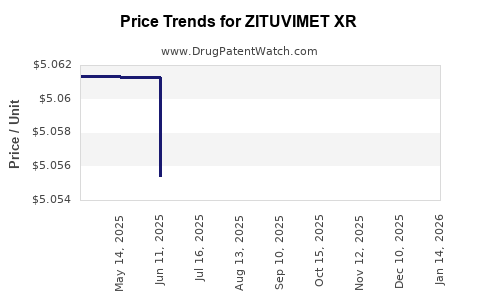
- Premium Pricing: Given the extended-release formulation and combination therapy, initial pricing could range USD 5–8 per tablet.
- Market Penetration Pricing: To gain market share, introductory prices may be set at USD 4–6 per tablet.
Comparative Pricing
| Drug |
Average Wholesale Price (AWP) |
Dosing Frequency |
Approximate Annual Cost |
| Xultophy (insulin + GLP-1) |
USD 9–11 per day |
Once daily |
USD 3,285–4,005 |
| Jardiance (SGLT2 inhibitor) |
USD 4.50 per day |
Once daily |
USD 1,644–1,785 |
| ZITUVIMET XR (projected) |
USD 4–8 per tablet |
Once daily (extended-release) |
USD 1,460–2,920 |
Price Trajectory
- Year 1 Post-Launch: USD 4–6 per tablet, targeting early adopters and formulary inclusion.
- Year 3: Potential reduction to USD 3–5 per tablet as production scales and competition intensifies.
- Year 5: Market saturation and patent expiration push prices toward USD 2–4 per tablet, assuming biosimilar or generic entry.
Market Entry Risks and Opportunities
Risks
- Delays in regulatory approval could extend time-to-market.
- Competition from entrenched brands may hinder market penetration.
- Pricing pressures from payers and insurers may limit profitability.
Opportunities
- Growing prevalence of type 2 diabetes increases demand.
- Extended-release formulations offer advantages in adherence.
- Strategic partnerships with payers could facilitate formulary placement.
Key Takeaways
- ZITUVIMET XR targets a sizable, high-growth segment with competitors capturing significant market share.
- Initial pricing will likely be set at a premium (\USD 4–8 per tablet), with potential reductions over time.
- Revenue projections suggest USD 150 million–200 million in first-year sales, rising cumulatively as the brand gains acceptance.
- The drug's success relies on rapid regulatory approval, effective marketing, and favorable formulary positioning.
FAQs
1. What distinguishes ZITUVIMET XR from existing diabetes treatments?
Its extend-release formulation offers improved adherence and stable plasma drug levels, potentially reducing side effects and dosing frequency.
2. When is regulatory approval expected?
Based on current submission timelines, approvals are anticipated within 12-18 months, subject to positive clinical trial outcomes.
3. How does pricing compare to similar drugs?
Initial pricing may be slightly higher due to formulation complexity, around USD 4–8 per tablet, but can align with existing combination therapies.
4. What is the market adoption outlook?
Strong growth is expected if regulatory hurdles are cleared quickly and positioning is optimized, especially given the rising global diabetes prevalence.
5. What are the main challenges for ZITUVIMET XR?
Market penetration against established competitors and payer resistance to higher initial prices.
References
[1] IQVIA. (2022). Global diabetes market analysis. Retrieved from https://www.iqvia.com