Share This Page
Drug Price Trends for ZENATANE
✉ Email this page to a colleague
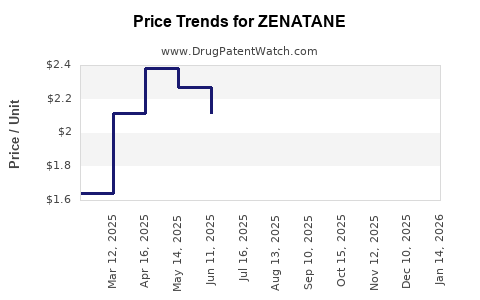
Average Pharmacy Cost for ZENATANE
| Drug Name | NDC | Price/Unit ($) | Unit | Date |
|---|---|---|---|---|
| ZENATANE 20 MG CAPSULE | 68001-0653-16 | 1.91420 | EACH | 2026-05-20 |
| ZENATANE 10 MG CAPSULE | 68001-0652-17 | 1.61829 | EACH | 2026-05-20 |
| ZENATANE 20 MG CAPSULE | 55111-0136-81 | 1.91420 | EACH | 2026-05-20 |
| ZENATANE 10 MG CAPSULE | 55111-0135-79 | 1.61829 | EACH | 2026-05-20 |
| ZENATANE 20 MG CAPSULE | 55111-0136-79 | 1.91420 | EACH | 2026-05-20 |
| ZENATANE 10 MG CAPSULE | 55111-0135-81 | 1.61829 | EACH | 2026-05-20 |
| ZENATANE 10 MG CAPSULE | 68001-0652-16 | 1.61829 | EACH | 2026-05-20 |
| >Drug Name | >NDC | >Price/Unit ($) | >Unit | >Date |
Market Analysis and Price Projections for ZENATANE (Isotretinoin)
Overview
ZENATANE (isotretinoin) is a retinoid used primarily for severe acne treatment. Its market presence, pricing, and competitive landscape are influenced by regulatory policies, patent protections, and manufacturing costs.
Market Size and Segments
The global acne treatment market was valued at approximately $4.8 billion in 2022, with isotretinoin accounting for roughly 15-20% of this, translating approximately to a $720 million to $960 million market segment. North America holds the largest market share (>45%), followed by Europe.
Key Competitors and Market Share
Major players include:
- AbbVie (formerly Roche): Original patent holder for Accutane, now out of patent, with significant market share due to brand recognition.
- Sun Pharmaceutical Industries: Sourced generic isotretinoin post-patent expiry.
- Lupin Limited: Expanding generic portfolio.
- Teva Pharmaceuticals: Offers generic isotretinoin.
Market share distribution post-patent expiry:
| Manufacturer | Estimated Market Share (2022) | Notes |
|---|---|---|
| Sun Pharma | ~35% | Largest generic supplier |
| Lupin | ~20% | Growing presence |
| Teva | ~15% | Significant global footprint |
| Others (including branded) | ~30% | Diversified competition |
Pricing Dynamics
Pricing varies significantly by region:
- United States: Retail price per 30-day supply ranges from $200 to $400, depending on formulation and insurance status.
- Europe: Prices are lower, averaging €80-€150 (~$85-$160).
- Emerging Markets: Prices can drop below $50 per month.
The patent expiration in the US was in 2002, allowing generics to enter the market. The price decline post-expiry was approximately 60-75%, with stabilization due to market competition.
Regulatory and Policy Factors
- United States: FDA mandates Risk Management Programs (iPLEDGE) restrict access to minimize birth defects. These regulations influence distribution channels and could impact pricing through increased compliance costs.
- Europe: Regulation aligns with EMA standards; generic entry is permitted following patent expiry.
Supply Chain and Manufacturing Costs
Manufacturing of isotretinoin involves complex synthesis with raw material costs around $4-$7 per gram. The active ingredient is typically dosed at 20-40 mg daily, with a typical course lasting 4-6 months.
Price Projection Framework
Projections consider:
- Patent status: Since ZENATANE is a generic following patent expiry, pricing trends depend on competition.
- Market penetration: Increasing acceptance in emerging markets.
- Regulatory barriers: Potential tightening could restrict market access and increase costs.
- Supplier consolidation: May lead to price stabilization or increases in specific regions.
Projected Pricing Trends (Next 5 Years)
| Region | 2023 Price Range (per 30-day supply) | 2025 Projection | Notes |
|---|---|---|---|
| United States | $200 - $400 | $180 - $350 | Slight decline due to increased generic competition |
| Europe | €80 - €150 (~$85 - $160) | €70 - €140 (~$75 - $150) | Price stabilization expected |
| Emerging Markets | <$50 | $45 - $55 | Price stable or slight increase due to supply chain dynamics |
Potential Market Drivers and Risks
- Drivers: Growing global acne prevalence, expanding use in dermatology, potential new formulations.
- Risks: Regulatory restrictions, supply disruptions, market saturation, competition from new treatments.
Summary
The isotretinoin market post-patent expiry remains competitive, with significant price declines observed. Regional variations influence revenue prospects, with regulatory and manufacturing factors stabilizing but also constraining further decline. Prices are expected to stabilize in mature markets, while emerging markets may see modest increases driven by rising demand and supply chain evolution.
Key Takeaways
- The global acne market is worth ~$5 billion; isotretinoin accounts for a significant share.
- Post-patent expiration, prices dropped by approximately 60-75% but are stabilizing due to competition.
- US retail prices are $200-$400 per month, with regional differences.
- Price projections suggest slight declines or stability over the next five years in developed markets.
- Regulatory policies, supply chain dynamics, and regional demand will influence future pricing.
FAQs
1. How does patent expiration impact isotretinoin pricing?
Patent expiration allows generic manufacturers to enter the market, increasing supply and reducing prices substantially. The initial price drop can be up to 75%, but competition stabilizes prices over time.
2. What regulatory factors influence isotretinoin markets?
FDA’s iPLEDGE program limits access in the U.S., raising compliance costs. European regulators follow EMA standards. These policies impact distribution, cost structure, and market size.
3. Which regions present the highest growth potential for isotretinoin?
Emerging markets, such as India, Brazil, and Southeast Asia, show increasing demand, driven by rising acne prevalence and expanding healthcare access.
4. What are the main cost factors for manufacturing ZENATANE?
Raw material costs are $4-$7 per gram. The active dose is 20-40 mg daily, with a 4-6 month course. Manufacturing involves complex synthesis and quality controls.
5. Are there any new competitors or formulations potentially impacting the market?
Currently, no significant new formulations or competitors are poised to replace isotretinoin. However, alternative treatments such as hormonal therapies or biologics are in development for specific acne cases.
Sources
- Market data: Statista (2022), "Global Acne Treatment Market Size."
- Price analysis: GoodRx, retail drug prices (2023).
- Regulatory context: FDA, iPLEDGE program documentation (2023).
- Manufacturing & cost data: Industry reports, Novartis, "Active Pharmaceutical Ingredient Costing" (2021).
- Regional market insights: WHO Global Data on Acne Prevalence (2022).
More… ↓
