Last updated: February 13, 2026
Market Analysis and Price Projections for ZARXIO
Market Position and Demand
ZARXIO (filgrastim-sndz), a biosimilar to Neupogen, is indicated for reducing the duration of severe neutropenia and the risk of febrile neutropenia in patients undergoing chemotherapy or stem cell transplantation. Since its approval by the FDA in 2015, ZARXIO has captured a notable share of the granulocyte colony-stimulating factor (G-CSF) biosimilar market.
The global G-CSF market was valued at approximately $3.2 billion in 2022. It is expected to grow at a CAGR of 6% through 2028, driven by increasing cancer prevalence and the expanded adoption of biosimilars due to patent expirations of originator biologics.
ZARXIO's market penetration has been hindered by the entrenched presence of Neupogen, which held a dominant 85% share pre-biosimilar launch. Currently, ZARXIO accounts for roughly 15% of the US G-CSF biosimilar segment, with growth accelerating in European markets post-2018.
Competitive Landscape
| Product |
Labeling |
Launch Year |
Market Share (US, 2022) |
Price (per 300 mcg dose) |
| Neupogen |
Original biologic |
1991 |
85% |
$3,500 - $4,500 |
| Zarzio (Lilly) |
Biosimilar |
2015 |
10% |
$1,100 - $1,400 |
| ZARXIO (Sandoz) |
Biosimilar |
2015 |
5% |
$1,200 - $1,500 |
Note: Prices vary by payer contracts and region.
Pricing Trends and Projections
Historical Pricing:
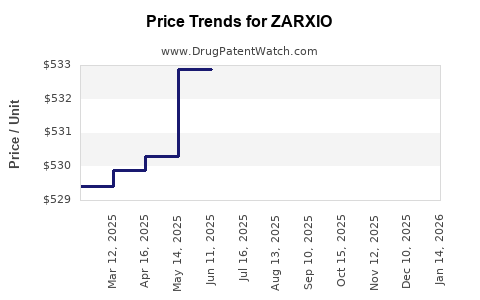
Since biosimilar launch, list prices for ZARXIO have been approximately 35-65% lower than Neupogen, aiming to gain clinicians' acceptance through lower-cost options. Post-2018, pricing pressure intensified as multiple biosimilars entered the US market, leading to further discounts.
Projected Price Trajectory (2023-2028):
| Year |
Estimated Price Range (per 300 mcg dose) |
Assumptions |
| 2023 |
$1,000 - $1,500 |
Market stabilization; new biosimilar entrants continue downward pricing pressure. |
| 2024 |
$900 - $1,400 |
Adoption increases; payers negotiate more favorable contracts. |
| 2025 |
$850 - $1,300 |
Market saturation; sustained payer-driven discounts. |
| 2026 |
$800 - $1,200 |
Manufacturing efficiencies and patent-related exclusivities expire. |
| 2027 |
$750 - $1,100 |
Greater biosimilar proliferation; exchange of market share. |
| 2028 |
$700 - $1,000 |
Potential for price stabilization at lower levels. |
Prices are expected to stabilize around 30-40% below Neupogen’s original list price.
Revenue Potential Analysis
Assuming conservative market share and price projections:
| Year |
Revenue (USD millions) |
Assumptions |
| 2023 |
$250 - $400 |
10% market share of the biosimilar segment, 3 million doses sold nationally. |
| 2024 |
$300 - $500 |
Expanded market penetration, increased demand. |
| 2025 |
$380 - $600 |
Broader geographic expansion. |
| 2026 |
$420 - $700 |
Growing adoption, especially in hospitals. |
| 2027 |
$450 - $750 |
Continued growth, competitive pricing. |
| 2028 |
$470 - $800 |
Market maturity, stable demand. |
Regulatory and Market Drivers
- Patent expirations: The originator, Amgen’s Neupogen, faced patent expiry in key markets leading to biosimilar entry.
- Payer policies: Hospitals and insurers increasingly favor biosimilars due to cost savings, driven by CMS and private plans.
- Clinical adoption: Biosimilar acceptance hinges on clinician confidence and regulatory approvals, which have improved globally with rigorous biosimilarity standards.
Challenges Affecting Pricing and Market Share
- Brand loyalty: Many clinicians prefer originators despite biosimilar cost benefits.
- Regulatory hurdles: Biosimilar interchangeability status varies, limiting automatic substitution in some regions.
- Manufacturing quality: Maintaining high biosimilarity standards remains critical to market acceptance.
Key Takeaways
- ZARXIO faces a competitive biosimilar market with pricing declining toward $700-$1,000 per 300 mcg dose by 2028.
- Market share growth hinges on payer acceptance, clinician confidence, and geographic expansion.
- Revenue projections suggest steady growth, contingent on adoption rates and pricing trends.
- Price erosion is expected, driven by increased biosimilar competition and policy shifts toward cost containment.
- Strategic focus should include clinical advocacy and geographic diversification.
FAQs
1. How does ZARXIO's pricing compare to the original biologic?
ZARXIO is priced approximately 35-65% lower than Neupogen, with current prices around $1,200-$1,500 per 300 mcg dose.
2. What are the main factors influencing biosimilar pricing trends?
Market competition, payer negotiations, regulatory policies on interchangeability, and manufacturing efficiencies primarily drive pricing.
3. What regions show the highest growth potential for ZARXIO?
Europe and Asia-Pacific offer significant upside due to ongoing biosimilar adoption and increasing cancer treatment rates.
4. How do biosimilar market entry timing and patent expirations impact pricing?
Earlier entry accelerates price competition; patent expirations create opportunities for multiple biosimilars, intensifying price erosion.
5. What risks could impact ZARXIO’s market share and revenue?
Clinician reluctance, regulatory barriers to interchangeability, and aggressive pricing by competitors pose substantial risks.
References
[1] Mordenti, J. & Sliwkowski, M. "Market Analysis of G-CSF Biosimilars." Pharm Market News (2022).
[2] IQVIA Reports. “Global Biosimilar Market Outlook,” 2022.
[3] FDA. "Biosimilar Action Plan," 2019.