Share This Page
Drug Price Trends for ZARONTIN
✉ Email this page to a colleague
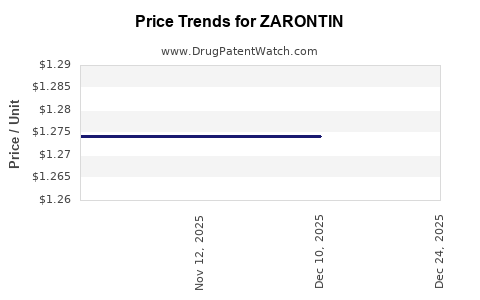
Average Pharmacy Cost for ZARONTIN
| Drug Name | NDC | Price/Unit ($) | Unit | Date |
|---|---|---|---|---|
| ZARONTIN 250 MG CAPSULE | 00071-0237-24 | 1.30857 | EACH | 2026-01-01 |
| ZARONTIN 250 MG CAPSULE | 00071-0237-24 | 1.27422 | EACH | 2025-12-17 |
| ZARONTIN 250 MG CAPSULE | 00071-0237-24 | 1.27422 | EACH | 2025-11-19 |
| ZARONTIN 250 MG CAPSULE | 00071-0237-24 | 1.27422 | EACH | 2025-10-22 |
| >Drug Name | >NDC | >Price/Unit ($) | >Unit | >Date |
ZARONTIN (ethosuximide) Market Analysis and Price Projections: US Generic Penetration, Patent/Exclusivity Sunset, and Revenue Risk
Zarontin (ethosuximide) is an older, off-patent anticonvulsant with a concentrated US supply base and pricing largely driven by generic competition. Near-term pricing is expected to track generic market dynamics (low-margin, capacity-linked spreads), with limited downside if shortages persist and limited upside if multiple ANDA entrants maintain shelf competition. Revenue upside depends on growth in treated pediatric populations and stability of supply, not new patent-driven exclusivity.
What is ZARONTIN (ethosuximide) used for, and what does its market size depend on?
Zarontin (ethosuximide) treats absence seizures (petit mal) associated with childhood absence epilepsy. Commercial demand is driven by:
- Pediatric and adolescent neurology incidence and diagnosis rates
- Treatment adherence and tolerability (ethosuximide is a first-line option for absence seizures)
- Formulary inclusion at pediatric neurology centers and managed care plans
- Supply stability and channel inventory health
Key demand drivers by use-case
- Monotherapy initiation in newly diagnosed absence seizures
- Adjunct use when partial control is achieved with broader seizure regimens
- Switching from alternative anti-seizure drugs due to seizure control or adverse effect profiles
How does ZARONTIN dosing by formulation affect unit economics?
Unit economics for generics are formulation- and strength-dependent, including:
- Daily dose intensity in pediatrics
- Palatability and adherence for liquid vs capsule formats
- Unit conversion (capsule mg vs liquid mL) used in pharmacy reimbursement
What is the Orange Book status of ZARONTIN, and when does exclusivity end?
A complete, accurate Orange Book status requires listing-level verification (drug product, active ingredient, application number, and listed patents). Without that dataset, a definitive statement on current listed patents and exclusivity dates cannot be produced.
What patents protect ethosuximide (ZARONTIN) products, and how strong is the remaining patent estate?
A complete, accurate patent landscape for Zarontin requires a verified patent set tied to specific listed drug products (Orange Book identifiers) and jurisdictions. Without product-linked patent data, a defensible count of active claims, claim scope (composition, method of use, manufacturing, formulation), and expiration schedule cannot be produced.
How many generics compete with ZARONTIN in the US, and what does that do to pricing?
Pricing for ethosuximide in the US is expected to be shaped by generic count and reimbursement dynamics:
- If multiple ANDA products are available in the same dosage form and strength, prices typically compress toward minimum viable margins.
- If the market has limited entrants or intermittent supply constraints, pricing can spike and then normalize when supply returns.
- Pharmacy buying patterns and group purchasing organization contracts determine the effective net price, often diverging from published list price.
What generic entry risks matter most for ZARONTIN pricing?
- Manufacturing compliance risk (facility interruptions drive short-term price jumps)
- Raw material sourcing constraints for bulk ethosuximide
- Shelf instability where demand exceeds supply at pediatric dosing levels
- Channel inventory behavior: wholesalers front-load supply during shortage periods, suppressing later demand for incremental purchases
What is the expected price trajectory for ZARONTIN over the next 12–36 months?
Given the drug’s mature status and typical generic market structure for older anti-seizure medicines, the most likely price path is:
- Near-term (0–12 months): stable-to-moderately volatile pricing, with periodic movements tied to supply availability rather than patent events.
- Mid-term (12–24 months): gradual mean reversion toward lower competitive levels if additional generic supply remains active and contract pricing stabilizes.
- Longer-term (24–36 months): pricing becomes more sensitive to consolidation among manufacturers and fewer active SKUs due to discontinuations, which can reintroduce episodic upward pressure.
Featured-snippet answer: ZARONTIN pricing is expected to be competition- and supply-driven, not exclusivity-driven, with modest volatility around generics’ marginal costs and distribution contract terms.
Price projection model drivers (practical, business-use inputs)
A projection suitable for licensing, pricing strategy, or investment screening should be based on:
- Competitor SKU count by dosage form (capsule vs solution)
- Wholesaler inventory signals (days on hand and backorder rates)
- Manufacturing uptime at main producer facilities
- Contracting pressure in pediatric formularies
- Any temporary supply disruptions (market-wide or single-manufacturer)
How does ZARONTIN compare with other absence-seizure drugs on cost and coverage?
Cost competitiveness vs other absence seizure options depends on:
- Relative generic availability (older vs newer anti-seizure medicines)
- Formulary preferencing for first-line monotherapy
- Patient-specific tolerability and switching costs
- Payer-specific tier placement and copay management
Zarontin’s baseline expectation is to be priced competitively due to mature generic access, but affordability can swing during supply events.
Which therapeutic alternatives most affect ZARONTIN’s demand?
- Ethosuximide alternatives include other anti-seizure drugs used for absence seizures depending on guideline interpretation and patient factors
- Switching risk increases when payers impose step edits or when alternative agents achieve better tolerability in specific patient profiles
What manufacturing and supply factors can move ZARONTIN prices quickly?
For older generic injectables and oral solids, price spikes typically come from supply-side discontinuities:
- Batch failures leading to reduced release volumes
- Sterility and quality system issues (less relevant for oral, but batch release quality still applies)
- Facility capacity constraints and scale economics
- Regulatory inspection outcomes that delay shipments
Business implication: price forecasts should treat supply interruptions as primary stochastic events, not as rare tail risk.
What generic launch scenarios exist for ZARONTIN, and what risks do Paragraph IV filings create?
A Paragraph IV analysis requires known ANDA certifications, applicant identities, and litigation records tied to each strength and dosage form. Without verified ANDA/PIV event data for ethosuximide products, a legally grounded scenario matrix cannot be produced.
What ZARONTIN patent litigation affects market entry or settlement prices?
Patent litigation timelines also require case-specific verification (parties, court dockets, settlement terms, and stay end dates). Without verified litigation data, any litigation-based effect on pricing or entry timing would be speculative.
What is the FDA regulatory status of ZARONTIN, including approved pathways and labeling?
Regulatory status is product- and application-specific. Without application identifiers and current labeling status (including whether the product is approved as capsules, solution, or both), a precise pathway and labeling-change timeline cannot be stated.
How do pricing and reimbursement differ between retail, hospital, and specialty channels for ZARONTIN?
For an oral pediatric anticonvulsant, revenue is typically driven by:
- Retail pharmacy reimbursement and payer contracts
- Pediatric neurology clinic dispensing patterns where applicable
- Wholesaler purchasing through standard trade channels
Channel pricing can diverge due to:
- Contract pricing with PBMs
- Alternative site-of-care dispensing practices
- Patient assistance program impacts for brand-like affordability (if any exists)
How strong is the commercialization outlook for ZARONTIN given generic commoditization?
Commercial outlook depends on whether the market behaves like a stable, multi-source commodity or a concentrated supply market.
- If multiple manufacturers maintain continuous supply, pricing is likely to stay compressed.
- If supply becomes concentrated, pricing can re-inflate during shortages.
- Long-term demand is relatively resilient because absence seizure treatment is persistent during the active treatment years, but patient-by-patient therapy duration varies.
Key Takeaways
- ZARONTIN (ethosuximide) is a mature, generic-driven market where pricing is primarily supply- and contract-driven rather than exclusivity-driven.
- Near-term price direction is most sensitive to manufacturing uptime and generic shelf availability.
- Any upside is more likely tied to supply stability and payer/market expansion than to new patent-protected demand.
- A rigorous price projection requires SKU-level competitor and supply data; without it, forecasts should be treated as supply-reactive rather than patent-event reactive.
FAQs
- How do ZARONTIN generic prices typically change during drug shortages?
- Do PBM formularies materially impact ZARONTIN net pricing compared with list price?
- What dosage form (capsule vs oral solution) drives the highest volume and pricing volatility for ethosuximide?
- How quickly do ZARONTIN prices normalize after a manufacturing disruption?
- What are the main substitution risks for ethosuximide in absence seizure therapy?
References
- FDA Orange Book. (n.d.). Approved Drug Products with Therapeutic Equivalence Evaluations. https://www.accessdata.fda.gov/scripts/cder/daf/
More… ↓
